
Monash physicists uncover a new form of quantum matter that could reshape future quantum technologies
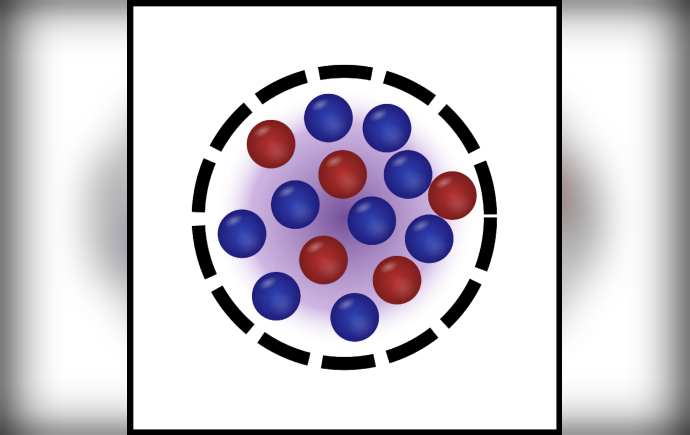
A schematic of the Bose-Fermi droplet, which demonstrates the unique phase researchers observe in their theory. Credit: Photo supplied
Researchers at Monash University have predicted a new type of quantum matter that challenges decades of thinking about how ultracold particles behave.
The study shows that under the right conditions, mixtures of two fundamentally different types of quantum particles – bosons and fermions – can form stable, self-bound "quantum droplets". Until now, scientists believed these exotic droplets were unlikely to exist in strongly interacting Bose-Fermi systems.
The discovery provides a new theoretical roadmap for experiments around the world and could deepen our understanding of quantum materials that underpin future technologies, from ultra-precise sensors to quantum computing.
Lead author and Monash PhD candidate Sam Foster from the School of Physics and Astronomy said the work opens the door to exploring entirely new quantum states.
"Quantum systems can behave in ways that seem impossible in our everyday world. We've shown that these two very different types of particles can balance each other perfectly to create a stable droplet that effectively holds itself together."
Unlike an ordinary liquid droplet, a quantum droplet exists because of the strange rules of quantum mechanics. In this case, an attractive force between the particles is exactly balanced by the pressure generated by the fermions, preventing the system from collapsing.
Sam said the findings solve a long-standing theoretical challenge.
"Previous theories could only describe these systems when the particles interacted relatively weakly. Our new approach lets us explore what happens when those interactions become much stronger, which is where the most interesting physics emerges."
The team found that the predicted droplets should be achievable using existing ultracold atom experiments, making experimental confirmation a realistic next step.
Beyond predicting the droplets themselves, the researchers also uncovered evidence of quantum behaviour similar to the transition between a liquid and a gas, revealing an unexpectedly rich landscape of quantum phases.
Sam said the significance extends well beyond atomic physics.
"Understanding how matter organises itself under extreme quantum conditions gives us new tools for designing and controlling quantum systems. While this is fundamental research, discoveries like this often become the foundation for tomorrow's quantum technologies."
The research was carried out by Sam Foster, Associate Professor Jesper Levinsen and Professor Meera Parish from the Monash School of Physics and Astronomy, with collaborators from Heidelberg University.
The paper, ‘Quantum droplets in a resonant Bose-Fermi mixture’, is published in Physical Review Letters.
Further information
Silvia Dropulich
Marketing, Media & Communications Manager, Monash Science
T: +61 3 9902 4513 M: +61 435 138 743
Email: silvia.dropulich@monash.edu