
Paul Smith
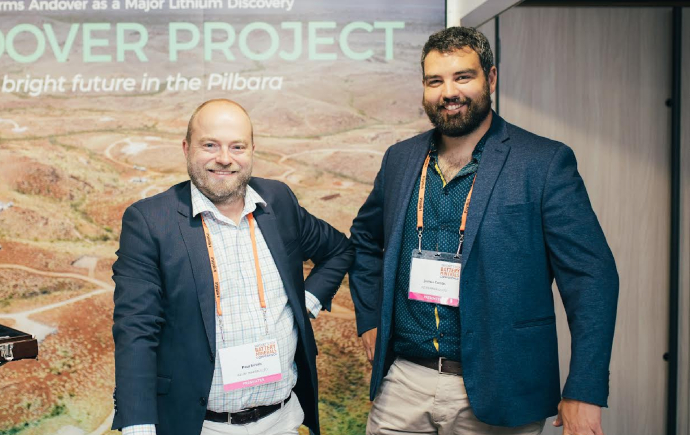
Paul Smith
- Degree type: Degree
- Degree(s): Bachelor of Science
- Major(s): Geosciences
From mineral sands to major discovery
Paul began his career with a junior explorer in Melbourne before moving into a FIFO role with Iluka Resources, exploring for mineral sands across Australia and internationally, including two years living and working in Central Asia. His experience spanned titanium, zircon, gold and base metals - always with a strong focus on greenfields discovery and early-stage target generation.
In 2021, Paul joined Azure Minerals, where he was immediately involved in nickel-copper-cobalt discoveries at Andover and Ridgeline. But it was what followed in 2022 that would define the next chapter of his career.
Recognising lithium potential at Andover
As a Senior Exploration Geologist, Paul played a leading role in identifying the lithium potential of the Andover Project in Western Australia. The breakthrough came not from luck, but from deliberately challenging existing geological assumptions.
Through detailed field mapping, structural interpretation and targeted geochemical sampling, Paul and the Azure exploration team identifed spodumene-bearing pegmatites — including high-grade samples containing up to 5% Li₂O. What had been an underappreciated geological setting was rapidly revealed as something much larger.
In early 2023, drilling confirmed the scale of the system. The eighth hole of the program (ANDD008) intersected 105 metres at 1.26% Li₂O — a result that electrified the market and confirmed Andover as a globally significant hard-rock lithium discovery.
By August 2023, an Exploration Target of 100–240 million tonnes at 1–1.5% Li₂O was announced, placing Andover among the top tier of undeveloped lithium projects worldwide.
Global attention and a historic takeover
The significance of the discovery quickly extended beyond geology.
Chilean lithium giant Sociedad Química y Minera (SQM) initially invested $20 million for a 19.99% stake in Azure Minerals in late 2022.Then in 2023, SQM and Hancock Prospecting, backed by Gina Rinehart, launched a $1.7 billion takeover of Azure Minerals — one of the largest pre-mineral resource acquisition deals in Australian mining history.
The deal secured a 60% stake in the Andover Lithium Project (with 40% held by legendary prospector Mark Creasy) and cemented Andover’s status as a globally strategic asset in the race to supply battery materials.
Leadership in discovery
As drilling accelerated — at one stage involving up to nine diamond rigs and 3 reverse circulation rigs — Paul was promoted to Exploration Superintendent, where he built and led a high-performing exploration team to advance the project at pace.
Yet, despite the scale of the discovery and its financial significance, Paul reflects on Andover as a story about geological fundamentals. Paul says,
“Successful exploration is built on strong geological fundamentals, curiosity, and the confidence to trust field observations — even when they run counter to prevailing models and taking ownership of ideas, backing them with data, and persisting through
A Monash mindset in action
Paul’s journey from Monash graduate to leader in one of Australia’s most important lithium discoveries reflects the power of rigorous scientific training, critical thinking and the courage to back your ideas with data.
The Andover discovery is more than a commercial success — it represents Australia’s growing leadership in critical minerals essential for batteries, renewable energy storage and electric vehicles. As global demand for lithium continues to rise, discoveries like Andover will play a crucial role in enabling the energy transition.
Now with Premier1 Lithium, exploring the Yalgoo and Abbotts North gold projects in Western Australia, Paul continues to pursue new discoveries — driven by the same geology-led discipline and curiosity that underpinned Andover.
For our alumni community, Paul’s story is a powerful reminder: world-class discoveries often begin with someone willing to question assumptions, walk the ground, and trust their science.