
World first: Australian scientists map the structure of cell growth regulator, opening up new options for treatment of tuberous sclerosis complex disease
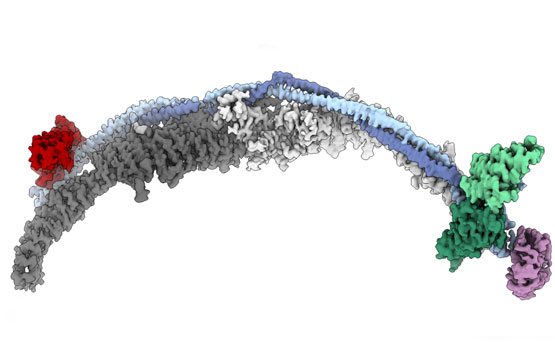
Researchers from the Monash Biomedicine Discovery Institute have dissected and examined the structure of the human tuberous sclerosis complex (TSC) for the first time, paving the way for new future breakthroughs in understanding how genetic mutations contribute to tuberous sclerosis complex disease, also known as tuberous sclerosis.
A rare genetic disease affecting one in 6000-10,000 people globally, tuberous sclerosis causes benign tuber-like tumours to grow in the brain, spinal cord, nerves, eyes, lungs, heart, kidneys, skin and other areas of the body. The tumours form in the brain prior to birth and can grow throughout a person’s lifetime, and can cause seizures, delayed development, intellectual disability and challenging behaviours. Tuberous sclerosis has no known cure.
Published in Sciences Advances, the research team used state-the-art cryo-electron microscopy at the Ramaciotti Centre for Cryo-Electron Microscopy to visualise the placement of atoms and connections that make up the TSC molecule. The TSC molecule acts as a molecular ‘handbrake’ that rapidly suppresses or halts cell growth, and represents one of the major control features present in virtually every cell in our body. In a normal and healthy context, this safety mechanism ensures our cells stop growing when required and prevents the runaway growth of tumours.
Cryo-electron microscopy gave the research team an unprecedented 3D view of the TSC molecule, snap-freezed ‘in time’ using liquefied nitrogen at cryogenic temperatures, allowing them to dissect and understand its workings for the first time, much like seeing the inner mechanisms of a clock. A major breakthrough following five years of effort, the researchers were able to identify new components and features that explain how TSC is able to act as a molecular handbrake. “This breakthrough has given us a unique perspective on TSC, revealing structural details that we’ve never been able to see before, ” co-first author of the study Dr Christopher Lupton said. “Importantly, we’ve also identified a recognition site in TSC that is responsible for detecting signalling cues”, co-first author Dr Charles Bayly-Jones explained. “These signals determine whether or not our cells should grow”.
Lead author, Associate Professor Andrew Ellisdon Head of the Structural Biology of Signalling and Cancer laboratory at the Monash Biomedicine Discovery Institute, said that the discovery provides a concrete model of the TSC molecule that will now lay the foundation for new experiments by research colleagues all over the world. “We’re now able to explain why some mutations in TSC cause human disease and some do not,” he said. “This will allow us to categorise mutations and may help predict the impact on patients and future treatment options.”
Read the full paper published in Sciences Advances, titled Structure of the human TSC:WIPI3 Lysosomal recruitment complex.
This work was supported by a US Department of Defense Tuberous Sclerosis Complex Research Program Grant (W81XWH-19-1-0182), an Australian Research Council (ARC) DECRA Fellowship (DE240100992), a Viertel Senior Medical Research Fellowship supported by The Cross Family and The Frank Alexander Charitable Trusts to MLH, and a Victorian Department of Health and Human Services Victorian Cancer Agency Mid-Career Fellow (MCRF21036) to A.M.E. This research was undertaken, in part, using the MX2 beamline at the Australian Synchrotron, part of ANSTO, and made use of the Australian Cancer Research Foundation (ACRF) detector.
About the Monash Biomedicine Discovery Institute at Monash University
Committed to making the discoveries that will relieve the future burden of disease, the newly established Monash Biomedicine Discovery Institute at Monash University brings together more than 120 internationally-renowned research teams. Spanning six discovery programs across Cancer, Cardiovascular Disease, Development and Stem Cells, Infection and Immunity, Metabolism, Diabetes and Obesity, and Neuroscience, Monash BDI is one of the largest biomedical research institutes in Australia. Our researchers are supported by world-class technology and infrastructure, and partner with industry, clinicians and researchers internationally to enhance lives through discovery.