
Press Release - Building Thriving Communities: Lessons from the Brave Women of the 'Reformasi' Movement
Monash University, Indonesia held a panel discussion highlighting women's increasing role in politics prior to and since the ‘Reformasi’ era.
Jakarta, May 31, 2023 - The era of political reformation which began in 1998 has created opportunities for diverse communities across Indonesia, including the opportunity to share knowledge in a democratic climate. Today’s democracy in the country has provided social activists ample opportunities to advance the social attitudes and political achievements within the Indonesian society.1
To appreciate such achievements of the Indonesian government and society, Monash University, Indonesia, recently held a panel discussion which elevates women’s voices about one of Indonesia’s most historic events, with the title "Reformasi: Stories from Women on the Front Line of the 1998 Protest" on May 28 at Tebet, South Jakarta.
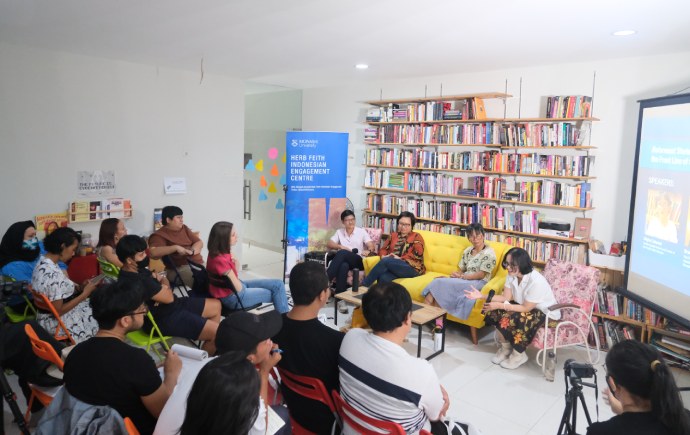
Moderator Sabina Puspita and panel Grace Wangge, Dhyta Caturani and Indri Saptaningrum
The discussion, held in collaboration with the Monash Herb Feith Indonesian Engagement Centre and Monash University’s researchers in Indonesia, unveiled inspiring stories from women who were involved in the transitional moments during the reform era and how those moments have shaped women’s roles in today’s society. For instance, women’s participation in the National Legislative Body (DPR-RI) grew by 12% from 8.8% in 1999 to 20.8% in 2019.2

Grace Wangge, Associate Professor of Public Health and VP of Engagement at Monash University, Indonesia
According to Grace Wangge, an Associate Professor of Public Health and VP of Engagement at Monash University, Indonesia, “Even after 25 years since experiencing the critical period of 1998, I still learned alot from the discussion. The discussion taught us not only the history but also her story of 1998. We at Monash Indonesia seek to make more events such as this discussion in the future,” she said.
The discussion’s agenda aligned with the core theme of 'thriving communities' as the third pillar of the Impact 2030 strategic goal pursued by Monash University. During the panel discussion, the speakers emphasized the limited information access for female students during the 1998 protests. These challenges resulted in the lack of clear communication channels for participants.3
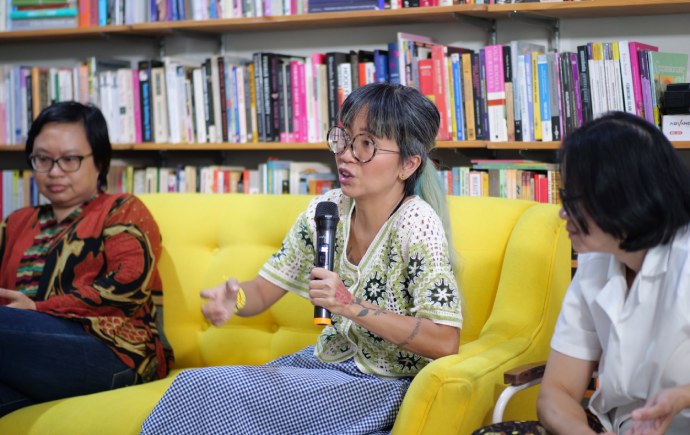
Dhyta Caturani, Gender Equality Activist and Founder of the Purple Code Collective
“This discussion asks us to think about the ways in which we can make use of digital platforms to build solidarity and collaboration among citizens with values of equality and democracy. Each of us can take a role, whether on the front or back of the line, for this collective effort to advance democracy in our society,” said Dhyta Caturani, Gender Equality Activist and Founder of the Purple Code Collective.

Indri Saptaningrum, Director of the Institute of Public Policy and the Institute for Advanced Research at Atma Jaya Catholic University of Indonesia
Indri Saptaningrum, Director of the Institute of Public Policy and the Institute for Advanced Research at Atma Jaya Catholic University of Indonesia, added, “The environment for us to speak now is better. We should appreciate today’s open spaces for voicing our own ideas and aspirations both offline and online. Nevertheless, it is not enough to be moving for change within only one space. We need to connect the voices for change on digital platforms with the action within communities offline, to enact real change or reforms.”
This panel discussion was attended by Monash University post-graduate students, professionals in the socio-political area, and public audience aged 20 to 30 years old. Monash University hopes that the collaboration with renowned academics from Monash University, Indonesia, other universities in Indonesia, and women's rights activists enriched the discussion and provided various perspectives on the “Reformasi" movement.
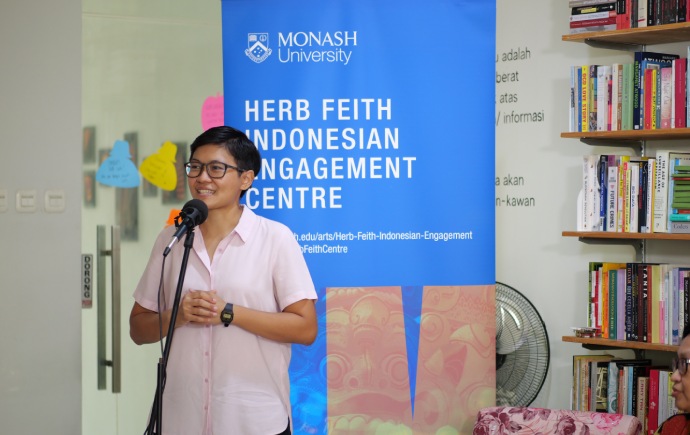
Sabina Puspita, Associate Director of The Herb Feith Centre
Co-organizer and moderator of the panel, Sabina Puspita, Associate Director of The Herb Feith Centre, said, “This is The Herb Feith Centre’s first time organizing an event in Indonesia and for such an important theme. The audience’s response is truly remarkable, we hope our events such as today’s will advance the conversations and research that contribute to the success of Indonesia.”
Today, Monash University, Indonesia, continues the work of the Indonesian government and society in expanding the access to digital transformation for all through public engagement and higher education such as its Master of Cyber Security and Master of Data Science programs. In addition, Monash’s Master of Public Health and Master of Public Policy and Management programs prepare Indonesia’s professionals in equipping communities with the policies needed from the public and private sectors to address the impacts of rapid digital transformation.
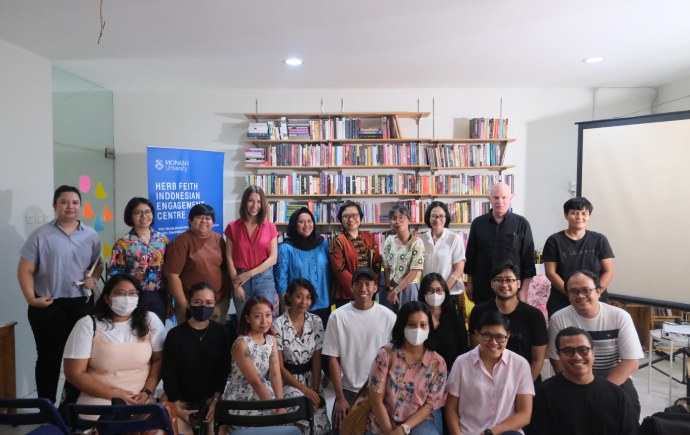
Participants of "Reformasi: Stories from Women on the Front Line of the 1998 Protest"
***
About Monash University, Indonesia
Officially operating in October 2021, Monash University Indonesia is a manifestation of the commitment of Monash University and the Indonesian government to create knowledge that can contribute broadly to developing Indonesia's social, technological, and economic sectors.
Monash University, Indonesia offers Master's degree courses with majors in Public Policy and Management, Business Innovation, Data Science, Cyber Security, Public Health, Urban Design and PhD, along with various executive and micro-credential programs aimed at specific sectors.
Monash University Indonesia has learning facilities according to Monash University Australia standards. It is currently opening applications for new student admissions and scholarships for studies in October 2023, which are currently open for registration.
Monash also has a proud long-term relationship with Indonesia and is a foreign university with the highest number of Indonesian graduates compared to other foreign universities. The track record of good relations between Monash and Indonesia manifests collaboration between parties such as the Herb Feith Centre, RISE, the World Mosquito Program, and the Citarum Action Research Program (CARP).
With a presence on three continents, international partnerships, and study abroad programs worldwide, Monash is Australia's largest university, ranked in the top 100 universities worldwide. Monash has a dynamic network of research and teaching locations in Australia, Italy, Malaysia, China, and India.
This unique alliance with the University of Warwick (UK) stands alongside international collaborations with leading universities and employers worldwide, expanding the University's global network.
For more information about the Monash University Indonesia campus, please visit the website in this link and information regarding academics at Monash University, Indonesia can be obtained through this link. Impact 2030, Monash University's strategic plan for the next ten years, can be accessed here.
MEDIA INFO:
Suryo Danuwinoto
Senior Marketing and Communications Manager
Monash University Indonesia
Email: danu.danuwinoto@monash.edu
Arvy Priyasajjana
Account Director
Hill+Knowlton Strategies Indonesia
Phone: +628118519287
Email: arvy.priyasajjana@hkstrategies.com
1. Thushara Dibley, Michele Ford / Thushara Dibley, Michele Ford. Activists in Transition. Ithaca: Cornell University Press, 2019.
2. Edward Aspinall, Sally White, and Amalinda Savirani, Women’s Political Representation in Indonesia: Who Wins and How? (May 2021)
3. Merlyna Lim, “The Internet, social networks, and reform in Indonesia.” Contesting media power: Alternative media in a networked world, 273-288 (2003).