
Attempt to Influence Public Opinion in the "Indonesia Gelap" Protest
 Since February 17, 2025, student demonstrations have been held in many regions. Calls for protests have circulated on social media following widespread public criticism of several policies implemented by President Prabowo Subianto during his first hundred days in office, including the Makan Bergizi Gratis (MBG) or free meal program, budget efficiency measures, and the national investment project plan through Daya Anagata Nusantara or Danantara. Initially, the Rp750 trillion budget cuts were suspected to be a means of funding the MBG program. However, the emergence of Danantara, which is set to manage state funds and assets amounting to US$900 billion or Rp14,715 trillion, has sparked controversy, particularly as it is to be led by Burhanuddin Abdullah, a convicted perpetrator of corruption involving Bank Indonesia funds.
Expressions of criticism and protest have been voiced on X. The hashtags #KaburAjaDulu (Let's just run away first) and #IndonesiaGelap (Dark Indonesia) have occupied online discussions. In response, counter-narratives emerged under the hashtags #PergiMigranPulangJuragan (Leave as a migrant, return as a rich person) and #IndonesiaTerang (Bright Indonesia). The Data & Democracy Research Hub at Monash University, Indonesia analyzed how the government has attempted to influence public protests on X over the past two weeks (February 9–22, 2025).
We collected conversations on X using keywords such as #IndonesiaGelap, #IndonesiaGelap2025, "Indonesia Gelap," #IndonesiaTerang, and "Indonesia Terang" through the Brandwatch tool. Our observation indicates that discussions using the hashtag ‘Indonesia Terang’ were minimal, amounting to only 2,209 tweets—just 0.0007% compared to the 3 million tweets under ‘Indonesia Gelap.’ The number of unique authors engaged in the ‘Indonesia Terang’ discourse reached only 1,978 accounts, whereas ‘Indonesia Gelap’ involved approximately 104,000 accounts. However, the "Indonesia Terang" narrative appeared more prominent due to its endorsement by opinion influencers, including public officials and mainstream media outlets.
Figure 1. Comparison of conversation trends for the hashtag #IndonesiaGelap (Red) versus the hashtag #IndonesiaTerang and the phrase 'Indonesia Terang' (Blue) on platform X during February 9–22, 2025.
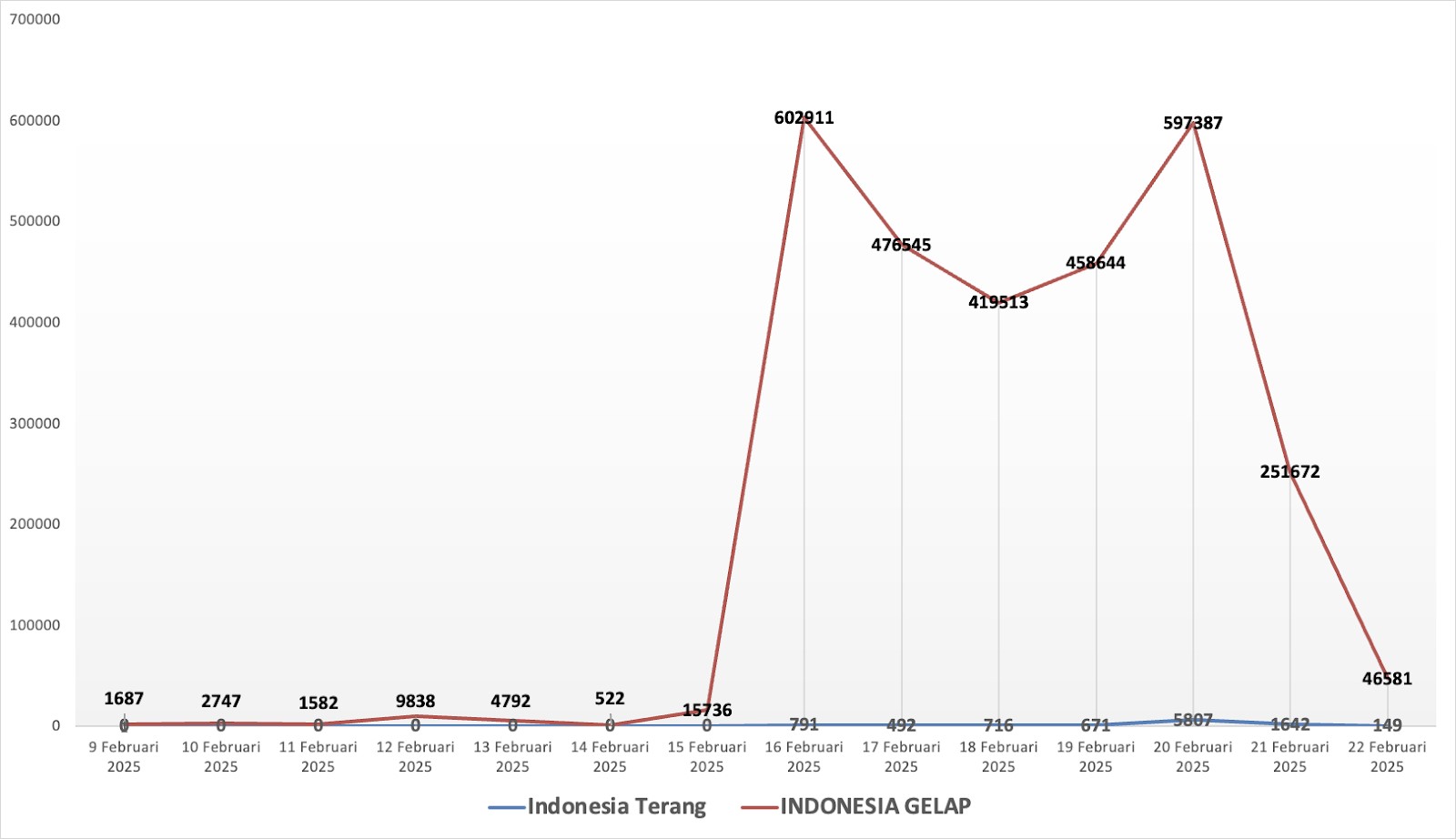 We also collected data using the phrase "Indonesia Terang" as a keyword. However, the volume remained relatively small, with only 8,196 words and 7,705 accounts involved. Upon analyzing the content written by influential accounts, we found that it was predominantly filled with criticism of the government, satire targeting the optimism promoted by the administration, and opinion articles published in mass media. Tweets using this phrase accounted for only about 0.0027% of the total conversations under the hashtag #IndonesiaGelap.
The Co-Director of the Data & Democracy Research Hub, Ika Idris, stated that in the dynamics of public-state relations, social media protests serve as a means for the public to express their opinions and contribute to shaping public policy, especially when they perceive policies to be haphazardly designed and poorly implemented. Ideally, policymakers should review their programs and policies in response to public aspirations. This approach would lead to more participatory and responsive policies that align with public interests. The process of considering public input is crucial, particularly given that some of the contested policies, such as MBG, appear impulsive, and hastily implemented without adequately addressing the challenges of execution.
"Rather than using public criticism as valuable feedback, the government has instead sought to counteract it by constructing a counter-narrative through the hashtag #IndonesiaTerang," emphasized Ika in an analysis shared with the media on Sunday, February 23, 2025.
Efforts to negate public opinion were also observed in discussions under the hashtag #KaburAjaDulu, which reflected disappointment over the perceived deterioration in the quality of life. Instead of responding with empathy, some public officials reacted dismissively to these expressions of public discontent. Raffi Ahmad, the President's Special Envoy for Youth and Creative Workers, even suggested replacing the hashtag with #PergiMigranPulangJuragan, implying that shifting public perception could be as simple as changing a hashtag.
Influencers and Their Narratives
Our observations indicate that the key influencer in the "Indonesia Terang" discourse was the Minister of Forestry, Raja Juli Antoni (@RajaJuliAntoni), who tweeted twice using the hashtag on February 21, 2025. In his first tweet, he stated, "There are too many reasons that can be fabricated to fuel pessimism. Just one reason is enough to spark optimism that Indonesia will continue to improve. #GenerasiOptimis #IndonesiaTerang @psi_id @Gerindra." This tweet was shared by only 106 users but reached approximately 274,000 users.
Raja Juli, who is also a politician from the Indonesian Solidarity Party (PSI), later tweeted an image of the front page of a media outlet featuring a headline about the president's statement that regional leaders are public servants. In his tweet, Raja Juli wrote, "Are your regional leaders serving the people or serving their political parties? #IndonesiaTerang #GenerasiOptimis." This tweet was retweeted approximately 1,000 times and viewed by 1.6 million users.
Apart from Raja, another government-affiliated influencer was the Presidential Office Spokesperson, Hariqo Wibawa Satria (@hariqosatria), who posted four tweets related to "Indonesia Terang" on February 17, 18, and 20. Not all of his tweets generated significant engagement, such as shares or comments, but they reached a broad audience. On February 18, he shared two videos of himself making statements on television about budget savings. In the first video, he wrote, "Budget savings have proven successful. Stop official trips disguised as work travel. #IndonesiaSemakinTerang." In the second video, he stated, "The Regional Leaders' Retreat or the Orientation for Newly Elected Regional Leaders in Magelang is a tangible example of budget efficiency. #IndonesiaTerang #PelantikanKepalaDaerah." Although the second video was only shared twice, it reached up to 6,500 users.
Beyond government officials, several PSI-affiliated politicians also participated, such as Sigit Widodo (@sigitwid) and Andy Budiman (@Andy_Budiman_). Sigit tweeted a media article headline about Norway’s Minister of Forestry praising Indonesia’s Minister of Forestry for preserving the country's forests. Meanwhile, Andy shared Raja Juli’s previous tweet regarding the inauguration of regional leaders.
"Additionally, the 'Indonesia Terang' discourse was amplified by political buzzer accounts, most of which simply retweeted political issue-related content. These accounts generally had between 1,000–2,000 followers, with account creation dates varying from as recent as 2023 to as early as 2015. Their tweets primarily revolved around explanations of budget efficiency, allegations that the protesting students are supporters of Hasto Kristiyanto, the Secretary-General of the Indonesian Democratic Party of Struggle (PDIP), who is currently a suspect in a Corruption Eradication Commission or KPK case, and framing student protests as acts of hatred," explained Ika.
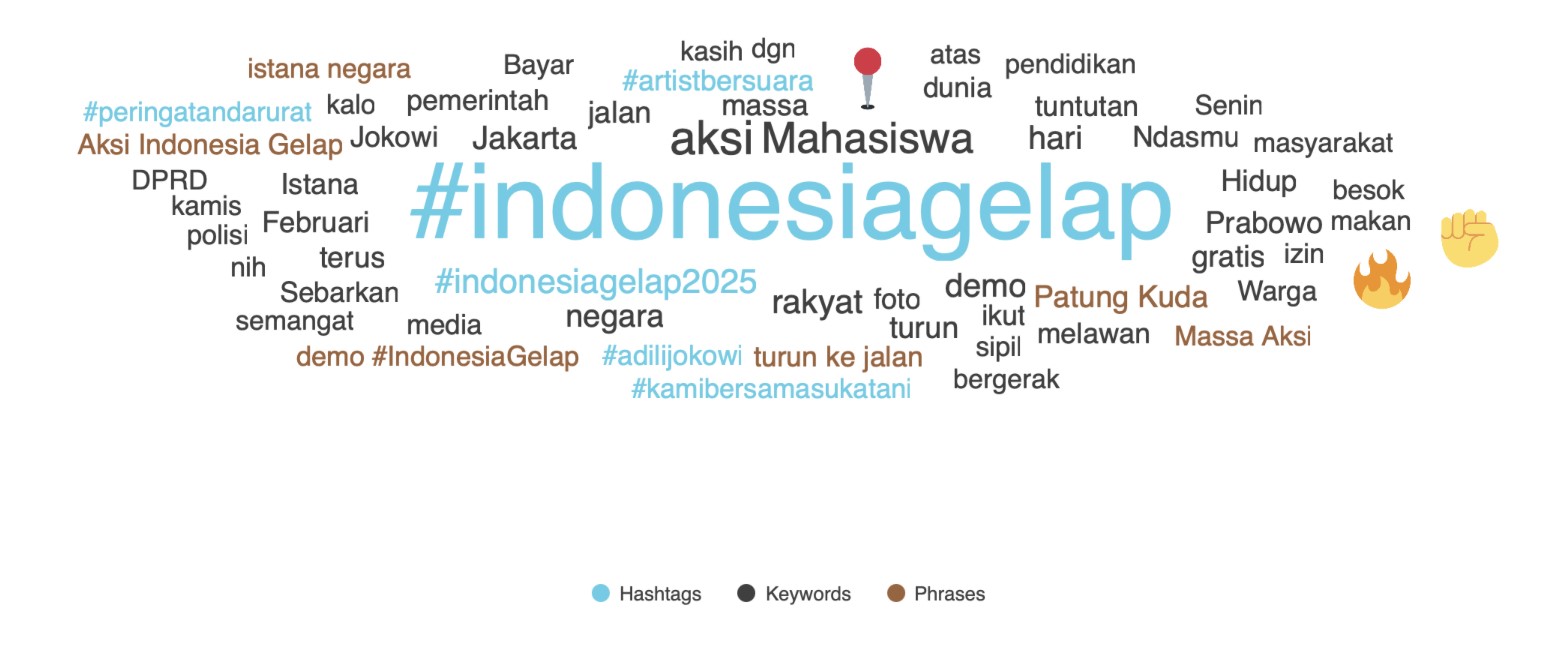
Based on the most frequently occurring words, discussions surrounding Indonesia Gelap were dominated by calls to take to the streets or participate in demonstrations, particularly in front of the Patung Kuda (Horse Statue) area. Words with negative connotations that appeared frequently in these conversations include #IndonesiaGelap (2,511,884 mentions), #IndonesiaGelap2025 (283,457 mentions), "Ndasmu" (127,679 mentions), "melawan" (111,958 mentions), and #AdiliJokowi (87,279 mentions). As illustrated in Figure 2, the most frequently used emojis in these discussions were the "fire" emoji (🔥), symbolizing burning passion or unrest, and the "raised fist" emoji (✊), representing resistance and solidarity.
Figure 2. Most Frequently Used Words in the ‘Indonesia Gelap’ Discussions on X from February 9 to February 22, 2025.
 Meanwhile, the most frequently used words in discussions about Indonesia Terang were dominated by words with positive connotations. These included #IndonesiaTerang (2,239 mentions), Kesejahteraan or prosperity (701 mentions), Bergizi or nutritious (686 mentions), Emas or golden (686 mentions), and #GenerasiOptimis or optimistic generation (373 mentions). The most commonly used emoji in these discussions was the "rolling on the floor laughing" emoji (🤣), which appeared 74 times, possibly indicating sarcasm or amusement in response to the narrative.
Figure 3. Most Frequently Used Words in the ‘Indonesia Terang’ Discussions on X from February 9 to February 22, 2025.
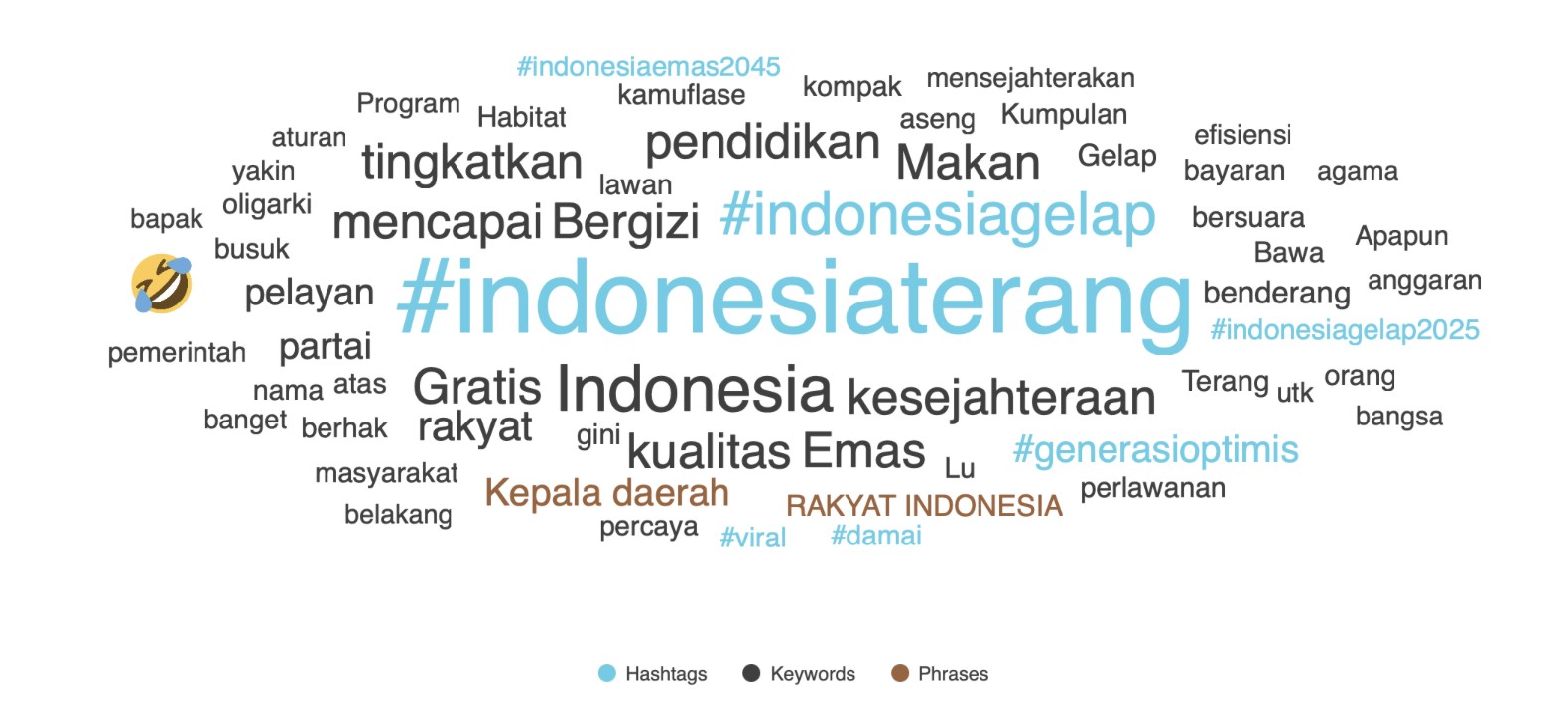
Based on the most frequently occurring words, the two conversations were indeed in stark contrast. The #IndonesiaGelap discussions primarily aimed to mobilize protests and resistance against the government's perceived haphazard policies, whereas #IndonesiaTerang sought to spread positively framed messages about government programs.
Not the First Attempt
Attempts to influence public opinion on platform X have been observed in previous protests, such as the #PeringatanDarurat or emergency alert protest in August of the previous year. At that time, counter-narratives emerged through hashtags like #IndonesiaBaikBaikSaja or "Indonesia is just fine" and #RUUPerampasanAset or Asset forfeiture bill to counteract #PeringatanDarurat. Additionally, #TerimaKasihJokowi or thanks Jokowi surfaced as a response to the surge of negative sentiment toward President Jokowi in the weeks leading up to Prabowo Subianto's inauguration as Indonesia’s new president.
"The strategy to influence public opinion typically involves using counter-hashtags or unrelated hashtags that have viral potential due to their attention-grabbing nature," explained Ika.
However, the public opinion manipulation observed in this protest was not as intense as during the #KawalPutusanMK or guarding the Constitutional Court's decision demonstrations. At that time, diversionary hashtags such as "Pilih Damai Bareng Prabowo" or "Prefer peace with Prabowo" and "Lebih Sejuk Lebih Nyaman” or more peacefully safely reached approximately 28,000 tweets on X.
"In contrast, #IndonesiaTerang only accumulated around 2,000 tweets. However, its primary influencers were government officials and coalition politicians. Despite its smaller scale, this effort ultimately undermines public expression and risks further eroding public trust in the government," Ika concluded.