
Australia Leadership Program: Monash University, Indonesia’s First Intercampus Student Mobility
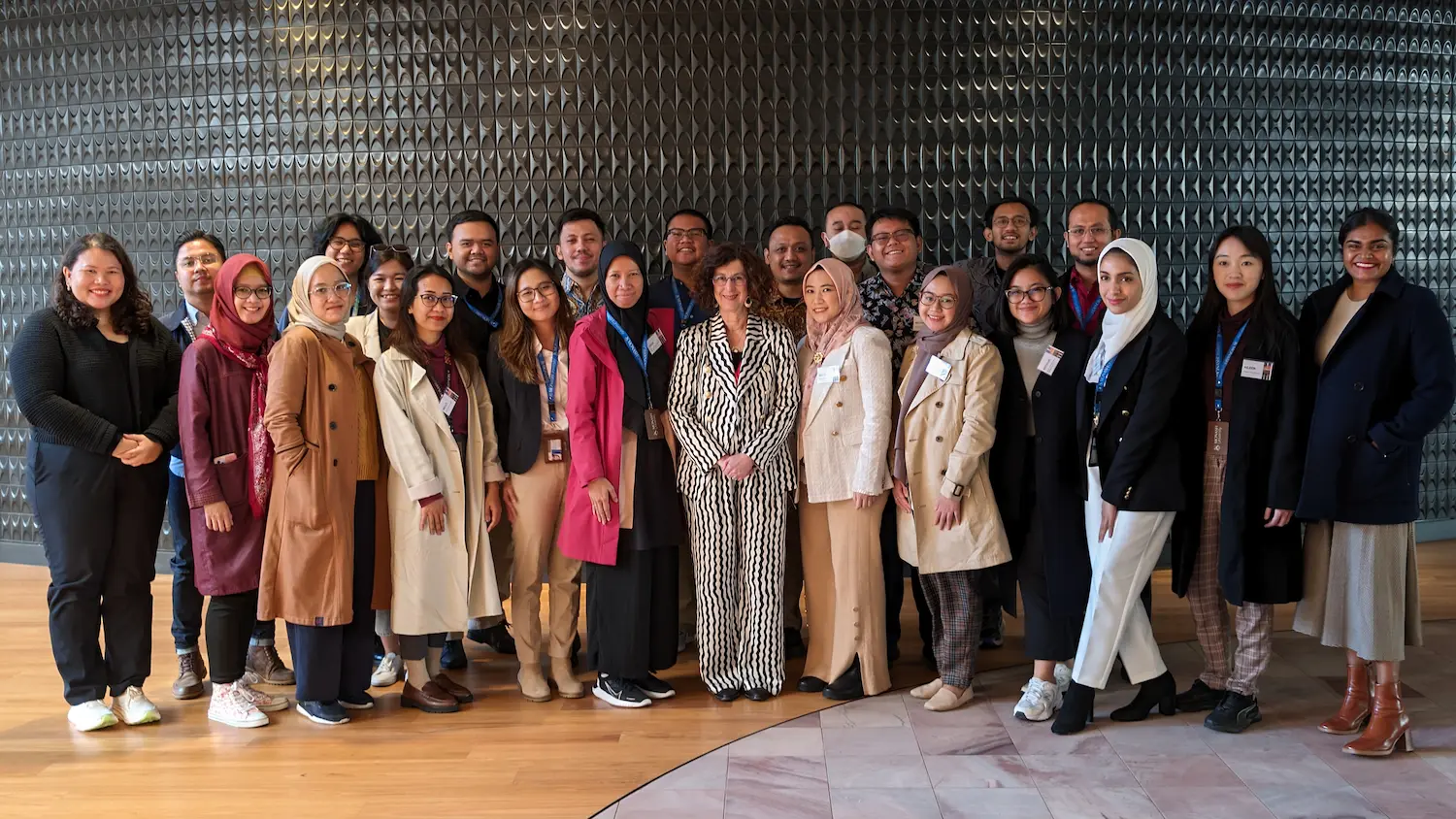
2024 ALP Delegation taking a picture with Professor Allie Clemans, Deputy Vice-Chancellor (Education) and Senior Vice-President at Monash University
Monash University, Indonesia ran the Australia Leadership Program (ALP) in Melbourne on 21-28 April 2024. With this year’s theme, Echoes of Tomorrow: Leading with Impact for a Sustainable Society, ALP invited students to discover innovative and impactful solutions for sustainable development and society by exploring the intersections between digital technologies and areas such as health, business, public policy, and community engagement. Led by Dr Sarah Gultom, Dr Gabriela Fernando, and Felicia Margaretha, ALP aimed to equip Monash University, Indonesia students with global awareness, knowledge, and leadership skills to become future global leaders.
Selected students from Masters of Business Innovation, Public Policy and Management, Public Health, Data Science, Cyber Security, and Urban Design had the opportunity to experience learning with world-class and cutting-edge facilities at Monash University Australia campuses (Clayton, Caulfield and Peninsula). During a week of curated activities, the students engaged in interdisciplinary discussions on the intersections between sustainability and technology. They were welcomed by the DVCE, Monash Abroad, Office of PVC Major Campuses & Student Engagement, Herb Feith Indonesia Engagement Centre, the Faculty of Arts, Monash Sustainable Development Institute, Faculty of Medicine, Nursing and Health Sciences, Action Lab (Faculty of Information Technology), Faculty of Engineering, Monash Business School, and the Australian Synchrotron, across Clayton, Caulfield, and Peninsula campuses. All key speakers and hosts gave the students the most updated knowledge and insights based on their world-class research and cutting-edge facilities. The students attended research showcases (e.g., paramedic and nursing simulations), seminars (e.g., climate change and health by FMNHS), workshops (e.g., business and technology case studies by Monash Business School), capacity building (e.g., design and systems thinking workshops by Action Lab and MSDI), and industry engagement (e.g., Australian Synchrotron).
 The ALP students having a discussion with Susie Ho, Director of Monash Innovation Guarantee, Associate Dean International and Graduate Education at Monash University
Throughout the week, the students enjoyed insightful and valuable workshops to gain knowledge in sustainable development and develop skills needed to transform a rapidly changing world. They synthesised their learnings to pitch ideas to integrate technology into initiatives in healthcare, energy transition, and social and economic inclusion for Indonesia. Those who demonstrated excellent ideas and exemplary engagement during the program were awarded Monash University’s Global Impact Leaders digital badge.
Lessons From the Past and Beyond
The following is a reflection piece by Alexander Michael (Master of Public Policy and Management) on the Australia Leadership Program 2024.
ALP has conveyed significant messages emphasising the importance of collaboration as a beginning of teamwork, defining a clear problem, and conveying clear and easy-to-do solutions. Firstly, solving big problems such as climate change requires effective collaboration rather than just cooperation. Decentralised policies that involve all stakeholders, including academia, are essential. An example is the development of a solar cell prototype at Monash University. The Faculty of Engineering worked with other divisions to improve the efficiency of the cell, and Monash facilitated its use as an accelerator for investors. This collaborative effort will benefit from a multiplier effect. Creating an exceptional idea is not an easy task. However, an innovator must learn the harsh truth that their invention may need to be revised according to market expectations. In this matter, perseverance to innovate and combine ideas is critical.
The second important message is related to defining the problem. Before breaking down every solution to solve each root cause, we need to take a step ahead and define the problem. Sometimes, we come to the realisation along the way that the problem is not related to the solution. Design thinking is available to help us with this. Monash Sustainable Development Institute has learned from its award-winning experience and offers a way to delve deeper into the meaning of the problem, what can be defined as a problem, who is involved in it, and most importantly, the connection between each emerging problem. Climate change in Indonesia involves many stakeholders, from the ministry level to NGOs. Even in public policy settings, politicians aim to prioritise climate change, but they often fail to create an impact among their constituents. On the other hand, bureaucrats in charge of policy regulations may create rules that are not practical for the people. This connection between the “policy stream” and “politics stream” can benefit from a design thinking approach to find a solution.
We learned from the ALP that it is practical to think about tackling climate change and sustainable development issues. Some people believe that only massive, impactful inventions can make a difference, but Professor Zerina Tomkins taught us that small changes in our daily lives can also support climate change efforts. For example, sending small picture files via email can reduce the impact of climate change over time. Every individual decision matters when it comes to reducing the impact of climate change.
After reflecting on the ALP theme “Echoes of Tomorrow: Leading with Impact for a Sustainable Society,” we realise that change must start from within. A new approach to innovation, a willingness to tackle challenges, and a continued commitment to innovation are all key to addressing climate change as a global issue. The way to achieve this is through meaningful networking and connections, which can help us understand each individual's key learning aspects. We have learned that sometimes interventions can be minimal, as Professor Asad Islam has suggested in his remarks about intervening in our underlying assumptions regarding basic necessities.
The global effort to eliminate the climate change crisis can be traced back to the latest COP commitment to the “damaged fund.” However, it is essential to understand that sustainability means respecting and acknowledging what it takes to solve global crises and helping other countries innovate solutions. During ALP, we have learned about the advantages of innovation in Australia, from synchrotron and digital health issues to tackling climate change. Meanwhile, Indonesia is still at the awareness stage and is finding it challenging to align with the right problem. Given this situation, the lesson on climate change and sustainable development issues is that action starts with our choices, and we need to take responsibility for our actions.
Learn Nadya Azzahra’s (Master of Public Health) idea of incorporating technology into healthcare for elders here.

2024 ALP Delegation visiting Monash University Clayton Campus
Friendships Formed and Continue
ALP received immense support from Monash University’s Deputy Vice Chancellor of Education (DVCE), Monash Abroad, PVC of Major Campuses & Student Engagement, Herb Feith Indonesian Engagement Centre, Monash Sustainable Development Institute, Action Lab, Faculty of Arts, Faculty of Medicine, Nursing, and Health Sciences, Faculty of Engineering, and Monash Business School.
From the first hello at the airport to walking along the streets of Melbourne and basking under the sun in Yarra Valley, the friendships formed among the students and between the campuses will continue. See you at the Australia Leadership Program 2025!