
Mitigating food safety risks: Ensuring the success of Indonesia’s free school meals programme
BSD City, Tangerang – While Indonesia’s national free nutritious meals programme holds the potential to address the "triple burden" of nutrition—stunting, wasting, and obesity—a recent analysis by public health experts from Monash University, Indonesia reveals urgent safety concerns that must be addressed to protect millions of students.
Launched in January 2025, the ambitious initiative reached over 46 million school children within its first year. However, the rapid scale-up has coincided with a significant rise in food poisoning cases, signaling a critical need for enhanced surveillance and stricter hygiene protocols.
The human cost of rapid implementation
A new research published in the Lancet Regional Health Southeast Asia, indicates that as of 31 December 2025, the programme has been linked to 177 food poisoning outbreaks, affecting more than 20,000 schoolchildren across 33 provinces. The reported symptoms—ranging from stomach pain and nausea to more severe cases involving seizures and shortness of breath—have been traced in several laboratory investigations to biological contaminants like E. coli, Salmonella, and Staphylococcus. This study was led by Dr. Henry Surendra and Dr. Grace Wangge of Monash University, Indonesia, in collaboration with Arif Sujagat, MPH from the Australian National University.
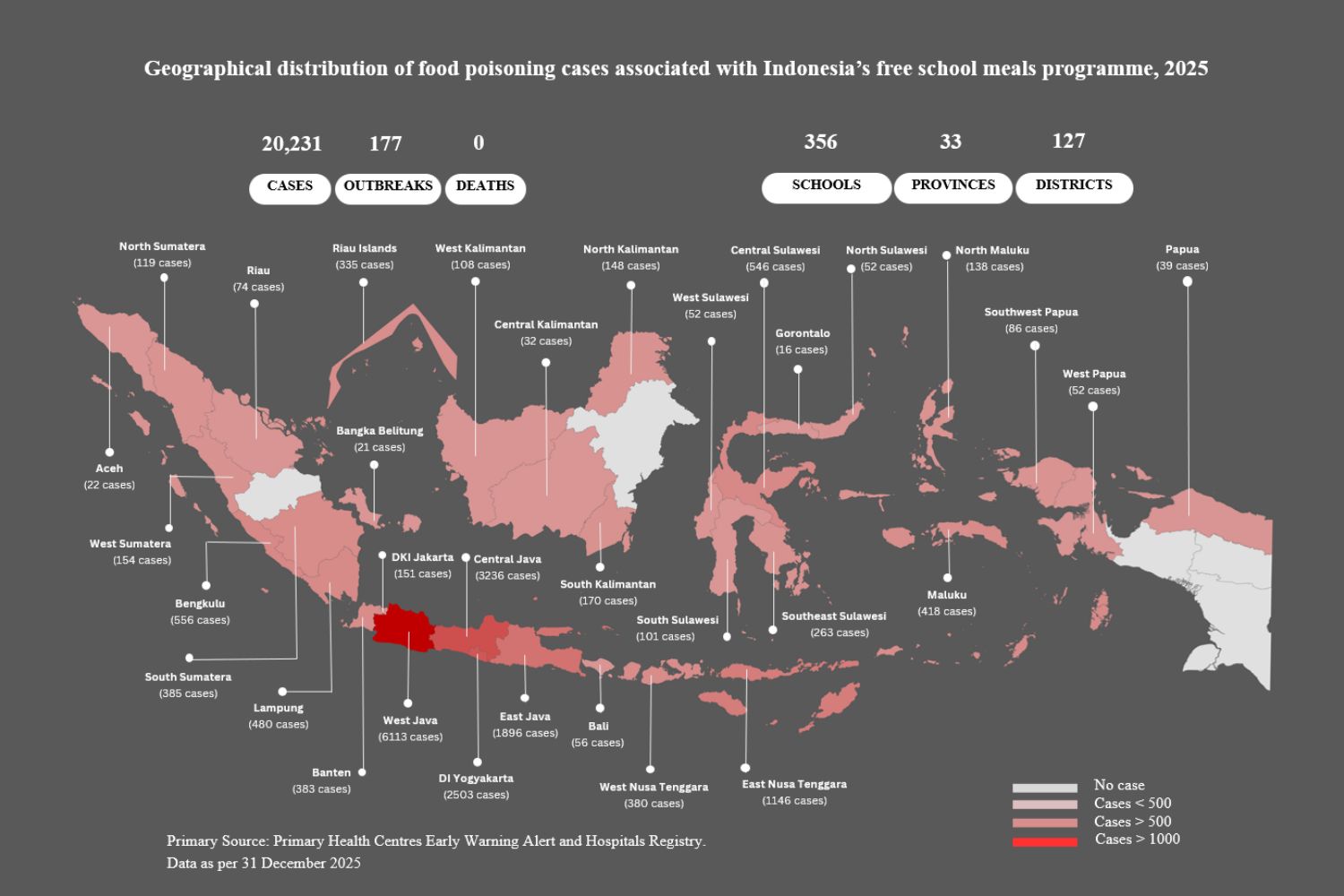
Geographical distribution of food poisoning cases associated with Indonesia's free school meals programme in 2025
Identifying the implementation bottlenecks
The surge in outbreaks is largely attributed to the immense logistical pressure placed on newly formed nutritional provision service units (Satuan Pelaksana Pemenuhan Gizi – SPPG). Key findings from the analysis include:
- Certification gaps: Out of 11,592 operational units, only 198 have obtained official hygiene certificates, and only 26 meet international Hazard Analysis and Critical Control Point (HACCP) standards.
- Time-temperature violations: Cooked meals were frequently left at room temperature for 7–8 hours before consumption, nearly double the WHO’s four-hour safety threshold.
- Inadequate facilities: Many units lack appropriate cold storage and sterilization equipment, leading to the use of unsterile cloths and improper rinsing of fresh produce.
- Surveillance gaps: Local district health offices have largely been excluded from the monitoring process, leaving a vacuum in outbreak detection and response.
A roadmap for safer school meals
To ensure the programme’s sustainability and its goal of improving health outcomes, the researchers advocate for a shift toward a strict regulatory framework similar to successful models in India and Brazil.
"Embedding food safety principles across the food supply chain—from procurement and storage to cooking and distribution—is essential in Indonesia’s ambition to reduce the burden of malnutrition," says Dr. Henry Surendra.
The team recommends several immediate actions:
- Mandatory compliance: Enforce strict adherence to HACCP and "Five Keys to Safer Food" principles for all SPPG units.
- Cross-Sectoral monitoring: Integrate local District Health Offices into the programme to establish school-based surveillance and outbreak response systems.
- Infrastructure investment: Provide funding for essential equipment, including freezers, sterilizers, and safe kitchen facilities.
- Operational research: Conduct ongoing cost-benefit analyses and identify implementation bottlenecks to support long-term sustainability.
While the free nutritious meals programme offers a transformative opportunity for Indonesia’s vulnerable communities, its success depends on balancing rapid scale-up with unwavering safety standards.
About the Researchers
This analysis was conducted by Dr. Henry Surendra from the Public Health Program at Monash University, Indonesia and Oxford University Clinical Research Unit Indonesia. Dr. Grace Wangge from the Public Health Program at Monash University, Indonesia, and Arif Sujagat from the National Centre for Epidemiology and Population Health, Australian National University.
This article has been reviewed by

