
Our Works
Our Works
Discover our latest efforts aimed at boosting digital literacy, advancing digital democracy, and shaping policies for a more informed society.
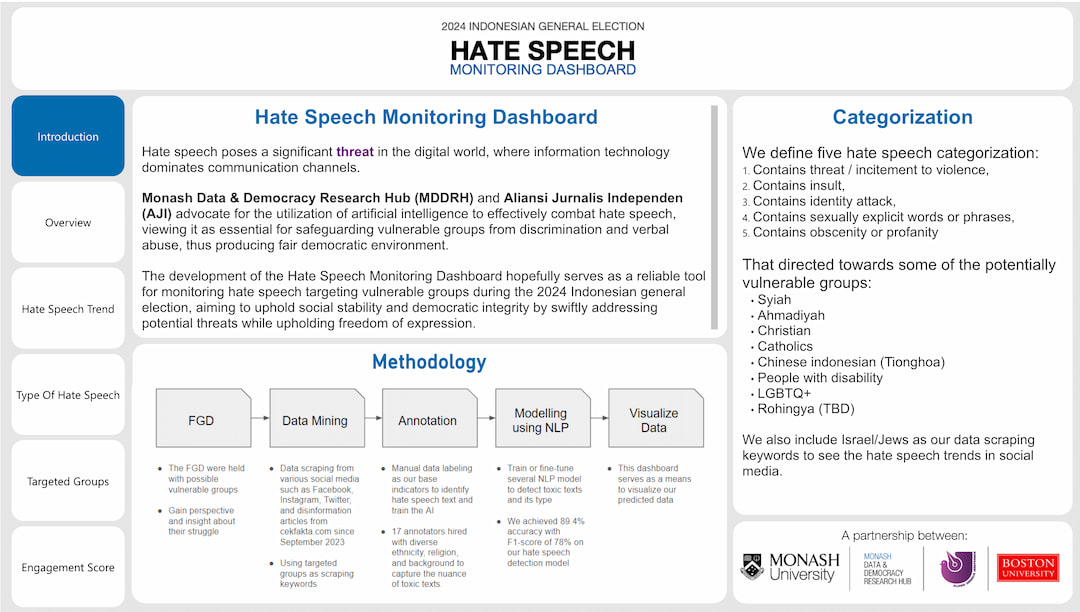
MDDRH Monash University, Indonesia, and the Alliance of Independent Journalists (AJI) Indonesia found an increase in hate speech targeting nine minority groups during the campaign period for presidential and vice presidential candidates in the 2024 General Election.
MDDRH Monash University and AJI Indonesia launched the findings as a dashboard or data visualisation based on artificial intelligence (AI) in Jakarta, on Monday, February 12, 2024.
This dashboard can be accessed on the page https://aji.or.id/hate-speech-monitoring It utilises AI, which is useful for recognizing trends and pinpointing the dangers of hate speech. It is hoped that the data from this dashboard will help make the right decisions to prevent conflict.
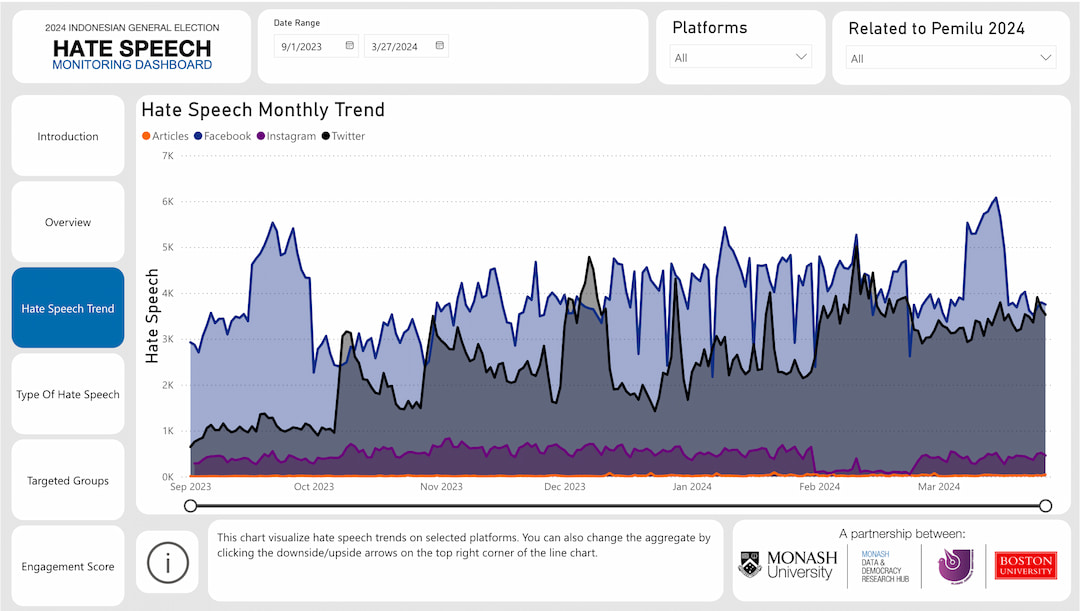 This dashboard tracks hate speech in real time on X (formerly Twitter), Facebook, Instagram, and some online news articles. The Monash University research team monitored three social media platforms, from September 1, 2023, to January 2024.
Derry Wijaya explained the method and series of monitoring processes. Monitoring hate speech goes through five stages, namely focus group discussions (FGD) to find out the problem and collecting hate speech words to be used as data collection keywords. Furthermore, through data collection from three social media platforms, manual annotation by 17 annotators from representatives of minority groups, modelling with machine learning, and data visualisation.
A total of 67 keywords were used to monitor conversations related to elections and seven minority groups, namely Christian, Catholic, Chinese, Shia, Ahmadiyah, Lesbian, Bisexual, Bisexual, Transgender, and Queer or LGBTQ, and People with Disabilities.
The MDDRH team's findings showed that hate speech appeared most frequently on Twitter, at 51.2%. Meanwhile, hate speech was 45.15% on Facebook and 3.34% on Instagram.
"The highest amount of hate speech occurred two days after the presidential candidate debate on January 7, 2024, which had the themes of Defense, Security, International Relations and Geopolitics," said Monash University researcher, Ika Idris.

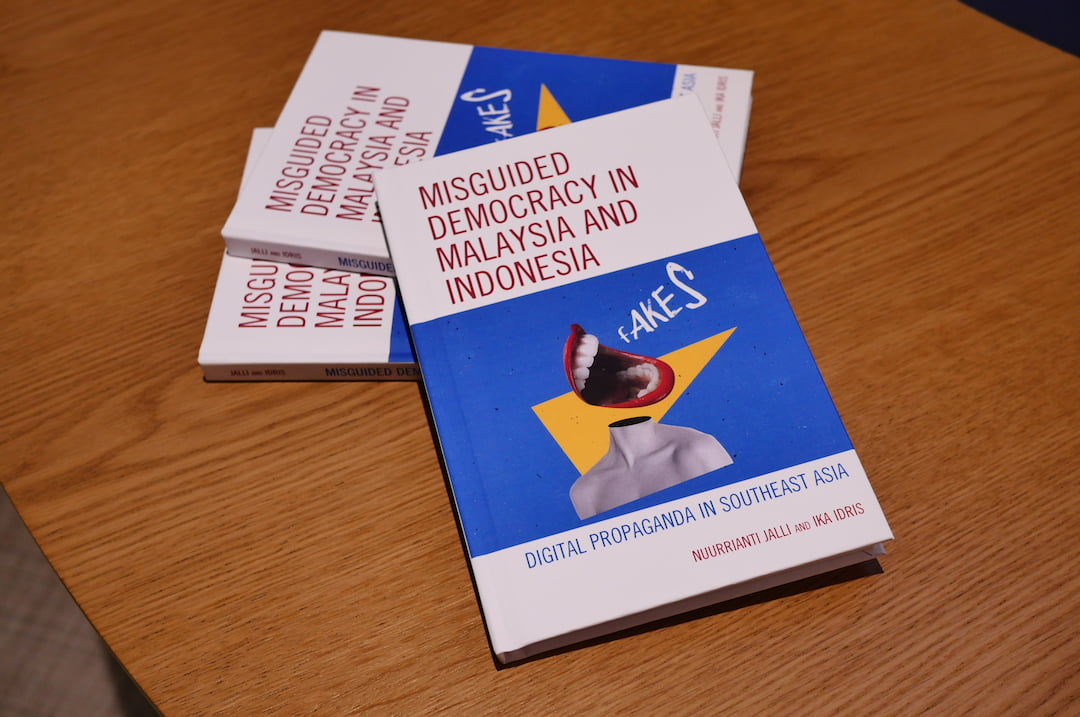
Monash Data and Democracy Research Hub (MDDRH) held a book discussion on democracy and disinformation in Jakarta.
MDDRH Researcher Ika Idris wrote the book titled "Misguided Democracy in Malaysia and Indonesia: Digital Propaganda in Southeast Asia," with a lecturer from Oklahoma State University, Nuurianti Jalli as co-author.
Ika Idris said that as the country with the most significant social media users in Southeast Asia, Indonesia must be alert to participatory propaganda strategies. The reason is that propaganda strategies in the digital era no longer emphasise a top-down approach that the propagandist centralises. But it has focused on driving audience participation.
Ika explained that this strategy resulted in many content creators accidentally becoming fake news entrepreneurs or becoming part of the digital propaganda ecosystem. This participatory propaganda strategy, for example, occurred during the 2016 United States presidential election.
 Many media organisations, media partisans, or content creators spread messages with click bait titles and reinforce political polarisation. In Indonesia, continued Ika, this strategy is clearly visible in the propaganda for Russia's invasion of Ukraine. According to him, many networks are spreading Russian propaganda on social media that spread material massively, quickly, repeatedly, and convey it via various platforms.
Book discussion featured several speakers, including co-writers, panellists, and moderators from various circles. This book is planned to be available in the Southeast Asian market in May 2024. Currently, the book, which was published by Lexington, is still circulating in the European and United States markets.
Present as reviewers were Paramadina University communications expert Putut Widjanarko and Center for Strategic and International Studies (CSIS) political department researcher Noory Okthariza guided by senior lecturer Monash University Malaysia, Dyah Pitaloka and Director of Monash Data and Democracy Research Hub (MDDRH) Monash University Indonesia, as moderators, Derry Wijaya.

CSIS held the 2024 Social and Political Science Conference (KISIP) again. This conference held discussions for two days and presented experts from various fields.
Two MDRRH Researcher Ika Idris and Derry Wijaya were speakers and moderators at a panel discussion session at the 2024 Social and Political Sciences Conference, which was held by the Center for Strategic and International Studies (CSIS) on January 17-18, 2024.
Ika was presenting her paper titled "The Dark Side of Media Innovation: A Case Study on Indonesia's Media Business Model."
Her paper discusses a new business model that is fuelling disinformation in Indonesia, cashing in on incentives from revenue generators like Google AdSense to produce and amplify unverified news.
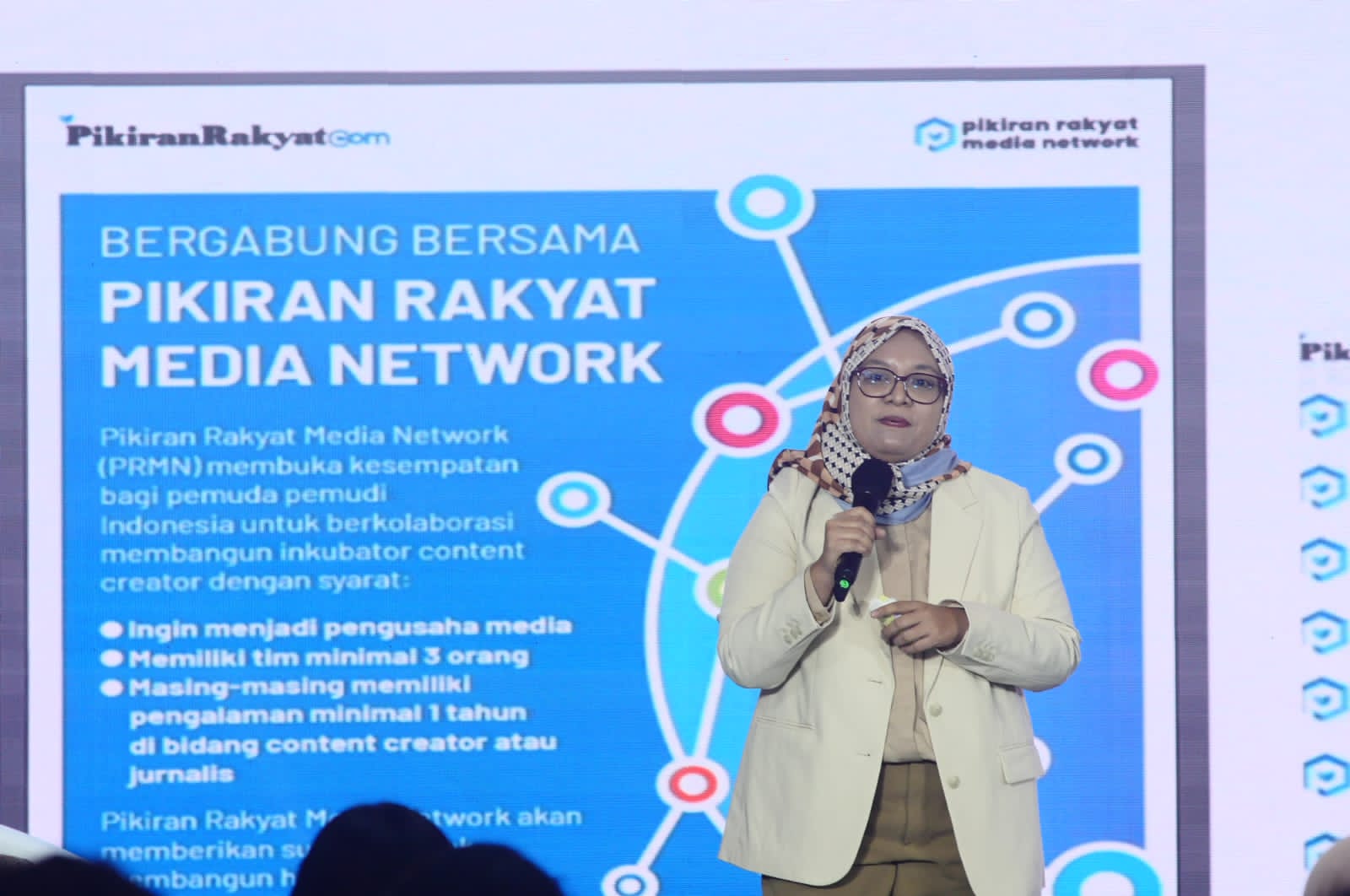 Termed ‘the incubator model’, the scheme makes money by hosting a cadre of small news websites that produce a huge number of articles per day with miniscule teams of editors. The articles, produced under intense time constraints, don’t undergo any scrutiny or fact-checking.
Payments are based on page views and incomes generated from Google AdSense, which automates the placement of advertisements and rewards host websites when an ad is clicked through.
Ika’s interview with content creators and partners of Pikiran Rakyat Media Network revealed that the practice is closer to a form of modern slavery. Some informants told of predatory and exploitative practices in the model.
On the second day of the conference, a panel discussion addressed the role of Media, Journalism, and Information Literacy in the Disinformation Era.
 Derry Wijaya and Prasetia Anugrah Pratama became fact checkers during the Presidential Election Campaign organised by cekfakta.com. Together, they verify the facts presented by the presidential and vice-presidential candidates in the previous debate session.
Prasetia examined the facts put forward by the candidates at the first presidential debate with the theme "Security Defense, International Relations and Geopolitics" on Sunday, January 7, 2024.
Meanwhile, Derry Wijaya joined the fact-check expert panel team for the presidential candidate debate on the themes of Social Welfare, Culture, Education, Information Technology, Health, Employment, Human Resources and Inclusion, on Saturday, February 3, 2024.
This initiative was launched by cekfakta.com, a collaborative fact-checking project started by MAFINDO (Indonesian Anti-Defamation Society), AJI (Alliance of Independent Journalists), and AMSI (Indonesian Cyber Media Association).

The collaboration between Narasi & MDDRH has uncovered an organized disinformation campaign across various social media platforms against Rohingya refugees. TikTok has emerged as the main source of this negative narrative, with over 3,700 videos uploaded, reaching billions of views, and generating massive interactions. As a result, this hate narrative continues to grow, endangering social cohesion and fueling tensions that could lead to real-world violence. Watch the full investigative report here: https://www.youtube.com/watch?v=p7-IFOGYxmU
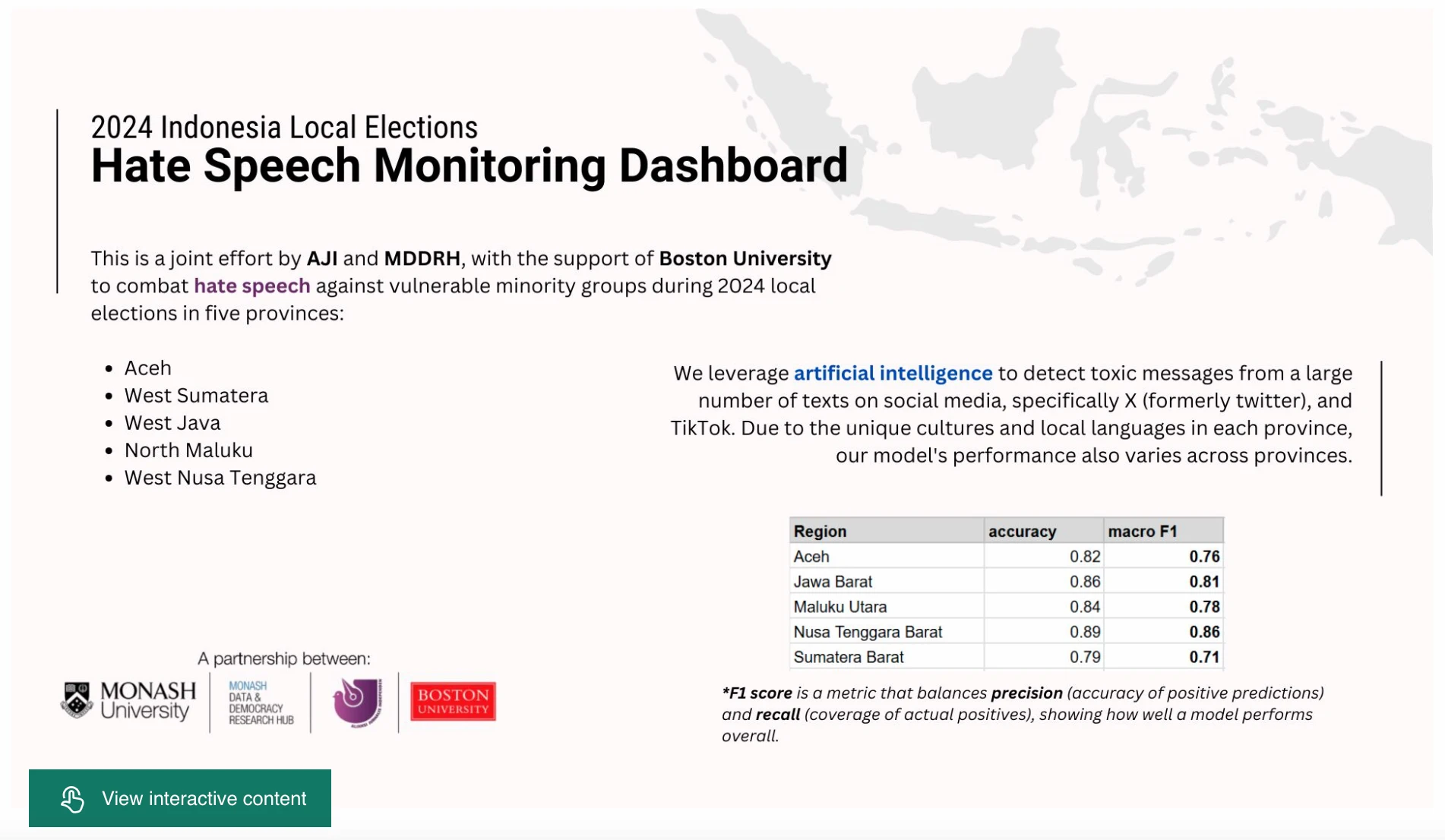
This is a join effort by AJI and MDDRH, with the support of Boston University to combat hate speech against vulnerable minority groups during 2024 local elections in five provinces: Aceh, West Sumatera, West Java, North Maluku & West Nusa Tenggara.
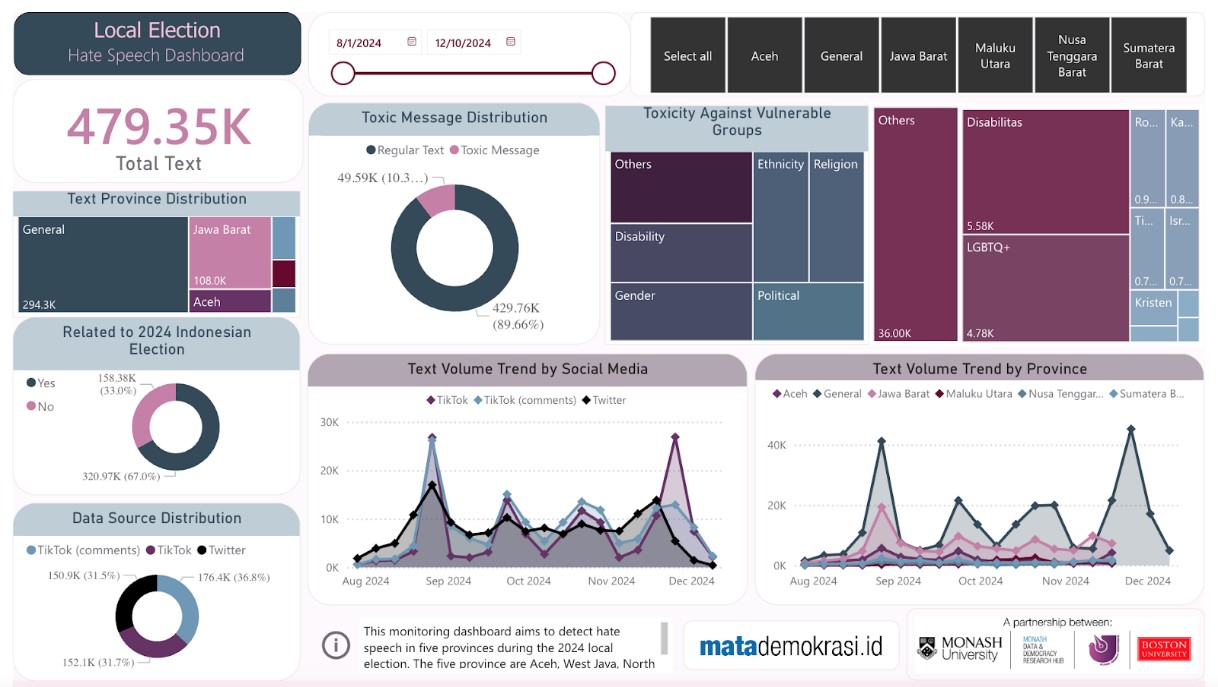
The monitoring of hate speech targeting vulnerable groups during the 2024 Regional Elections (Pilkada) was conducted from August 1 to December 17, 2024. The findings indicate:
- Hate speech content was most frequently disseminated through TikTok comments, with 26,301 identified cases (53.04%).
- Aceh recorded the highest volume of hate speech content among all regional elections, with 8,367 identified texts.
- The LGBTQ+ community was the most frequently targeted group, with 4,779 instances of hate speech, followed by Rohingya (937 texts), Catholics (877 texts), Chinese Indonesians (760 texts), Israel (754 texts), Christians (456 texts), Shia Muslims (204 texts), Ahmadiyya Muslims (158 texts), and other ethnic groups (139 texts).
This dashboard can be accessed on the page https://aji.or.id/hate-speech-monitoring.