
A single edge can tie any knot, mathematicians find
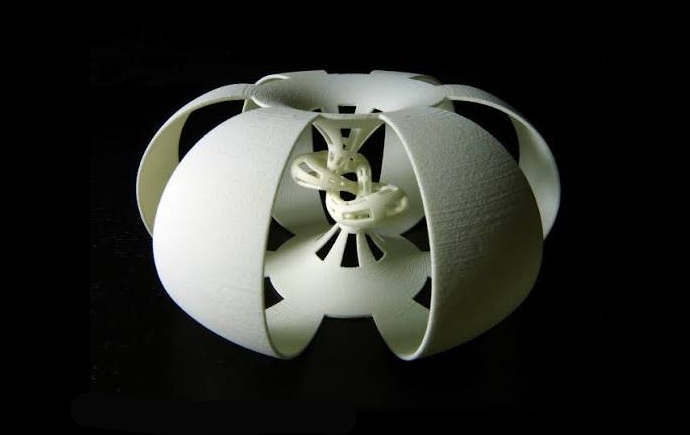
Image modified: Figure-eight knot complement, by François Guéritaud, Saul Schleimer and Henry Segerman, via Wikimedia Commons, licensed under CC BY-SA 3.0.
A new mathematical result has shown that even a single edge in the construction of a simple three-dimensional structure can be made as intricately knotted as any knot imaginable.
Researchers from Monash University and the University of Sydney have found that for any knot it is possible to glue together tetrahedra into three-dimensional space, so that one edge of the structure forms that knot.
The research by Dr Dionne Ibarra, Professor Daniel V. Mathews, Professor Jessica Purcell and Associate Professor Jonathan Spreer, is published in the Journal of Combinatorial Theory, Series A.
Knots are familiar objects, a loop of string tangled and joined at its ends, but in mathematics they are used to investigate fundamental questions about the structure of three-dimensional spaces.
Mathematicians can study such spaces by breaking them into simple building blocks called tetrahedra, the three-dimensional equivalent of triangle, and examining what happens when their faces and edges are joined together.
The new research proves that these apparently simple building blocks can conceal extraordinary complexity: even when the tetrahedra are glued together to form the simplest 3-dimensional space possible, known as the “3-sphere”, a single edge can form any knot, however complicated.
Professor Jessica Purcell, from the Monash University School of Mathematics, said the result revealed just how much complexity could be contained within an apparently simple mathematical structure.
“An edge sounds like one of the simplest objects you could have, but our result shows that a single edge can carry the complexity of any knot whatsoever,” Professor Purcell said.
“You can imagine subdividing 3-dimensional space into a collection of tetrahedra with their triangular faces glued together. We have shown that this can always be done so that one particular edge winds through it in the shape of whatever knot you choose.”
Importantly, the researchers did more than prove that such structures must exist. They developed an explicit method for constructing them from a diagram of a knot.
Associate Professor Jonathan Spreer, from the School of Mathematics and Statistics at the University of Sydney, said this makes the result particularly useful for researchers working computationally with three-dimensional spaces.
“The mind-bending part is that you don't need a huge chain of edges to encode an extraordinarily complicated knot. In the right kind of triangulation, one edge is enough.”
“These triangulations are objects that mathematicians actually compute with, so having an explicit construction is important,” said School of Mathematics co-author Dr Dionne Ibarra.
“Given a knot, our work builds a triangulation of three-dimensional space containing it,” she said.
The researchers’ method draws on ideas from knot theory, topology and hyperbolic geometry, using structures known as fully augmented links to construct the required triangulations.
The result may also have applications in computational topology. Researchers frequently investigate three-dimensional spaces by representing them using tetrahedra, and complicated knots within these structures can reveal properties that distinguish different kinds of triangulations.
The research began during a MATRIX research program in low-dimensional topology and was supported by the Australian Research Council.
Further information
Silvia Dropulich
Marketing, Media & Communications Manager, Monash Science
T: +61 3 9902 4513 M: +61 435 138 743
Email: silvia.dropulich@monash.edu