
Hotter temperatures cause hidden cellular ageing in wild birds
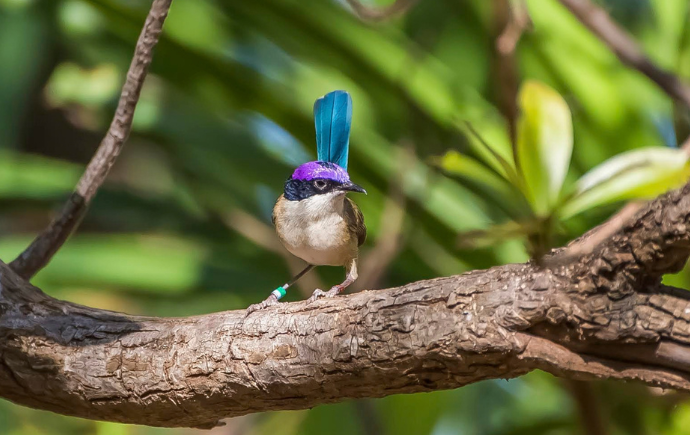
Purple-crowned fair wren. Credit: Laurent Lermusiax/AWC
Climate change is causing hidden, cumulative cellular damage in wild birds, according to new research led by Monash University.
The study, published in Proceedings of the Royal Society B, examined how non-lethal heat exposure impacts telomere dynamics in the purple-crowned fairy-wren (Malurus coronatus), a species native to the tropical regions of Australia. The species is endemic to the Kimberley Region in Western Australia, as well as the Victoria River Region and Gulf of Carpentaria in the Northern Territory.
Telomeres, which are the protective caps at the ends of chromosomes, shorten naturally as an animal ages or experiences physiological stress. Shorter telomeres are closely linked to reduced lifespan and lower reproductive success.
Researchers from the Monash University School of Biological Sciences found that hotter weather accelerated telomere loss during two critical lifecycle periods of the purple-crowned fairy-wren; when juveniles moved toward nutritional independence, and when adults entered their reproductive phase.
Neither favourable social conditions nor environmental factors softened the impact of heat exposure. Instead, the researchers discovered an exception: adult birds inhabiting high-density vegetation experienced less severe telomere erosion.
Co-author of the study, Dr Justin Eastwood, said the findings reveal a physiological toll that standard wildlife surveys often miss.
“While mass mortality events during severe heatwaves capture attention, the sublethal impacts of rising temperatures are far more widespread and often hidden,” Dr Eastwood said.
“Even when temperatures aren't hot enough to kill an animal outright, heat stress inflicts hidden damage at a cellular level. Over time, this cumulative degradation reduces individual fitness and could quietly drive population declines.”
The researchers highlighted that protecting natural microclimates, such as dense vegetation canopies within riverbanks or deep forests that block direct sunlight, will be vital to help species buffer against warming conditions.
Co-author, Professor Anne Peters, emphasised that habitat protection is vital for climate resilience.
“Preserving habitat with dense vegetation cover provides essential climate refugia, giving vulnerable species a fighting chance against increasing thermal stress,” Professor Peters said.
“Habitat quality was the single factor that gave these birds resilience. In dense, shaded vegetation, adults were buffered against heat-driven cellular decline. These results indicate the importance of protecting quality natural habitat and providing species with thermal safe havens that keep them biologically healthy.”
The authors emphasise that preserving high-quality vegetation canopy and integrating molecular stress indicators into long-term conservation strategies will be essential for protecting vulnerable wildlife.
Further information
Silvia Dropulich
Marketing, Media & Communications Manager, Monash Science
T: +61 3 9902 4513 M: +61 435 138 743
Email: silvia.dropulich@monash.edu