
Light behaves like a liquid, new Monash-led study finds
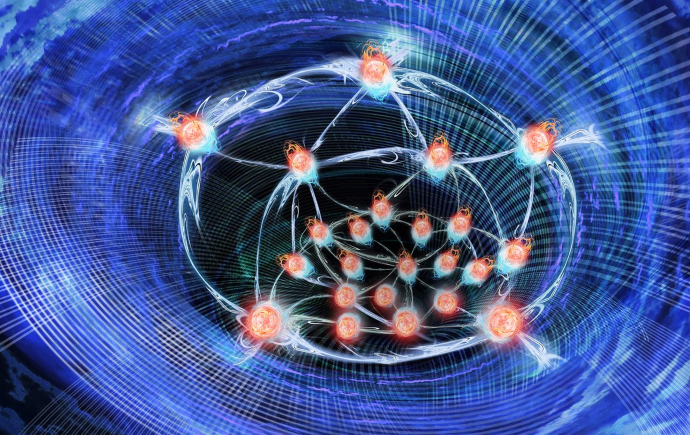
Seeing light behave like a liquid is a doorway into a new regime of quantum matter.
An international team of physicists has predicted a completely new state of matter inside semiconductor microcavities: self‑bound “quantum droplets” made of light.
In everyday life, light and droplets belong to different worlds, for example, sunlight streams, raindrops fall. But inside a microcavity only billionths of a metre thick, researchers have shown that light can organise itself into something that behaves astonishingly like a tiny liquid.
These droplets form from exciton‑polaritons, hybrid particles created when photons bounce between mirrors and strongly couple to excitons, the bound electron–hole pairs inside an atomically thin semiconductor layer. The team focussed on a mixture of two spin species of these polaritons, which offers the possibility to finely tune how the particles attract or repel each other. The team specifically leveraged the possibility to finely tune how the particles attract or repel each other by mixing two spin species of these polaritons.
“When the balance between attraction and repulsion is just right, quantum fluctuations take over and stabilise a completely new phase,” said lead author Dr Matteo Caldara, from the Monash University School of Physics and Astronomy. “Under these conditions, the polaritons clump together into a self‑bound droplet that behaves like a quantum liquid made of light.”
The work, published in Physical Review Letters shows that this droplet phase should emerge under realistic experimental conditions already achievable in state‑of‑the‑art microcavity platforms, including those based on transition‑metal dichalcogenide monolayers.
Unlike classical liquids, these droplets are held together not by surface tension but by purely quantum mechanical effects. Their formation signals that the system has entered a deeply quantum regime, one that researchers have long sought to access in solid‑state photonics.
According to Dr Caldara, this opens a powerful new pathway for quantum technologies: “Because these droplets form at ultra‑low densities and don’t suffer from the losses that plague cold‑atom systems, they could dramatically lower the threshold for polariton condensation and bring genuinely quantum photonic devices much closer to reality.”
Key findings of the study include:
- A liquid-like phase of light: The droplets are self‑bound, maintaining a fixed density even without external confinement.
- Quantum‑driven stability: Their existence relies on quantum fluctuations overpowering mean‑field forces, an effect previously observed only in ultracold atomic gases.
- Scalable semiconductor platform: The phenomenon arises in materials compatible with chip nano-scale photonics, offering a practical route to quantum light sources and strongly correlated photonic states.
- Clear experimental signatures: Researchers predict distinctive excitation spectra, flat‑topped density profiles, and droplet sizes of around 10 microns, well within reach of current imaging techniques.
The discovery provides a long‑awaited demonstration that polaritons can display unmistakably quantum behaviour, not just semiclassical wave dynamics. It also suggests that future devices could harness these droplets to create robust quantum states of light in scalable semiconductor architectures.
As Dr Caldara put it: “Seeing light behave like a liquid is more than a curiosity, it’s a doorway into a new regime of quantum matter that we can engineer on a chip-like device.”
Further information
Silvia Dropulich
Marketing, Media & Communications Manager, Monash Science
T: +61 3 9902 4513 M: +61 435 138 743
Email: silvia.dropulich@monash.edu