
Tiny push, big quantum change: scientists tune material one atom at a time
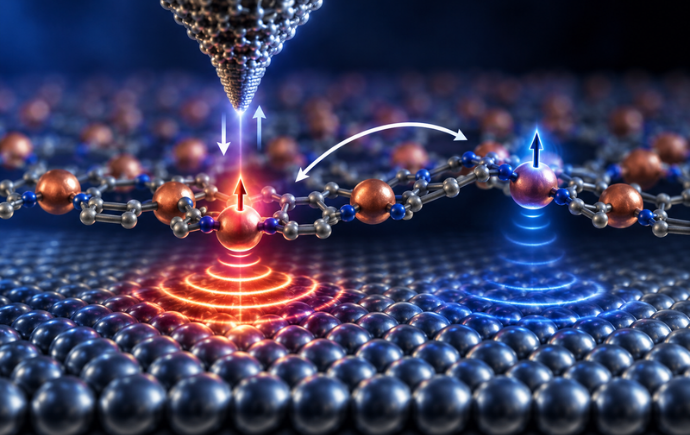
Artist’s impression of an ultra-thin metal-organic framework on a metal surface being manipulated with the tip of a scanning tunnelling microscope. Credit: Image supplied
Scientists have shown they can change the quantum behaviour of an ultra-thin material by physically nudging its structure at the atomic scale, demonstrating a new way to control the electronic and magnetic properties of materials.
The Monash-led international study shows how an extraordinarily small structural change, likened to tipping a molecular “see-saw”, can alter interactions between magnetic electrons in a two-dimensional material and electrons in the metal beneath it.
Published in Small, the research provides scientists with a highly controllable way to investigate fundamental quantum interactions that influence the behaviour of advanced electronic and magnetic materials.
The researchers studied a two-dimensional metal-organic framework (MOF), made from organic molecules and copper atoms and sitting on a metal surface.
At very low temperatures, localised magnetic electrons, or “spins”, in the material can interact with mobile electrons in the metal beneath them through a quantum phenomenon known as the Kondo effect.
The strength of that interaction is highly sensitive to distance.
The researchers found that the 2D material was slightly buckled, meaning different parts sat fractionally closer to or further away from the metal surface. Even these extremely small differences changed how strongly the magnetic spins interacted with electrons in the metal.
Using the ultra-fine tip of a scanning tunnelling microscope (STM), the team was then able to deliberately push and pull the material between different structural configurations.
The movement resembles a tiny see-saw: as one part of the molecular structure moves closer to the metal surface, another moves further away.
By tipping this atomic-scale see-saw, the researchers could controllably change the strength of the quantum interaction between the material and the metal beneath it.
Lead and corresponding author Dr Benjamin Lowe, a Monash University PhD graduate now at the Institute of Physics of the Czech Academy of Sciences (FZU), said the discovery began by accident.
“The first time we noticed the structural change, it was completely unintentional,” Dr Lowe said.
“Then we realised that it was something reproducible which we could use to control the material’s properties.”
“The exciting part is that an incredibly small change in the material’s structure can change the strength of its electronic interactions. By tipping this molecular see-saw, we have a way of controlling those interactions at the atomic scale.”
The electronic and magnetic properties of materials ultimately arise from interactions occurring at extraordinarily small scales. Understanding and ultimately controlling those interactions is an important part of developing new quantum, magnetic and electronic materials.
The new study moves beyond simply observing those effects.
By using an STM tip to physically manipulate the material, the researchers created a system in which they can deliberately change its atomic-scale structure and observe how its quantum properties respond.
This effectively provides an atomic-scale playground for studying complex quantum interactions, allowing researchers to investigate the relationship between a material’s structure and its electronic behaviour with exceptional precision.
Scanning tunnelling microscopy normally uses an extremely sharp conducting tip to probe a material’s surface. Electrons cross the tiny gap between the tip and the material, producing a current that allows scientists to investigate surfaces with atomic-scale resolution.
In this study, the researchers went a step further, using the microscope tip not just to observe the material but to physically manipulate it and control its properties.
The research was led by scientists from Monash University, the Institute of Physics of the Czech Academy of Sciences (FZU) and Lawrence Berkeley National Laboratory (LBNL) in the United States.
The research was supported by the Australian Research Council through its Centre of Excellence and Discovery Project programs, CzechNanoLab Research Infrastructure, the Czech Ministry of Education, Youth and Sports, the Grant Agency of the Czech Republic, the European Union’s Horizon Europe research and innovation programme through Marie Skłodowska–Curie Actions, and the US Department of Energy’s Office of Science through the Molecular Foundry.
Further information
Silvia Dropulich
Marketing, Media & Communications Manager, Monash Science
T: +61 3 9902 4513 M: +61 435 138 743
Email: silvia.dropulich@monash.edu