
Tiny titans of the Cretaceous: Australia’s oldest termite nest reveals secrets of polar forest life
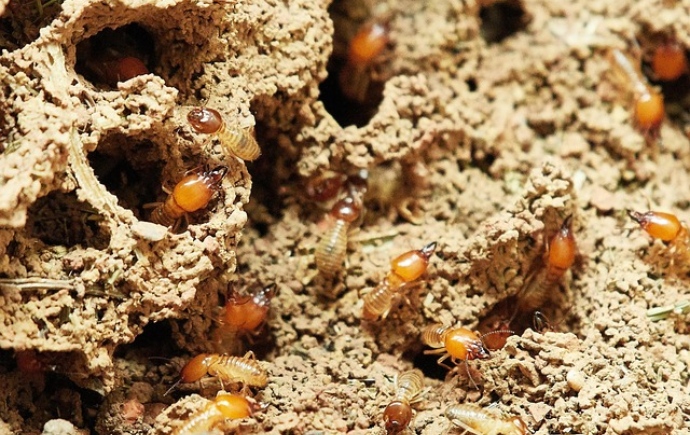
A chunk of fossilised wood discovered near Inverloch on Victoria’s southern coast is rewriting what we know about insect evolution and ancient polar ecosystems.
Packed with 127-million-year-old termite poo – yes, really – this unassuming log has been identified as the oldest known termite nest in Australia and the southernmost ever recorded. And it turns out, these tiny termites were quietly changing the world beneath the feet of dinosaurs.
Published in the journal Palaeogeography, Palaeoclimatology, Palaeoecology, the study was led by Monash University School of Biological Sciences student Jonathan Edwards, with a team of collaborators from Australia and abroad. Using cutting-edge imaging including synchrotron scanning and Raman spectroscopy, they were able to identify distinct hexagonal pellets as termite coprolites – fossilised faeces – within a network of tunnels that once housed a thriving nest.
“The nest was packed with termite coprolites that told us a clear story,” said Edwards. “We were able to confirm these were made by termites thanks to their microscopic hexagonal cross-section, something termites produce as they squeeze every last drop of water from their waste.”
Found in a conifer log from the ancient Strzelecki Group, which once lay within the Antarctic Circle, the discovery proves that termites had already spread across the globe during the Early Cretaceous and had made their way to polar forests. Today’s termites cannot survive freezing temperatures, and so the presence of these ancient cousins suggest that southern polar Australia had a remarkably temperate climate, likely cool and dark, but largely ice-free.
“This really makes a difference to how we view Australia’s past climate,” said Professor Alistair Evans, a study co-author also from the Monash University School of Biological Sciences. “Trace fossils give us direct evidence of how and when animals were alive 125 million years ago, and amazing insights into how termites and mites lived in polar environments,” Professor Evans said.
But termites weren’t the only tenants. Nestled among the termite droppings were even smaller tunnels and faeces, left behind by oribatid mites. These microscopic decomposers likely moved in after the termites abandoned the log, making it the first direct fossil evidence of a shared or at least sequential occupation.
“Finding both groups together reveals a chain of occupation, where decaying wood was reused and reshaped by multiple creatures,” said Edwards. “It’s a beautiful snapshot of an ancient forest doing what forests still do today: recycling life.”
The fossil, known as NMV P344746, also helps researchers understand the role of insects in nutrient cycling under the harsh constraints of polar darkness and cold. Without termites breaking down woody debris, the carbon flow in these ecosystems might have looked very different.
“They’ve been building their own homes for over 127 million years right here in Australia,” said Edwards, “and have only recently tried to share tenancy with us. But long before they moved into our floorboards, they were breaking down the forests of Gondwana, shaping the world beneath the feet of dinosaurs.”
Professor Pat Vickers-Rich, from the School of Earth, Atmosphere and Environment, and Dr Tom Rich, from Museums Victoria, led the research team of more than 700 volunteers, colleagues and students responsible for this discovery.
This remarkable specimen now resides in the collection of Museums Victoria and represents a rare and vivid link to a time when forests crept towards the poles, dinosaurs roamed the south, and termites quietly engineered the ecosystem beneath it all.
Further information
Silvia Dropulich
Marketing, Media & Communications Manager, Monash Science
T: +61 3 9902 4513 M: +61 435 138 743
Email: silvia.dropulich@monash.edu