
Pinnacle scholars: beyond academic excellence, giving exceptional science students the freedom to discover
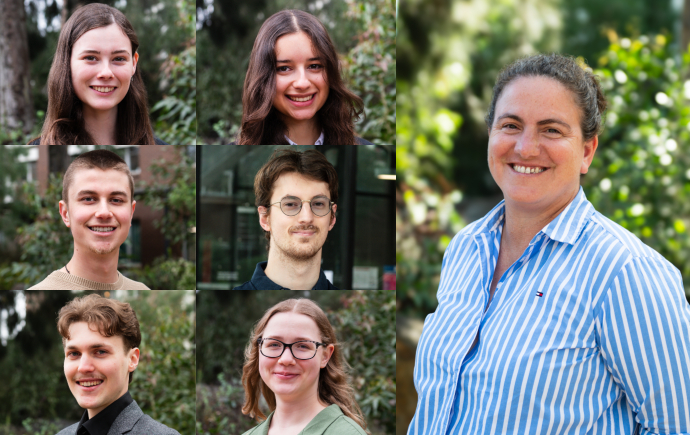
Professor Ruth Reef and the 2026 Pinnacle Science Scholars.
Academic excellence might get a student noticed.
But for Faculty of Science Associate Dean (Undergraduate Education) Professor Ruth Reef, what happens next is far more interesting.
Now in its fourth year, the Pinnacle Science Scholarship program was established to identify exceptional Monash Science students and give them the support and freedom to pursue opportunities that might otherwise be beyond their reach.
“Discovery comes from freedom,” Professor Reef said.
“If a student has the opportunity to work in a laboratory in Japan, for example, and the only barrier is the expense of getting there, we want to be able to remove that barrier.
“The point of Pinnacle Scholarships is not simply to reward students for getting good marks.
It is about supporting future science leaders and giving exceptional students the freedom to explore where their abilities and curiosity might take them.”
The scholarship provides up to $62,000 in support, including $8,000 per 48 credit points of study for up to three years and a $10,000 grant towards an international internship or exchange.
But academic achievement is only the beginning.
Students are initially identified through their Weighted Average Mark (WAM) before shortlisted candidates are asked to provide a statement about themselves and their motivations.
“We know they are academically strong. What we want to understand is who they are beyond their WAM,” Professor Reef said.
“We are looking for students who have the potential to become leaders in science, people with curiosity, resilience and initiative, who can work with others and who are thinking about what they might contribute through science.”
That broader conception of excellence is built into the scholarship itself. Its selection criteria include resilience and the ability to overcome obstacles, teamwork and leadership, entrepreneurial thinking and a commitment to making a positive impact through science.
The current Pinnacle Scholars cohort reflects just how differently that potential can develop.
Emily Cullen is combining a Bachelor of Science with a Bachelor of Music; Nikoletta Tsekrekos is studying a Bachelor of Science; Thomas Mitchell combines Engineering and Science; Daniel Arnould combines Science and Computer Science; while James Talbot and Bethany Orme are studying the Bachelor of Science Advanced – Research (Honours).
“There isn't one model of what a future science leader looks like,” Professor Reef said.
“That is part of the value of the program. These students have different interests, different strengths and potentially very different destinations. Our role isn't to prescribe where they should go. It is to create opportunities and give them room to find out.”
For Daniel Arnould, that freedom has already taken him to Brazil.
Daniel received support through a Global Student-led Initiative after his work was accepted as a poster at a workshop at ICLR 2026, an international machine-learning conference.
Bethany Orme's Pinnacle experience has taken her in a very different direction.
Earlier this year, she undertook a self-sourced research placement with the University of Cambridge's Department of Plant Sciences and Cambridge University Botanic Garden, where she contributed to research into plant diversification and the evolution of traits including betalain pigment biosynthesis.
“These are undergraduate students putting themselves into international research environments and pursuing opportunities that extend well beyond their normal coursework,” Professor Reef said.
“That is highly valuable. They meet researchers, encounter different ideas and ways of working, and start to see themselves as participants in an international scientific community.
“For me, that is where the idea of removing barriers becomes so important. If a student has the ability and the drive to pursue an extraordinary opportunity, we don't want a financial barrier to be the reason they can't do it.”
It also reflects a broader question for universities about how best to educate exceptionally able students.
Simply giving high-achieving students more work, or harder work, does not necessarily develop the qualities they will need to become scientists and leaders.
“The problems this generation will be working on won't sit neatly within the boundaries of a single discipline,” Professor Reef said.
“They will need deep scientific knowledge, but they will also need to collaborate, take risks, work across disciplines and cultures, and be prepared to follow questions into places they hadn't anticipated.”
For Pinnacle Scholars, financial support is therefore not simply a reward for past academic performance. It creates the capacity to pursue what comes next.
The scholarship's international component is substantial: recipients can receive a one-off $10,000 grant towards an international internship with a Monash overseas industry partner or a three-month exchange with an international partner university.
“Academic excellence opens the door,” Professor Reef said.
“What we are interested in is what students do once that door is open.
“If we can give talented students the freedom to explore an idea, enter a new research environment, build international connections or take an opportunity they otherwise couldn't afford, we are investing not simply in what they have already achieved, but in the scientists and leaders they have the potential to become.”
Further information
Silvia Dropulich
Marketing, Media & Communications Manager, Monash Science
T: +61 3 9902 4513 M: +61 435 138 743
Email: silvia.dropulich@monash.edu