
Protecting Australia’s native bees from global pollinator decline requires urgent action
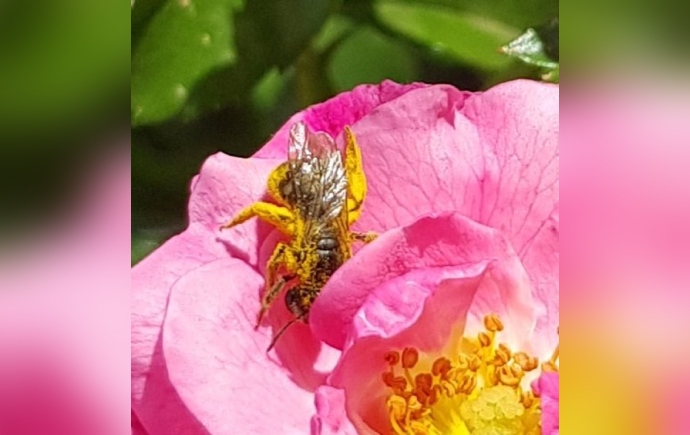
A native bee forages on a rose while covered in pollen. Credit: Dr Scarlett Howard
Australia is home to an extraordinary diversity of native bees, but scientists warn that major gaps in our knowledge mean species could be declining before we have the data to recognise what is happening.
A new review led by Monash University has examined decades of research on Australian native bees and found that, despite significant advances, fundamental gaps remain in what we know about their distribution, behaviour, conservation status, and resilience to environmental change.
Published in Ecology and Evolution, the research emphasises that Australia has a huge diversity of between 1760 and 3000 native bee species, the vast majority of which are found nowhere else in the world. Around 1730 species have been formally described, while hundreds more may remain undescribed.
Yet only three native bee species currently have threatened status under Australia’s Federal environmental legislation.
Lead author Dr Scarlett Howard, from the Monash University School of Biological Sciences, said the knowledge gap itself had become a conservation problem.
“We have remarkable and largely unique native bee fauna, but for many species we still don't have the basic information required to evaluate whether their populations are stable, declining, or already in trouble,” Dr Howard said.
“Australia’s native bees pollinate our native plants, maintain healthy ecosystems, and also have their own intrinsic value. Our wild bees have untapped importance for agriculture, and they represent biodiversity found nowhere else on Earth.”
The review examines the impacts of multiple and interacting pressures on native bees, including habitat loss and fragmentation, urbanisation, agricultural intensification, pesticide use, introduced species, altered fire regimes, and climate change. But the effects can vary substantially between different bee species and groups.
The researchers conclude Australia urgently needs coordinated, long-term monitoring of native bee abundance, distribution, behaviour, and species richness across different locations and seasons, alongside stronger commitments to supporting experts and a greater use of community science.
“Without long-term monitoring, we lack a baseline to determine what is changing as threats to bees intensify,” Dr Howard said.
“The good news is that we have options to support, protect, and conserve our native bees. With improved monitoring, ongoing research addressing critical knowledge gaps, and public participation, we can develop evidence-based strategies for conservation, identify vulnerable species, and act before declines become much harder to reverse.”
The researchers say Australia's experience also has global significance, providing a roadmap for protecting pollinators in other biodiverse but understudied regions.
Further information
Silvia Dropulich
Marketing, Media & Communications Manager, Monash Science
T: +61 3 9902 4513 M: +61 435 138 743
Email: silvia.dropulich@monash.edu