
The Korean Screen Culture Conference (KSCC)
The annual Korean Screen Culture Conference (KSCC) is dedicated to exploring all aspects of Korean screen culture, including television, K-pop, internet, computer gaming, webtoons, and film from both North and South Korea.
Previous successful conferences were held at: SOAS, the University of London (2012 & 2013), Sheffield Hallam University (2014), the University of Copenhagen (Denmark, 2015), King’s College, London (2016), Universität Hamburg (Germany, 2017), the University of Helsinki (Finland, 2018), the University of Central Lancashire (UK, 2019), the University of Tübingen (Germany, 2020), the University of Tübingen (Germany/ZOOM 2021).
KSCC (Korean Screen Cultures Conference)
Year | Venue | Number of presenters | |
1 | 2012 | SOAS, London | 5 |
2 | 2013 | SOAS, London | 27 |
3 | 2014 | Sheffield | 15 |
4 | 2015 | Copenhagen | 27 |
5 | 2016 | Kings College | 45 |
6 | 2017 | Hamburg | 38 |
7 | 2018 | Helsinki | 30 |
8 | 2019 | UCLAN | 45 |
9 | 2020 | Tubingen | 18 |
10 | 2023 | Monash | 38 |
11 | 2024 | Frankfurt | 27 |
12 | 2025 | Leiden | 27 |
| 13 | 2026 | Sofia | 59 |
Total | 401 |
(Call for Papers) 13th Korean Screen Culture Conference
25th June-26th June 2026
Sofia University “St. Kliment Ohridski”, Bulgaria
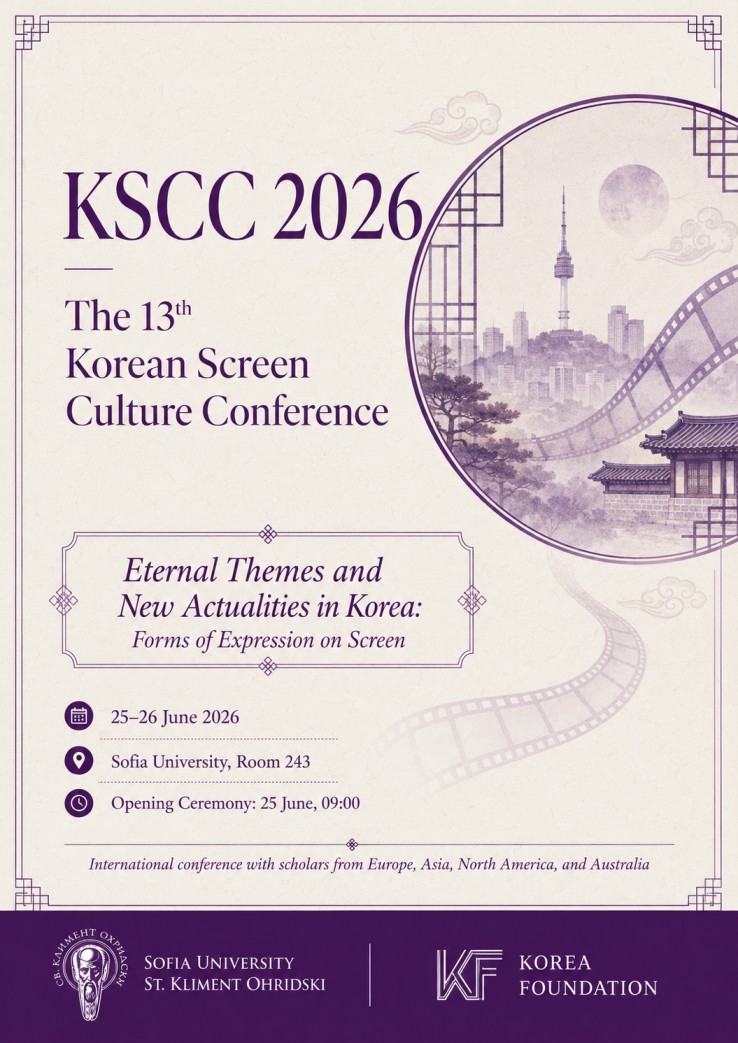
Proposed language: English
2026 Theme:“Eternal Themes and New Actualities in Korea: Forms of Expression on Screen”
The Korean Peninsula is a place where extremes coexist in remarkable balance. The ultramodern and the traditional, the natural and the man-made, the national and the global, the introverted and the extroverted - elements that might seem incompatible - nevertheless move in harmony in contemporary Korea. Through its masterful use of soft power, the country shapes an image that continues to captivate audiences worldwide. Korea’s screen culture, with its dynamism and diversity, reflects these contrasting forces, constantly searching for equilibrium amid their coexistence.
We welcome proposals for papers and panels that engage with the conference theme and all facets of Korean screen culture. Topics may include, but are not limited to: Korean cinema - North and South, past and present; Korean diasporic cinemas; video games; the production, distribution, and reception of film, television, and K-pop music videos; as well as the transnational and intermedial aesthetics of Korean screen culture, such as the impacts of the Korean Wave (Hallyu), cross-border and cross-media adaptations, co-productions, collaborations, and a wide range of intermedia practices.
The organizers will provide two nights of accommodation for all presenters whose papers have been accepted. Presenters wishing to extend their stay beyond the two nights offered will need to cover the additional costs themselves. Unfortunately, due to budget limitations, we are unable to reimburse travel expenses.
Applicants will be notified of the result by 16 March 2026.
Proposal Format:
For both individual paper proposals and panel proposals, please include the following: your name, institutional affiliation, paper title, a 300-word abstract, and a 50-word biography for each author.
Please send your abstract as an email attachment to Irina Sotirova at irisotirova@yahoo.com. The email subject line should match the file name, using the format: familynamefirstnameKSCC2026 (for example: sotirovairinaKSCC2026).
All applicants will receive an email confirming receipt of their abstract within five working days. If you do not receive confirmation, please follow up by email. For all other inquiries, please contact Irina Sotirova at the same address.
KSCC 2025 is organized by a committee comprising:
Dr. Ji-yoon An (UBC), Dr. Andrew Logie (Helsinki University), Dr. Shin Dong Kim (Hong Kong Baptist University), Dr. Andrew Jackson (Monash University), Dr. Yonson Ahn (Goethe University Frankfurt), Dr. Bonnie Tilland (Leiden University), and Dr. Irina Sotirova (Sofia University).
(Call for Papers) 12th Korean Screen Culture Conference
30th June-1st July 2025
Leiden University, the Netherlands
The annual Korean Screen Culture Conference (KSCC) is dedicated to exploring all aspects of Korean screen culture, including television, K-pop, internet, computer gaming, webtoons, and film from both North and South Korea.
Previous successful conferences were held at: SOAS, the University of London (2012 & 2013), Sheffield Hallam University (2014), the University of Copenhagen (Denmark, 2015), King’s College, London (2016), Universität Hamburg (Germany, 2017), the University of Helsinki (Finland, 2018), the University of Central Lancashire (UK, 2019), the University of Tübingen (Germany, 2020), the University of Tübingen (Germany/ZOOM 2021), Monash University (Australia, 2023), and Goethe University in Frankfurt (Germany, 2024).
2025 Theme: ‘New Configurations of Sociality in Korean Screen Culture.’
South Korean and international news media alike increasingly fixate on social problems associated with low birth rate and aging society, single-person households and loneliness, gender inequality and gender wars, ultra-competitive schooling and workplace environments, and abuses within the entertainment industry; Korean film, television, webtoons, music videos, and beyond have equally insistently addressed these social changes through asserting new modes of sociality. For example, media depicts family-like support outside of the traditional family form, extends the meaning of “family,” or invents alternative modes of sociality or revives forgotten modes of sociality (such as communal village arrangements, etc.). Although these social issues and media creators’ responses to them mainly pertain to South Korea (ROK)—in contrast, North Korean (DPRK) society and media get far less international attention than its politics, and the global Korean diaspora is often subsumed under various national contexts—it is hoped that this conference can open up discussions of new configurations of sociality in South Korea, North Korea, and the Korean diaspora. Approaching Korean screen cultures with a focus on sociality has potential for pushing the boundaries of global Korean Studies.
We welcome proposals for papers and panels on the theme of the conference and all aspects of Korean screen culture, including but not limited to: Korean cinema – North and South, past and present; video games; production, distribution & reception of film, television, and K-pop music videos; and the transnational and intermedial aesthetics of Korean screen culture such as the impacts of the Korean Wave (Hallyu), transnational and intermedial adaptations, co-productions, collaborations, and various intermedia practices.
The conference will take place across two full days, on the Leiden University campus. Speakers will be expected to arrive on 29 June 2025. In principle the conference is not a hybrid conference, but special requests to participate remotely may be considered.
The organizers will arrange two nights of accommodation to all presenters whose papers have been accepted. Presenters who wish to extend their stay beyond two nights can expect to bear this cost themselves. Unfortunately, budget limitations do not allow us to reimburse travel expenses.
Deadline for proposals is: 10 March 2025
Applicants will be notified of the result by 24 March 2025.
Proposal format:
In your proposals - both for individual papers and panel proposals - please include your name, institutional affiliation, paper title, an abstract of 300 words, and a 50-word biography of each author.
Please send the abstract as an email attachment to Bonnie Tilland at: b.r.tilland@hum.leidenuniv.nl
The email subject should be the same as the file name, which should be: family name first name KSCC2025. (for example: bonnietillandKSCC2025)
All applicants will receive an email confirmation of receipt of their abstract within 5 working days. If you do not receive confirmation, please email. For all other inquiries, contact Bonnie Tilland at the above email.
KSCC 2025 is organized by a committee comprised of Dr Ji-yoon An (UBC), Dr Mark Plaice (University of Central Lancashire), Dr Andrew Logie (Helsinki University), Dr Shin Dong Kim (Hallym University), Dr Andrew Jackson (Monash University), Dr Yonson Ahn (Goethe University) and Dr Bonnie Tilland (Leiden University).
The 2025 conference is supported by the Korea Foundation.
(Call for Papers) 11th Korean Screen Culture Conference
7th-8th June 2024
Goethe University Frankfurt, Germany

We welcome proposals for papers and panels that engage with the following suggested topics. However, papers addressing themes related to the core conference focus will also be considered:
Suggested Topics:
Submission Guidelines:
Proposals: Abstracts (400 words) and panel proposals (1,400 words) and a brief bio (150 words) including contact details by 29 February 2024; acceptance notifications by 13 March 2024; full papers of 6,000-8,000 words by 26 May 2024.
Click here.
The 10th Korean Screen Culture Conference (KSCC) 2023
1st-2nd December 2023, Monash University, Clayton Campus, Melbourne, Australia (Hybrid)
Conference report
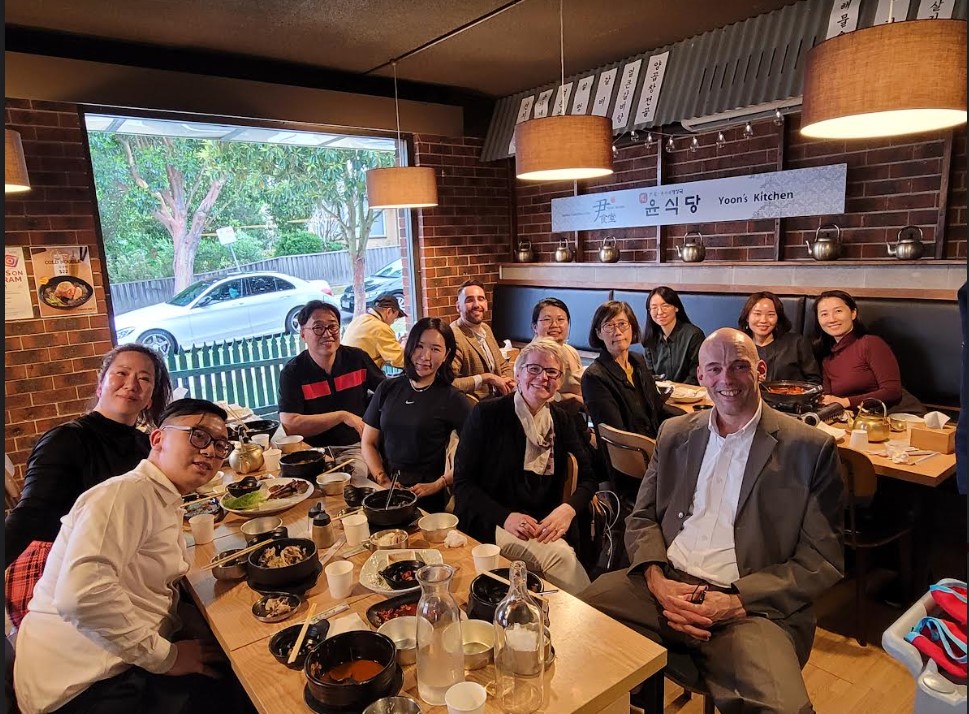
Between 30 November and 2 December 2023, Monash University Korean Studies Research Hub (MUKSRH) successfully held the 10th Korean Screen Cultures Conference (KSCC 2023) at Monash University’s Clayton Campus in Melbourne. The KSCC was held as part of MUKSRH’s ‘Monash Korean Studies Beyond Borders Conferences’ series supported by the AKS Core 2.0 grant. Over the 3-day period, there was a total of 12 panels as well as 1 keynote talk. 38 speakers (17 on site and 21 online) representing tertiary level institutions in 10 different countries spoke on different aspects of Korean screen culture including instatoons, South and North Korean movies, K-dramas, You Tube videos and K-pop. This was the largest KSCC ever held and the first to be held outside Europe and in hybrid fashion. This was also the first time that presenters spoke about topics like the uses of K-pop and K-drama in pedagogy and linguistic approaches were complemented by other diverse perspectives on the impact of Korean screen cultures outside the Peninsula. Introductory comments were provided by his excellency the Republic of Korea Consul-General to Melbourne Mr Changhoon Yi who spoke of the rapid global spread of Hallyu– a development that has brought South Korea global cultural recognition. Professor Jo Winning introduced the conference by situating it within the overall research and educational strategy of Monash Korean Studies. Andy Jackson discussed the history of the KSCC from its early development in the UK and its spread to other academic institutions in Germany, Denmark and Finland. Technically, this year’s event was the 12th KSCC to be held, however, it is the 10th to be held with a face-to-face component, since the 2020-2021 pandemic disrupted its organisation at universities in Germany (Tuebingen). Jo Elfving-Hwang provided an insight into historical K-dramas in her keynote address and the best paper awards were won by Sarah Molisso of City University, London for her paper on feminist instatoons and by Spencer Hines of UniMelb for his indepth analysis of Hong Sang-soo’s filmmaking techniques. A big thank you to the KSCC2023 committee, all the panel chairs, the Republic of Korea Consulate to Melbourne, the LLCL, Tae Kim, Eleena Chang and MUKSRH Hub Coordinator Sandy Nguyen for helping to put this together.
The event was reported on South Korean national television:
For the full conference schedule, please click here
This work was supported by the Core University Program for Korean Studies through the Ministry of Education of the Republic of Korea and Korean Studies Promotion Service of the Academy of Korean Studies (AKS-2023-OLU-2250001).
2023 Theme: ‘The Global Spread of Korean Screen Cultures and its impact on Korea.’
From the global phenomenon Squid Game and Physical 100 broadcast on Netflix, to the international critical and popular success of Parasite and the worldwide popularity of BTS and Black Pink, it seems that never has Korean Screen Culture been so prominent around the globe. This conference investigates the causes and impacts behind the global spread of Korean movies, TV shows, online games, K-pop videos, webtoons and other imagery. The conference will ask the question of whether this current success represents a new chapter in the development of South Korea’s cultural industries or the swan song for Korean popular culture.
KSCC 2023 is organized by a committee comprised of Dr Ji-yoon An (UBC), Dr Mark Plaice (University of Central Lancashire), Dr Andrew Logie (Helsinki University), Dr Barbara Wall (Copenhagen University), Dr Shin Dong Kim (Hallym University) and Dr Andrew Jackson (Monash University).
Andy Jackson at: andy.jackson@monash.edu
For more on the KSCC, please follow us on facebook
Posters and Programmes from Previous Events
2023 10th KSCC panels & presentations

2020 9th KSCC virtual programme