
Donation of Anatomy 3D prints
Donation of Anatomy 3D prints to Low Middle Income Countries (LMIC)
Following on from Prof McMenamin’s work in Liberia in late 2015, the Monash Anatomy 3D Printing lab within the Centre for Human Anatomy Education (CHAE) continues to look at ways to assist LMIC in anatomy education. Prof McMenamin spoke on this topic at Royal Australian College of Surgeons (RACS) annual meeting in Melbourne in May, 2021. Some of the activity described below was in part due to discussions and linkages made at that meeting.
Fiji
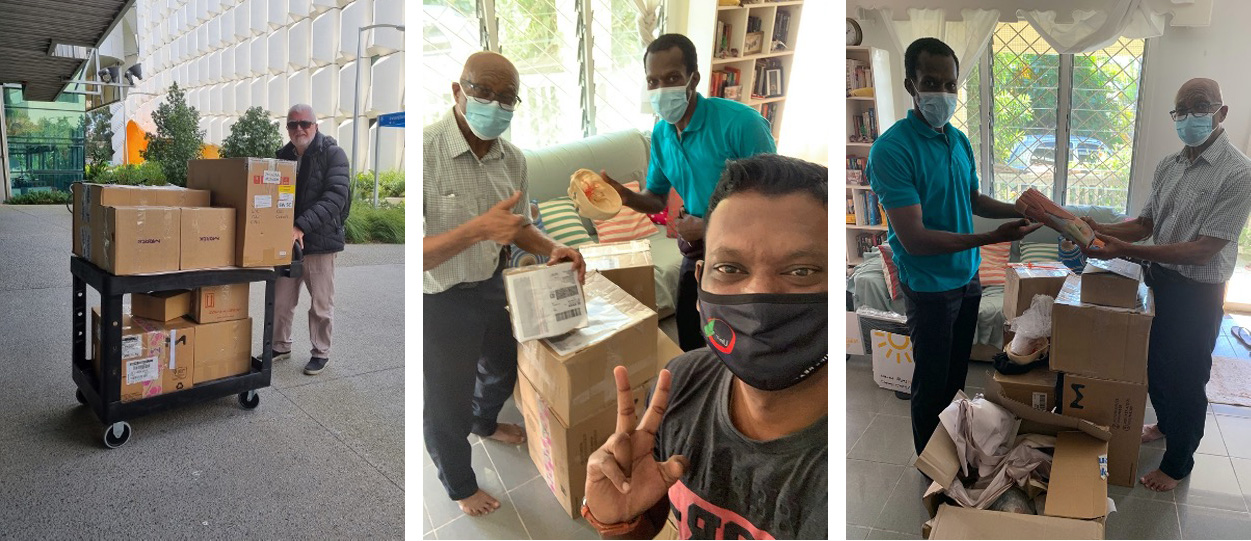
The CHAE has been providing teaching support to the Umanand Prasad School of Medicine & Health Sciences (UPSM)in Fiji for a few years. Assoc Prof Michelle Lazarus visited there in 2016 and Prof Paul McMenamin taught around 4 active learning classes online in 2020. Teaching sessions in 2020 were organized by ‘Friends4Fiji’, a medical student-based volunteer group within the FMNHS at Monash University. Following the success of this, Prof McMenamin and the volunteers are repeating and extending the online learning activities in late 2021. In addition, we have just donated around 40 individual 3D printed replicas of human anatomy specimens with detailed descriptions to UPSM. These are prints which have been superseded by new ones printed for our own classes or are surplus to local needs. The images below show the material packed up for transport from Monash in late May and being unwrapped in Fiji a few weeks ago by the Dean, Prof Fred Merchant and colleagues. This donation will allow students to examine unique and anatomically accurate replicas of human specimens originating from Monash. The UPSM medical school does not have access to cadavers nor does it have many other learning resources besides textbooks, so they have expressed their extreme gratitude for our donation as it effectively allows them to set up a new anatomy learning resource centre.
Papua New Guinea
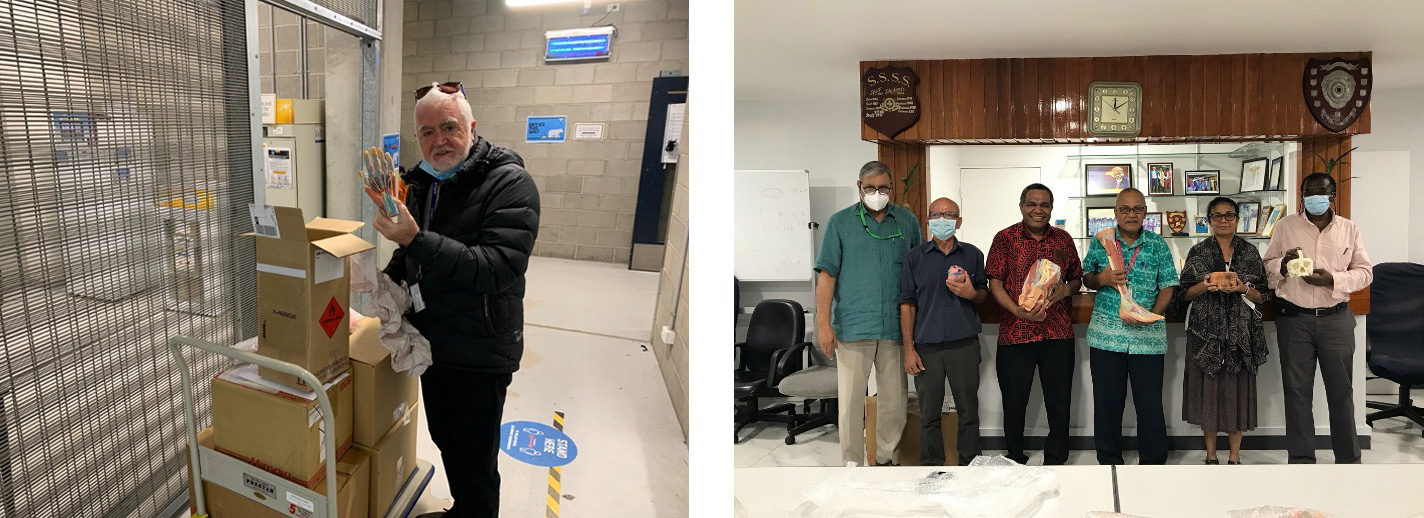
With introductions by Prof Jeffrey Rosenfeld, Prof McMenamin approached the Executive Dean of Medicine and Health Sciences, Professor Nakapi Tefuarani, at the University of Papua New Guinea and asked if we could be of assistance in providing some learning materials in the form of 3D prints. Their medical school is in a similar situation to Fiji with no access to cadavers and have only a limited supply of some old prosections for teaching. Therefore the Dean and his colleagues were very enthusiastic about our offer of help. We sent around 25 individual 3D prints in late July in concert with medical supplies from Monash Health (organized by Prof Ram Nataraja) being delivered to their local hospital. The goods have just arrived today (Aug 25th) in Port Moresby (see pics below) Prof McMenamin and the staff in the Monash 3D Printing lab in the CHAE will continue to try to support this medical school based on observed identified needs.
Summary and Future opportunities to help LMIC
I am extremely proud of the work we have been able to do for LMIC and in retirement I hope to continue this work where possible, albeit in a restricted form presently due to Covid and travel restrictions. I believe there are fantastic opportunities to do valuable work in places not as fortunate as we are in Australia and at Monash University especially.
I have recently been contacted by Dr Neil Wetzig who established AusHeal, an organization that provides surgical training and medical assistance in the Democratic Republic of Congo (DRC). He heard my presentation at RACS and was wondering if our 3D prints may be valuable for teaching trainee surgeons and medical students in the DRC as they have little practical opportunities to learn anatomy and as a result there is a major problem with iatrogenic injuries, especially during childbirth and caesarian deliveries. I hope to look at ways to raise funds to help Dr Wetzig’s work in the DRC and welcome any ideas on how the FMNHS or Monash University could help. I know outreach is not primarily a mission for the university but I believe there is tremendous potential for raising our international profile but more importantly, ethical and moral benefits in altruistic activities.
Ackowledgements
I would like to thank Assoc Prof Justin Adams, Director of the Monash 3D Printing lab, for his continued support of this work in identifying material suitable for donation. The technical staff, Michelle Quayle and Lucy Costello, have greatly assisted by identifying material and helping repair any damaged prints.