
Monash 3D printing
Monash 3D Printing
Monash 3D Printing offers 3D printing, scanning & modelling services to Monash staff and students, as well as external clients. We specialise in full colour scanning and printing.
For quotes and information please contact us 3dprinting@monash.edu
Equipment
3D printing
Mimaki 3DUJ-553
The Mimaki 3DUJ-553 is an inkjet printer which allows full colour mixing from its Cyan, Magenta, Yellow, Black, White and Clear ink palette. The ink is UV curing with water soluble support structures to produce models with a smooth, hard, slightly shiny finish.
Ink Colour: CMYK, White, Clear
Layer Height: 22-42micron
Maximum build size: 508 x 508 x 305mm
File Formats: OBJ, STL, PLY, WRL
Formlabs Form 3
The Form 3 uses stereolithography (SLA) printing technology. This process uses a laser to cure resin and produces a single colour model. The surface is smooth, however overhanging parts will need support structures which can be removed later. A number of different resin types are available, each with varying material properties. For example, resins with high thermal stability, varying flexibility and rigidity. Please enquire for details on resins available.
Layer Height: 25-300micron (depending on resin type)
Maximum build size: 145 x 145 x 185mm
File Formats: OBJ, STL
Raise3D Pro3+
The Raise3D Pro3+ is a Fused Deposition Modelling (FDM) 3D printer. This technology uses a plastic filament which is melted into layers. A variety of filament types are available including PLA, ABS, TPU, TPE, PETG, ASA, Nylon and Carbon Fibre infused filaments. Others are available so please enquire for further details.
Layer Height: 0.01-0.25 mm
Maximum build size: 300 x 300 x 605mm
File Formats: OBJ, STL
Surface scanning
Artec Space Spider
The Space Spider uses blue-light technology to capture high-resolution surface geometry and full colour texture models from physical objects. This scanner is ideal for creating 3D models for colour 3D printing, AR or VR applications.
Services
Converting CT scans to 3D models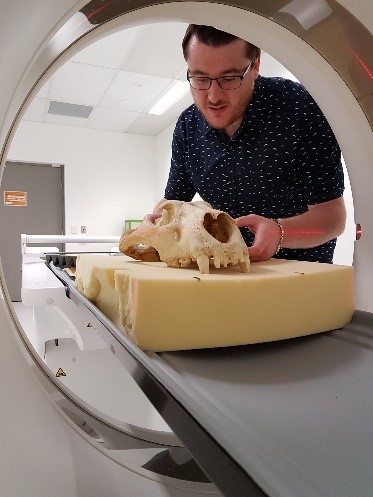
Specialised medical software allows us to convert CT and MRI datasets into 3D models or images. We can then edit models derived from CT data to separate out individual bones or structures for better visualisation of the area of interest. These models can be 3D printed for surgical planning.
Medical-grade 3D printed parts
We now have Formlabs BioMed Amber resin for biocompatible 3D printed parts available. Parts printed in this resin can be used for short-term skin and mucosal membrane contact and can be sterilized by autoclave, E-beam, gamma and ethylene oxide methods. Example uses include drilling templates, implant guides, medical device components, fixation trays, implant sizing templates and surgery planning tools. Please contact us for further information on Biocompatible printing.
Moulding and casting
Moulding and casting can produce models with varying textures and layers. Pieces cast in silicone have a soft, flexible feel, but can still capture detailed geometry.
Technical advice
With more than 10 years’ experience in the 3D modelling area, we are able to provide practical technical advice on which printing or scanning service is best for your specific project. We can advise on how to obtain the 3D data you need, how to process and edit your models or datasets and provide technical support and information for creating a physical replica.
About us
Since 2012, the 3D printing program in the Centre for Human Anatomy Education has been at the forefront of advancing practical applications of 3D imaging and printing technology within anatomical education. Our first publication on the methods in Anatomical Sciences Education has become one of the fundamental citations for 3D printing in medical education.
Our initial research into this space has resulted in commercial contracts with global distribution and sales through our partners Erler-Zimmer and Mentone Educational, with more series currently in development and increasingly expanding into complex training and simulation. At the same time, we have engaged directly with the imaging powerhouse Sectra AB to distribute primary anatomy educational content through their Education Portal. This has produced an unparalleled radiographic database of medical anatomy tied to educational content ranging from descriptions, to fully labelled 3D models and educational videos.
Under the current directorship of A.Prof Justin W. Adams and 3D printing technicians Michelle Quayle and Lucy Costello, our 3D printing program plays a significant role here at Monash University by facilitating the use of the technology to the campus-wide community. We offer 3D part design, prototyping, and printing services using our range of 3D visualisation software and 3D printers. We also engage in external contract work and work regularly with other Universities, clinicians, and commercial groups to promote the use of 3D printing with the educational and research communities.
Publications
For further information on our published work please see:
The production of anatomical teaching resources using three‐dimensional (3D) printing technology PG McMenamin, MR Quayle, CR McHenry, JW Adams (2014)
Anatomical sciences education 7 (6), 479-486
3D printed reproductions of orbital dissections: a novel mode of visualising anatomy for trainees in ophthalmology or optometry JW Adams, L Paxton, K Dawes, K Burlak, M Quayle, PG McMenamin (2015)
British Journal of Ophthalmology 99 (9), 1162-1167
3D printed models of cleft palate pathology for surgical education PA Lioufas, MR Quayle, JC Leong, PG McMenamin (2016)
Plastic and Reconstructive Surgery Global Open 4 (9)
Three‐dimensional printing of archived human fetal material for teaching purposes JC Young, MR Quayle, JW Adams, JF Bertram, PG McMenamin (2019)
Anatomical sciences education 12 (1), 90-96
Advanced 3D printed model of middle cerebral artery aneurysms for neurosurgery simulation RG Nagassa, PG McMenamin, JW Adams, MR Quayle, JV Rosenfeld (2019)
3D printing in medicine 5 (1), 1-12
The reproduction of human pathology specimens using three-dimensional (3D) printing technology for teaching purposes PG McMenamin, D Hussey, D Chin, W Alam, MR Quayle, SE Coupland, JW Adams (2021)
Medical Teacher 43 (2), 189-197
A novel 3-dimensional printing fabrication approach for the production of pediatric airway models AD Weatherall, MD Rogerson, MR Quayle, MG Cooper, PG McMenamin, JW Adams (2020)Anesthesia & Analgesia