
Wai Chung Tse
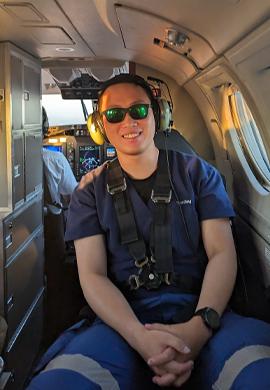
Wai Chung Tse
- Student type: Domestic
- Degree type: Double Degree
- Degree(s): Bachelor of Medical Science and Doctor of Medicine (MD)
Bachelor of Medical Science and Doctor of Medicine (MD)
Why did you choose to study your degree and why did you choose Monash?
Medicine was not a childhood ambition for me. It came out of time spent in Haiti prior to starting medical school, where I saw both the enormous need for clinical care and the ways in which well-meaning outside help can fall short of what a community requires. That experience left me with a specific goal: to be useful in global health in a way that was ethical and sustainable, built around local capacity and to have the clinical credibility to do it properly.
Highlights of your time at Monash?
The people, first and foremost. The friendships I made studying alongside my cohort have lasted well beyond graduation, and they remain some of the closest in my life. Medicine is a long degree and a demanding one and going through it with that group is what I look back on most fondly. The other highlight was how far the degree let me travel. I completed an ICU and anaesthesia elective in Berlin and a research elective in Amsterdam, both of which showed me how differently well-resourced health systems can be organised and how much of clinical practice is shaped by system design rather than biology. I also spent time in Weipa in remote far north Queensland on a rural generalist elective, which was a very different lesson in the same subject.
Did you complete a clinical placement/internship or study abroad during your course? How has this benefited you both personally and professionally?
Yes, several. Berlin for ICU and anaesthesia, Amsterdam for research, and Weipa for rural generalist practice. Monash set the foundation for working abroad, and I have kept going since graduating. Since then, I have been working across the Asia Pacific, including Nepal, Papua New Guinea, and Vanuatu. Most of that work has been through PEARLS, which stands for Point of Care Ultrasound in Emergency and Acute Care in Resource Limited Settings. It is a training program for clinicians in low- and middle-income countries, where access to CT and formal radiology is often limited but a handheld ultrasound probe plugged into a phone can change a diagnosis at the bedside. Local participants who progress become faculty for the next course. I lead faculty development for the program, which is the part I care most about, because it is the mechanism by which the work becomes locally owned and sustainable.
How has your Monash degree helped you succeed in your career? How have you been able to apply your skills in your current position?
The most valuable thing the degree did was prompt me to look for opportunities from first year, and most of the value I got out of it came from outside the classroom. It started with a Monash winter research scholarship with Professor Suzanne Nielsen, Deputy Director of the Monash Addiction Research Centre and an NHMRC Leadership Fellow. That project was the beginning of my research career, and the questions it raised about harm reduction and health systems are ones I am still working on. I now hold a research role at the Burnet Institute in the Disease Elimination Program, working on hepatitis C care cascades among people receiving opioid agonist treatment, which is a direct continuation of what began in that scholarship. Clinically, working as a medical student assistant in the emergency department at Box Hill Hospital was formative. Dr Nerissa Imeri and Dr Deb Bernstein, both emergency physicians there, took the time to teach a student properly, and that early exposure to undifferentiated acute presentations is a large part of why I ended up in critical care. Dr Elissa Kennedy Smith, a FACEM with a Diploma of Diagnostic Ultrasound in Emergency Medicine who has chaired ACEM's Emergency Department Ultrasound Committee, then mentored me through my point of care ultrasound training. That mentorship led directly to my CCPU accreditation across 12 modules and to the PEARLS teaching work I do across the Pacific.
Any professional achievements you’d like to share?
Commencing a fully funded PhD in Systems Engineering, focused on health systems design, at the University of Cambridge in October 2026, supported by the Ramsay Centre and the Cambridge Trust. I was announced as a 2026 Ramsay Postgraduate Scholar this year. - Over 25 peer reviewed publications with over 280 citations, with work that has contributed to WHO and UNODC guidance. - CCPU accreditation across 12 ultrasound modules, and involvement in training more than 200 clinicians internationally through the PEARLS faculty network. - Faculty roles across the Ultrasound Core Course and the Emergency Medicine Course Advanced at Alfred Health.
What has been your biggest challenge and how did you overcome it?
Balancing everything as a junior trainee. Clinical training in intensive care is demanding on its own, and I have been trying to do it alongside teaching commitments and public health research at the Burnet Institute, where I work in the Disease Elimination Program under Professor Margaret Hellard AM and Professor Mark Stoove. Professor Hellard is a Deputy Director of the Burnet and Head of Hepatitis Services in the Infectious Diseases Unit at The Alfred, and Professor Stoove is Head of Public Health there. Working with people of that calibre is a privilege and the growth as a clinician scientist there has been enormous, but it also means the standard expected of the work is high regardless of what my roster looks like that fortnight.
Words of advice for future students or other alumni?
Start early and put your hand up. Nearly everything that has mattered in my career traces back to something I applied for as a student without being quite qualified for it, including a winter research scholarship that turned into a research career. Find mentors and keep them. One person who takes your work seriously early on is worth more than any prize, and the people who taught me as a student are still the ones I call. And if global health interests you, go with the intention of being useful rather than interesting. The work that lasts is the work that builds local capacity and keeps running after you fly home.
In 60 words or less summarise how your Monash degree has supported your career trajectory.
Monash gave me more than a medical degree. It gave me the opportunity to seek out research, teaching and global health work from first year, and the mentors who made that possible. That foundation took me from an emergency department in Melbourne to ultrasound training across the Pacific, and now to a PhD in health systems engineering at Cambridge.
Learn more about the Bachelor of Medical Science and Doctor of Medicine (MD) here.