
Reflection on COP30 – Julia Bekin
This article is a verbatim reflection written by Julia Bekin, United Nations COP30 Delegate and Architecture student at Monash University.
Question 1: What single moment, meeting, or observation resonated most strongly with you?
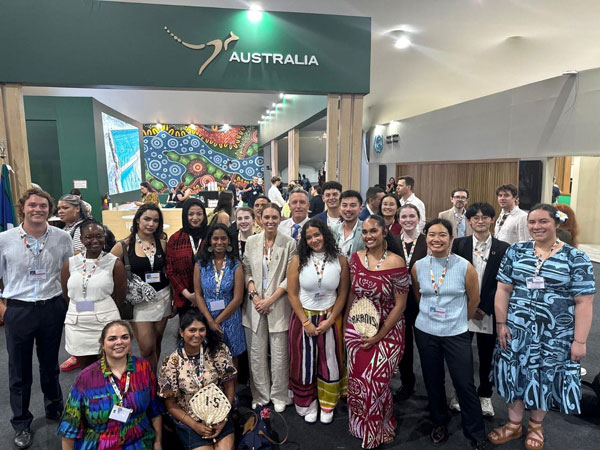
The moment that resonated most deeply with me at COP30 wasn’t a single panel or negotiation, but the physical experience of heat inside and outside the Blue and Green Zones. It was striking to watch high-level negotiators, many of whom come from privileged backgrounds or live in fully air-conditioned environments, suddenly confronted with the very conditions they were debating: heat, humidity, discomfort, and fatigue. Brazilian media and civil society voices framed this as an important reality check, a way for decision-makers to feel, even briefly, what climate extremes mean outside the protective bubble of controlled indoor environments.
At the same time, I felt the other side of this reality: the very real accessibility barriers created by insufficient temperature control. As someone living with a chronic condition that is directly impacted by heat, thermal discomfort is not an abstract inconvenience; it carries immediate physical consequences. During COP, these temperatures significantly reduced my ability to participate, engage, and learn at the level I expected of myself.
My background in architecture further shaped how I interpreted this experience. Thermal comfort is not a secondary detail but a foundational determinant of human performance. Environmental design research consistently shows that cognitive focus, emotional regulation, stamina, and decision-making decline when thermal conditions are poor. This means that, even before considering disability or chronic illness, prolonged exposure to excessive heat undermines participation, concentration, and negotiation at an event as demanding as COP. In this context, the indoor heat at COP30 was not simply uncomfortable, it had direct implications for both the effectiveness and the equity of the conference.
This produced a complex tension: the symbolic importance of negotiators experiencing the climate realities they aim to address, contrasted with the institutional responsibility to ensure conditions that support full and equal participation. There is genuine value in delegates confronting, physically and viscerally, the conditions that define climate risk for billions of people. Yet COP is also a high-stakes decision-making environment. Effective engagement depends on physical wellbeing, and for people with disabilities—including those with heat-sensitive conditions like mine, inadequate temperature control becomes an access barrier rather than a symbolic gesture.
Holding both truths simultaneously became my defining moment at COP30. It revealed a deeper complexity within climate justice: that empathy and symbolism are meaningful, but they must coexist with accessibility and inclusion. We need negotiators to understand the realities of extreme heat, but not at the cost of excluding disabled delegates or anyone whose health is compromised by those same conditions. Experiencing these contrasting truths firsthand reshaped how I think about the intersection of climate, health, and justice going forward.
Question 2: What are the most significant developments that emerged specifically at the intersection of health and climate? For example: Please reflect on the adoption of the Belém Health Action Plan (BHAP) and/or the $300 million philanthropic funding announcement by the Climate & Health Funders Coalition.
From my perspective, the most significant developments at the health–climate intersection at COP30 were the formal elevation of health as a core climate priority and the introduction of concrete frameworks intended to operationalise this link. In particular, the launch of the Belém Health Action
Plan (BHAP) and the announcement of over USD 300 million in philanthropic funding from the Climate & Health Funders Coalition marked an important shift: for the first time, health was not treated as an adjacent concern but as a central pillar of climate action.
The BHAP is notable because it positions climate change squarely as a mainstream public–health challenge. Its focus on surveillance systems, health-workforce training, and innovation reflects a long overdue recognition that climate impacts, especially heat stress, are already reshaping global health burdens. However, as someone living with a chronic condition that is directly affected by temperature, I see a clear gap between recognition and lived experience. As I felt personally during COP30, the difference between acknowledging heat as a health risk and providing conditions that truly protect people is substantial. For people with disabilities or mobility limitations, the real measure of BHAP’s success will be whether these commitments translate into accessible, practical interventions: inclusive early-warning systems, continuity of medication during climate disruptions, and cooling options that do not require long travel or physical strain.
The philanthropic funding announcement has the potential to catalyse these types of interventions, especially in low-resource settings, provided the financing is governed transparently and shaped by local priorities, including disability-inclusive design. Without those safeguards, large funding pledges risk reinforcing existing inequities instead of addressing them.
At the same time, BHAP’s focus on strengthening health systems cannot stand alone. Growing up in a neighbourhood where heat, pollution, and noise were everyday realities taught me that climate-health action must also address the wider structural determinants of health: housing quality, shade and cooling infrastructure, clean-air policies, and accessible public services. Without investments in these areas, global frameworks risk treating symptoms while leaving the root causes of health inequity unchanged.
Although these developments are important milestones, they still fall short of creating binding mechanisms or implementation pathways. Much of the conversation at COP30 remained conceptual: we are articulating the problem more clearly, but not yet embedding health criteria into adaptation funds, establishing disability-inclusive monitoring frameworks, or defining obligations for Parties. Even the frequent discussions about heat did not translate into systematic protocols, such as standards for safe working conditions for negotiators, community delegates, or frontline workers.
In this sense, the prominence of health at COP30 represents a necessary first step, but the next phase requires moving from acknowledgement to accountability. Health must become a cross-cutting requirement—built into climate finance, adaptation planning, and implementation—rather than an emerging theme. Only then will frameworks like BHAP and the associated funding commitments deliver the equitable, accessible climate-health action they promise.
Question 3: What is the main takeaway Monash should leverage in its future climate and health strategy?
The main takeaway Monash should carry forward into its climate and health strategy is that health equity must be embedded into climate action from the outset, not treated as an outcome that emerges downstream. My experience at COP30, particularly navigating heat with a temperature-sensitive disability, underscored how quickly climate policy becomes exclusionary when accessibility is not structurally built in. For Monash, this creates a clear opportunity: to position itself as a leader in climate–health integration by ensuring that research, teaching, and policy engagement centre the people most affected.
To translate this into practice, Monash could focus on three strategic priorities:
Advocate for disability-inclusive implementation of global frameworks such as the Belém Health Action Plan.
This includes supporting the development of disability-specific indicators, participatory budget lines, and accessible service pathways such as inclusive early-warning systems, continuity-of-care mechanisms, and locally designed cooling options. Doing so would place Monash at the forefront of inclusive climate governance.
Advance blended-finance models that link philanthropic pilot funding with long-term public investment.
The USD 300M philanthropic commitment announced at COP30 highlights how early funding can seed innovation, but long-term scaling requires durable financial structures. Monash can contribute by producing policy briefs, evidence mapping, and convenings that demonstrate how to expand pilots into systemic climate–health interventions.
Lead community-centred research on climate–health solutions co-designed with disabled communities and climate-vulnerable neighbourhoods.
Growing up in São Paulo showed me how everyday environmental conditions, heat, pollution, noise, and inadequate infrastructure, shape health outcomes long before clinical data captures them.
Monash can address a critical global gap by publishing case studies on adaptive housing, cooling interventions, and accessible public-space strategies rooted in lived experience.
Together, these priorities would strengthen Monash’s role as a bridge between research, policy, and community realities — and position the university as a global leader in climate–health action. Most importantly, they respond directly to what COP30 revealed: that climate policy is fundamentally health policy, and meaningful leadership requires designing for inclusion from the very beginning.