
Stephen Jane and the making of a research precinct
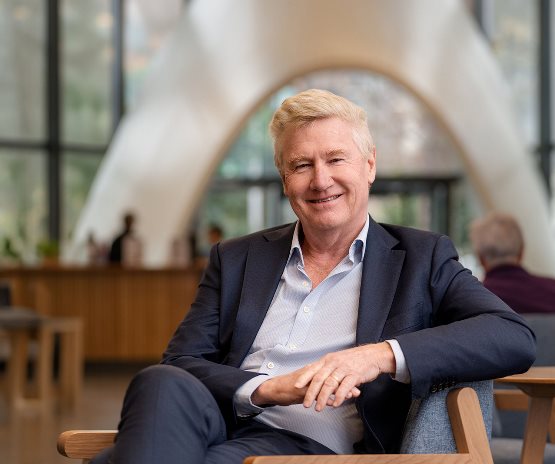
Professor Stephen Jane retires after helping build a research ecosystem that has transformed clinical trials, advanced patient care and shaped generations of clinician-scientists at Monash and The Alfred.
From the creation of Victoria’s newest cancer centre serving Melbourne’s south-eastern corridor, to shaping what is now Australia’s leading clinical trials site and a research powerhouse turning over $360 million a year, Professor Stephen Jane leaves an enduring legacy in research and clinical leadership at Monash University and The Alfred.
On the eve of his retirement, he reflects on the environment researchers face today, the importance of surrounding yourself with good people, and the growth of the precinct centred around The Alfred Hospital, where he’s spent most of his career. Steve Jane leaves what is now Monash University’s newest campus, The Alfred, after seven years as Founding Dean of the Sub-faculty of Translational Medicine and Public Health, and more than 40 years as a clinical haematologist and researcher, occupying senior roles at both The Alfred (including as Director of Research) and Monash.
One Direction: Medicine
Raised in North Balwyn, the son of a stay-at-home mum and a dad high up in local government, Steve Jane never set his sights on being a fireman, police officer or footballer: even though there were no doctors in the family, he was set on medicine.
He found his feet as a young doctor with the counsel of three mentors. The pursuit of haematology was influenced by The late Barry Firkin, the first head of the Central Clinical School, “A larrikin — brilliant, but personable and incredibly supportive”.
The young Steve wanted to make a contribution, and realised the best environment for this was a hospital, not private practice. Professor Emeritus Hatem Salem, the founder of the Australian Centre for Blood Diseases (ACBD), advised him that if he wanted to build a career in the public system, he would need academic training. So he found himself sharing lab bench space with another young haematologist and physician by the name of Christina Mitchell. A third mentor at this time was Abe Chachoua, a larger-than-life haematology registrar who could have walked straight off the pages of The House of God, the 1970s classic — scandalous at the time — about surviving a gruelling hospital internship. Steve’s self-professed idolisation of Abe was not out of place in the freewheeling lab culture of the 1980s. “People would be smoking at the bench, and mouth-pipetting acrylamide (a potent neurotoxin),” he says. “You’d knock off and have a beer, and then come back into the lab and do some other work.”
The Alfred’s international ranking as one of the world’s top 50 hospitals is precisely because of its academic relation with Monash, and the strength of evidence-based medicine here.
A precinct where research meets care
Over the next decades, Steve and his fellow lab rat ascended the ranks (Professor Chris Mitchell also retires this year, as Executive Dean of the Faculty of Medicine), presiding over substantial growth in Monash’s research footprint.
During his tenure as Head of the Central Clinical School from 2011 and then Dean of the Sub-faculty from 2019, Steve recruited 300 scientists, including numerous people who are today heads of department, and established Australia’s first dedicated academic departments of Diabetes and Neuroscience. He established the Alfred-Monash Clinical Trials Program, which has now supported more than 700 trials at the Alfred precinct, bringing in annual revenue of $30m. The Trial Hub program from 2020-2026 created a template for bringing cancer trials to regional areas. And in 2024, what started as an exercise to find a dedicated space for cancer trials became the $150m Paula Fox Melanoma and Cancer Centre, once state and federal governments and donors came on board. His own dual Monash-Alfred appointment was an experiment in health service and academic collaboration: joint appointments eventually became the norm for director roles in the precinct.
Incoming Dean, Professor Terence O’Brien, praised a generous mentor of “energy, determination and diplomatic skill”, and said one of the critical ingredients of his success was his own research excellence. A cutting edge molecular scientist with a special interest in genomics and experimental haematology, Steve produced more than 100 peer-reviewed papers on developmental and acquired blood disorders, epithelial development and gene regulation, in high-impact journals such as Nature and The Lancet.
“I don't think I was ever brilliant,” Steve says. “I think I was dogged. I've always been somebody who doesn't like to get caught up in red tape. If there's a job to be done, I like to do it — or I want the person I've asked to do it, to do it.”
It helped that he and longstanding former Alfred Health CEO Andrew Way (who stepped down in 2024), shared a vision for research integration between hospital and university, an unwavering belief that tight partnership benefits both organisations, with research, clinical trials and education embedded in clinical practice. “Andrew and I had identical philosophies, with him having come from the English system very much attuned to academic health science centres,” he says.
“The Alfred’s international ranking as one of the world’s top 50 hospitals is precisely because of its academic relation with Monash, and the strength of evidence-based medicine here. It’s embedded in the culture too — I think we all consider ourselves as Alfred and Monash, Monash and Alfred.”
But asked who he’d barrack for if Monash and The Alfred were ever to set up rival football teams, he first splutters at the unfairness of the question, then sensibly declines to answer.
Building a culture of discovery and translation
The Central Clinical School’s name change in 2024 to The School of Translational Medicine captured the energy of a precinct where even full-time scientists are constantly around clinicians and gravitate towards clinical challenges in their research.
“Someone like [Associate Professor] Ross Dickens [ACBD] is a fantastic example,” Steve says. “Ross, an absolute card-carrying basic scientist, has a fantastic commercial program that's going to be transformational.
“I'm not sure he would have done that in another institution," he says. "Not because Ross isn't brilliant — he is. But this is the culture of the place: to discover and translate that discovery, for patient benefit.”
A personal highlight of his leadership roles has been witnessing excellence beyond haematology. “As a leader, you have to be very careful about carrying a card for a particular discipline, and everyone’s looking at you thinking that’s where your preferences lie.
‘But what I saw and learned from other disciplines that I wouldn’t have been exposed to otherwise, was just as spectacularly good.”
Terry O’Brien, who was recruited to set up the Department of Neuroscience in 2018, spoke of Steve’s commitment to people. “Steve has long understood that institutions become outstanding by identifying exceptional people, both internally and externally, and providing them with an environment and support they need to succeed.”
He’s proud to have been a key player in Australian medicine’s growth story. “You can actually get the very best healthcare in the world here, and not pay a cent for it.
“If you're sick, go to The Alfred. We have outstanding clinicians in virtually every discipline. That's an amazing thing, and so different from so many other countries.”
He departs having helped establish the precinct as a premier destination for imaging clinical trials and a leader in the adoption of artificial intelligence in healthcare.
The education teams will miss his annual slide at the Honours recruitment night, showing the Alfred surrounds as part of a vibrant, happening precinct, in contrast to the bleakest industrial streetscape he could find to show students why they should pick The Alfred over Clayton.
Challenging times for medical research
Steve will soon take on a board role at Monash Health, with others in the pipeline. He’s looking forward to travel, cooking, reading and enjoying his two grandchildren. He knows he is leaving a troubled sector. Research, he says, has always been a much more uncertain path than clinical practice, especially the failed experiments and lack of reinforcing feedback from patients. But times are even harder now amid stagnating research funding.
“At one stage I held six NHMRC grants, and that would be completely unheard of now,” he says. “An enormous amount of effort is put in by many people to try and get funding for their research. They spend more time doing that than they actually do at the bench doing their research. It really is a very tough environment now.”
Nonetheless, he’s relished the leader’s mandate to enable, elevate and celebrate colleagues, especially emerging researchers. Steve identifies succession planning as one of the precinct’s strengths. He reels off a list of senior academic researchers who could easily have succeeded him as Dean, but, “I couldn't be happier passing the baton to Terry [O’Brien, current head of school].”
“To bring in all those fantastic people, see them all thrive and flourish ... we've had a remarkable success rate in terms of the people. There's no question it makes you look better when you surround yourself with bloody good people.”