
Chemical waste labelling and disposal
This page provides guidance on labelling, segregating and safely disposing chemical waste at Monash University, in line with:
- Environmental Protection Act (2017)
- AS/NZS 2243.2 Safety in Laboratories: Chemical aspects and storage (2021)
- Using Chemicals Procedure.
Chemical waste disposal must be considered in the relevant risk assessments and chemical waste disposal processes must be established before starting work.
Heads of units and supervisors are responsible for ensuring that staff and students dispose of chemical waste appropriately. This includes developing procedures for your area, communicating requirements and providing training.
If you need help, Safety Officers for your area can also advise on safe disposal practices.
Segregating waste
Chemical waste must be segregated according to its physical and chemical properties. Mixing incompatible materials can cause toxic gas release, explosions or other serious safety risks.
Information regarding the reactivity of chemicals, incompatibilities and segregation requirements can be found in their Safety Data Sheet (SDS) (sections 7 & 10). You can look up SDSs in Chemwatch.
Labelling chemical waste
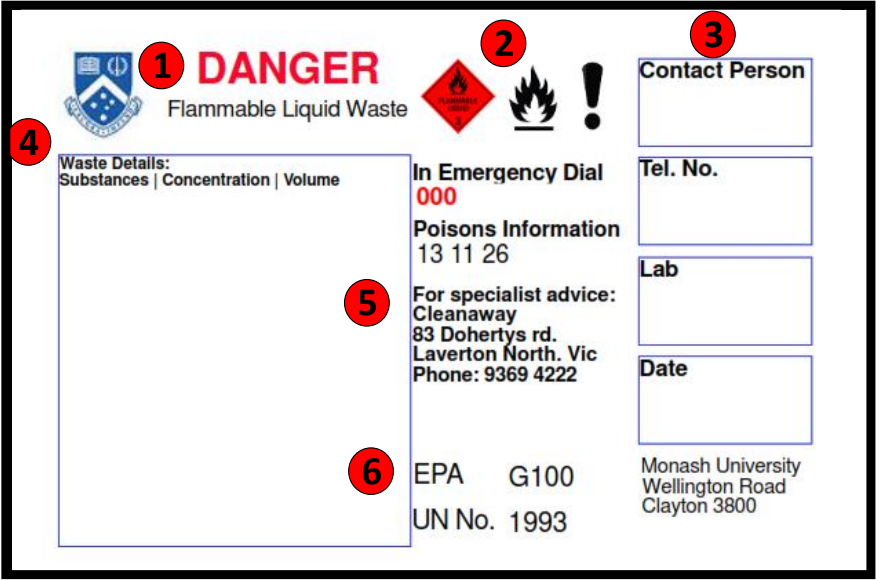
All chemical waste containers must be clearly labelled. Labels are available from chemical stores, or find the label you need in the Waste Types, Descriptions and Labels table below and print them on an Avery template.
Reusing chemical containers is discouraged due to the risk of violent reactions between incompatible residual chemicals. Clean containers for chemical waste collection are available from Monash Stores and should be used where possible.
If you’re reusing a chemical container for waste:
- only use the container for the same chemical or a compatible chemical waste
- make sure you remove or deface the original label and affix a new waste label
Labels must include:
- Signal word: DANGER, WARNING or CAUTION.
- Pictograms: Picture of the hazard type and class.
- Name and contact details of the person who completed the label, including phone number and laboratory.
- Waste description, including substances, concentration and volumes where possible.
- Specialist information: Contact details of waste contractor, and contact details for specialist advice.
- EPA transport codes: Required to transport dangerous goods (DGs) in Victoria.
Waste classifications and labels
Before you label and dispose of the chemical waste, you’ll need to know which waste stream is applicable. At Monash, chemical waste streams align with Dangerous Goods classifications and are designed to prevent mixing of incompatible chemicals. For example, mixing between acids and alkaline chemicals.
Once you identify the correct waste stream in the table below , download and print the corresponding label.
Common waste types at Monash are also included in the Chemical Management Poster.
Disposing of chemical waste
Empty chemical containers
Empty chemical containers, including laboratory glassware, must not be disposed of via general or recyclable waste streams and must be treated as chemical waste.
Disposal
Before you can dispose of chemical waste, including empty chemical containers, it must be:
- correctly labelled
- stored in a suitable container
- housed appropriately until collection.
The disposal method is through an EPA-licensed waste contractor arranged through Monash Stores – this ensures safe and environmentally responsible disposal off-site. Regular collections can be arranged with the contractor.
For advice on classification and handling, contact your Safety Officer, supervisor, Monash Stores or Cleanaway (1300 66 77 87).
Treating waste at the source and waste to sewer
Some waste may be treated in-house, but only if it is safely converted s into a non-hazardous product. Hazardous waste must never be poured down the sink or disposed of by dilution.
Need help?
For more information, contact the Health, Safety & Wellbeing team by email at hsw@monash.edu.
Procedures and resources
Waste Types, Descriptions and Lavels
| Waste type | DG Class | Description | Clayton | Parkville |
|---|---|---|---|---|
Flammable liquids | 3 | Includes solvents such as acetone, ethanol and acetonitrile, mixtures and by-products from synthetic reactions. Sometimes, volatile solvents are mistakenly thought to be flammable. Refer to the SDS for verification. | ||
Flammable solids | 4.1 | These are solid materials that undergo rapid combustion or are self-reactive. Aluminium powder and other metallic powders are flammable solids. | ||
Spontaneously combustible | 4.2 | These materials will start to combust when they come in contact with air. White phosphorus is spontaneously combustible, as are some forms of activated carbon. | ||
Dangerous when wet | 4.3 | These are materials that combust or give off toxic vapours when they come into contact with air (e.g. sodium). | ||
Oxidising agent | 5.1 | Includes nitrates such as ammonium nitrate and chlorates such as calcium hypochlorite. | ||
Toxic substances | 6.1 | Includes acrylamide, ethidium bromide, phenol/chloroform, cadmium and mercury batteries, mercaptoethanol waste, solid paraformaldehyde and other toxic wastes. | ||
Halogenated solvent | 6.1 | Generally, these have chloro-, bromo- or fluoro- atoms attached. Any contaminants must be identified on the label. | ||
Contaminated glassware | 6.1 | Glassware that has been contaminated with chemicals and needs to be disposed of. | ||
Fixative waste | 6.1 | Typically, this waste is generated by histology processes. | ||
Solid waste (contaminated) | 6.1 | These are lab consumables with chemical contamination. It includes gloves, paper towels, tubes, etc. | Solid Waste (Contaminated) 1x2 | Solid Waste (Contaminated) 1x2 |
Cyanide | 6.1 | Due to the potential to generate highly toxic Hydrogen Cyanide, waste containing cyanide should have its own waste stream. | ||
| Picric Acid, wetted with not less than 30% water, by mass | 4.1 | Picric acid is safe under most circumstances when wetted with not less than 30% water. If the water is allowed to evaporate, the crystals that form are shock-sensitive and can become explosive. Contact the Health, Safety & Wellbeing team for advice on disposal of dried out or crystalised form of the substance. | ||
Biohazardous waste | 6.2 | Includes bio-medical wastes, sharps, quarantine wastes and waste from work with Genetically Modified Organisms (GMOs). Biohazardous waste is disposed of in accordance with the Using Biologicals and Animals Procedure. | ||
| Radioactive waste | 7 | Radioactive waste is disposed of in accordance with the Using Ionising Radiation Procedure. | ||
Corrosive acid waste | 8 | Includes acids, which can be sufficiently volatile to give off vapour that is irritating to the eyes and nose. Some acids are incompatible with other acids and should not be mixed. | ||
Hydrofluoric acid | 8 | This acid is extremely toxic and requires its own waste stream. | ||
Nitric acid | 8 | This acid is a strong oxidiser and should not be mixed with other chemical waste, where possible. | ||
Alkaline waste | 8 | Includes alkalis, which can be sufficiently volatile to give off vapour that is irritating to the eyes and nose. | ||
Miscellaneous chemical waste | 9 | Includes chemical waste that falls under the miscellaneous dangerous goods classification, and other chemical waste. | ||
Combustible liquid | 9 | These are liquids that will burn, but are not volatile as to be classified as flammable, e.g. diesel and some motor oils. | ||
Cytotoxic waste | N/A | Cytotoxic waste is material or drugs which are harmful to living cells or carcinogenic, mutagenic and/or teratogenic. Cytotoxic waste includes cytotoxic waste chemicals and materials associated with their use, such as needles, syringes, intravenous appliances, ampoules, vials, gloves and swabs. All Cytotoxic waste is to be identified by appropriate mauve coloured bags or containers with the telophase symbol. EPA-licensed waste disposal contactors and transporters must be used and each waste load is to be accompanied by an on-line “wastecert” transport certificate. | ||
| Blank labels | N/A | This waste stream is to be used for unusual waste that falls outside the normal waste streams. Additional details will need to be added by the person that generates the waste. | Blank 1x2 Blank 2x2 Blank 2x5 | Blank 1x2 Blank 2x2 Blank 2x5 |
Avery label templates
All labels can be printed out on Avery label templates.
| Size | Re-order number | Software code |
|---|---|---|
| 1x2 | 959008 | L7168 |
| 2x2 | 959030 | L7169 |
| 2x5 | 959031 | L7173 |