
Managing psychosocial risk at Monash
Why managing psychosocial risk matters
Unmanaged psychosocial hazards can increase the risk of psychological injury and negatively affect safety, wellbeing and performance.
They can also contribute to higher rates of absenteeism, turnover, conflict, errors and injuries.
Managing psychosocial risk helps to:
- protect the health and safety of staff
- support sustainable work practices
- improve engagement, performance and retention
- meet legal obligations under occupational health and safety legislation
Legal requirements in Victoria
Under the Occupational Health and Safety Amendment (Psychological Health) Regulations, employers must, so far as is reasonably practicable:
- identify psychosocial hazards arising from work
- assess the risks associated with those hazards
- implement and review control measures to eliminate or reduce risks
- consult with workers and health and safety representatives
These duties build on existing obligations under the Occupational Health and Safety Act and align with national and international guidance on psychological health and safety at work.
How Monash manages psychosocial risk
Monash applies a risk management approach consistent with occupational health and safety principles.
Risk assessment model
You’ll use the standard risk management model to guide your assessment:
- Identifying hazards
- Assessing the likelihood of harm
- Controlling the risks
- Monitoring and revising controls
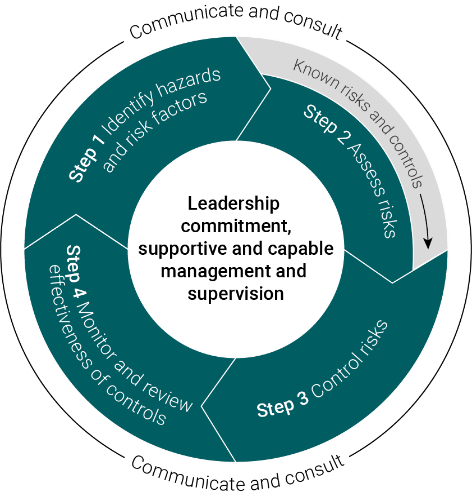
Risk management model
1. Identify hazards
Psychosocial hazards may be identified through:
- consultation with staff and Health and Safety Representatives
- incident and hazard reports
- staff surveys and feedback
- workload, role or change reviews
- analysis of trends (e.g. turnover, absenteeism, complaints)
2. Assess risk
Identified hazards are assessed to understand:
- the potential impact on health and safety
- who may be affected
- contributing factors (e.g. workload, systems, environment)
Monash is implementing a Psychosocial Risk Assessment Tool with the guidance and support of the Psychosocial Specialists to support consistent assessment across faculties and divisions. Contact psychosocial@monash.edu for more information.
3. Control risk
Where risks are identified, Monash focuses on system-level controls, such as:
- redesigning work or workloads
- clarifying roles, responsibilities and expectations
- improving systems, processes or resources
- strengthening leadership capability and support
- improving communication, consultation and change management
A Psychosocial Hazards Control Library (pdf) is available to guide selection of appropriate controls.
4. Review and improve
Control measures are reviewed to ensure they remain effective, particularly:
- after incidents
- following significant organisational change
- when new hazards are identified