
David de Kretser Medal and Lifetime Achievement Medal awarded for 2024
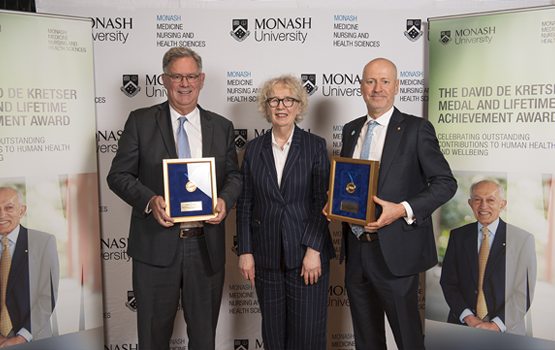
Professor John Bertram, Executive Dean Professor Christina Mitchell AO and Dr Doug Hilton AO.
A renowned researcher in kidney developmental biology and the head of Australia's national science agency CSIRO have been awarded the faculty's highest honours for 2024. Professor John Bertram was awarded the David de Kretser Medal and Dr Doug Hilton AO was awarded the Lifetime Achievement Medal at a ceremony held at the Chancellery at Monash University's Clayton campus yesterday evening. The ceremony was hosted by Executive Dean of Monash Medicine, Nursing and Health Sciences Professor Christina Mitchell AO and attended by special guests.
The David de Kretser Medal celebrates the exceptional contribution of a staff member to any area of the faculty's operation over a significant period of their working life. The Lifetime Achievement Medal recognises a person who has made an outstanding contribution to human health and wellbeing, nationally and internationally. The faculty established the awards in 2006 and bestows them annually.
Professor John Bertram
Professor John Bertram is internationally recognised for his outstanding research contributions in kidney developmental biology, developmental origins of chronic kidney disease and hypertension, stereology and imaging. He has shown that low nephron number in kidneys is linked to high blood pressure and kidney disease in animals and several human populations. These findings have contributed to initiatives to develop approaches for the non-invasive imaging and counting of glomeruli, which is anticipated to improve clinical management of people with, and at risk of developing, kidney disease and hypertension. He has also played significant roles in the mentorship of young students and scientists.
In 1998, Professor Bertram was appointed the Chair of the Department of Anatomy at Monash and served as its head until 2016. Under his leadership, the department was renamed Anatomy and Developmental Biology, Australia's first Bachelor of Science major in developmental biology was introduced, the Centre for Human Anatomy Education was established, and departmental researchers were relocated into new state-of-the-art research laboratories. The department grew to be one of the largest in the faculty, with close to 30 research groups with a broad focus on developmental biology. A feature of Professor Bertram's leadership was also the recruitment and promotion of women.
Professor Bertram has more than 300 publications to date and >18,000 citations, and has been awarded more than $29 million in research funding, including two grants from the National Institute of Health and numerous National Health and Medical Research Council grants. He has supervised more than 30 PhD students, three of whom have gone on to achieve professorial positions. Professor Bertram's expertise in stereology was recognised with his election as President of the International Society for Stereology (2000-2003). He chaired the International Congress of Stereology in Melbourne in 1999 and the X1th World DOHaD (Developmental Origins of Health and Disease) Congress in Melbourne in 2019.
Professor Bertram has also been awarded the Neale Prize by the Australian and New Zealand Society for Nephrology, the President's Medal from the Australian and New Zealand Society for Cell and Developmental Biology, and in 2019 was elected a Fellow of the Australian Academy of Health and Medical Sciences. Professor Bertram has also been inducted into the Monash University Vice-Chancellor's Honour Roll.
Dr Doug Hilton AO
Dr Doug Hilton AO is a molecular and cellular biologist and the current Chief Executive of CSIRO, Australia's national science agency. He was previously the Director of the Walter and Eliza Hall Institute of Medical Research (WEHI), where his medical research focused on understanding how blood cells communicate and using this knowledge to improve disease treatments.
Dr Hilton was also previously the head of the Department of Medical Biology in the Faculty of Medicine, Dentistry and Health Sciences at the University of Melbourne, where his research team held more than 20 patents and translated their research through collaboration with venture capitalists and the biopharmaceutical industry. He is also the immediate past President of the Association of Australian Medical Research Institutes (AAMRI).
He is best known for his discoveries in cytokine signalling, his advocacy for health and medical research and his work on gender equity in science. His research aims to understand which of the 30,000 genes are important in the production and function of blood cells and how this information can be used to better prevent, diagnose and treat blood cell diseases such as leukaemia, arthritis and asthma.
Dr Hilton has been awarded numerous prizes for his research into how blood cells communicate and has led major collaborations with industry to translate his discoveries from the bench to the bedside. He is an inventor of more than 20 patent families, most of which have been licensed, and is a co-founder of the biotechnology company MuriGen.
Dr Hilton was appointed the Officer of the Order of Australia in the Queen's Birthday 2016 Honours List for distinguished service to medical research and education, particularly in the field of haematology, as a molecular biologist and author, to gender equity, and as a mentor of young scientists. He is a Fellow of the Australian Academy of Science, the Academy of Technological Sciences & Engineering, and the Australian Academy of Health and Medical Sciences. He also received the 2023 NHMRC Outstanding Contribution Award.
Through an honorary appointment in the School of BioSciences at the University of Melbourne, Dr Hilton also studies a family of tiny day-flying moths involved in the pollination of Australian plants. Beyond his research endeavours, Dr Hilton has emphasised the importance of strong institutional cultures and promoted diversity in science as a member of the Champion of Change Coalition and a board member of Australians Investing in Women.
Executive Dean of Medicine, Nursing and Health Sciences Professor Christina Mitchell AO warmly congratulated both recipients. “It’s my great pleasure to award Professor Bertram and Dr Hilton our faculty’s highest honours,” she said. “Professor Bertram has made a significant contribution to Monash Medicine Nursing and Health Sciences with his innovative leadership in anatomy and developmental biology, and his championing of women in research. Dr Hilton has had a remarkable career and has been a passionate advocate for health and medical research. We’re delighted to recognise and celebrate these two outstanding members of our community.”
About Professor David de Kretser AC
Professor David de Kretser AC, with his many accolades and significant contribution to the field of male fertility, is an inspiration to many health and medical researchers. It is fitting that Monash Medicine, Nursing and Health Sciences premier award to a staff member bears the name of such a distinguished academic. Professor de Kretser is a reproductive endocrinologist whose appointments at Monash University included Professor of Anatomy, the founding director of the Monash Institute of Medical Research and the Associate Dean for Biotechnology Development. In 1991, he established the Monash Institute of Reproduction and Development, which is now known as the Hudson Institute of Medical Research. For many years, he participated in the World Health Organization Special Program in Human Reproduction, which utilised his teaching skills in many countries. Following a term as the 27th Governor of Victoria from 2006 to 2011, he returned to Monash to pursue research as a Sir John Monash Distinguished Professor.
Find out more about the David De Kretser Medal and Lifetime Achievement Medals.
About Monash University
Monash University is Australia’s largest university with more than 80,000 students. In the 60 years since its foundation, it has developed a reputation for world-leading high-impact research, quality teaching, and inspiring innovation.
With four campuses in Australia and a presence in Malaysia, China, India, Indonesia and Italy, it is one of the most internationalised Australian universities.
As a leading international medical research university with the largest medical faculty in Australia and integration with leading Australian teaching hospitals, we consistently rank in the top 50 universities worldwide for clinical, pre-clinical and health sciences.
For more news, visit Medicine, Nursing and Health Sciences or Monash University.
MEDIA ENQUIRIES