
Mental health carers: recognising lived experience to provide better support
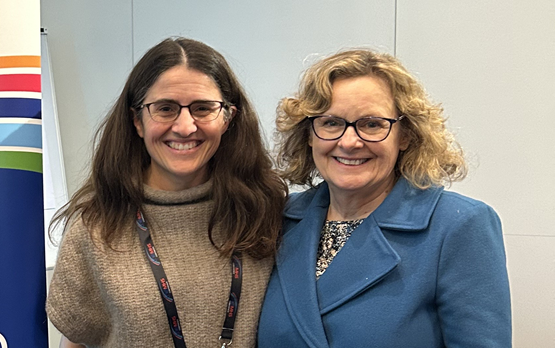
Associate Professor Melissa Petrakis and Caroline Walters.
More than 240,000 Australians care for someone with mental health challenges, providing up to $13.2 billion worth of unpaid care annually. Their efforts have mostly been unrecognised and undersupported, and never more so during the COVID-19 pandemic, when they had little choice but to provide higher levels and increased hours of support in their own homes during prolonged periods of reduced mental health service provision.
Monash Social Work researchers from the Social Work Innovation, Transformation and Collaboration in Health (SWITCH) Research Group, led by Associate Professor Melissa Petrakis, recently undertook research that further uncovered the costs of this support. Through a grant from the National Mental Health Commission, the National Mental Health Consumer & Carer Forum commissioned SWITCH to co-create an evaluation of the impact of the COVID-19 pandemic on the experiences and mental health and wellbeing of family, carers and supporters of people with mental health challenges – one of ten vulnerable populations identified in the National Mental Health Pandemic Plan.
Co-designed and co-lead research
In conjunction with representatives of national and state mental health organisations, they conducted co-designed and co-produced online focus groups with 73 family carers representing diverse communities and ages. Six themes emerged as a result: service users’ experiences during the COVID-19 pandemic, the effects of system failures and service provisions, the impact on carers’ health and wellbeing, unmet community needs, responsive innovations and policy and practice recommendations.
The researchers made ten recommendations to government as a result, including a short-term recommendation to fund available and responsive carer respite and longer-term recommendations to establish carer hubs and suicide prevention services in recognition of the acute and cumulative stress and distress that carers can experience. The research has since been recognised with two awards, including an Australia and New Zealand Social Work and Welfare Education and Research award in 2023 and an MHS Learning Network Mental Health Services Award in 2024. “This family carer and consumer-initiated and led project has resulted in publications and a dissemination process that closely and authentically speaks to the lived experience of mental health carers throughout the pandemic,” said Associate Professor Petrakis. “Service managers, policymakers and researchers must hear directly from family carers, describing experiences and needs in their own ways and in their own voices; as these voices matter.”
Advocating for a national carer peak body
The research was only part of the advocacy efforts made by SWITCH, in collaboration with their colleagues across the sector, to ensure mental health carers' voices are clearly heard and their unique needs as carers, and as citizens with human rights no less, are now better met. Associate Professor Petrakis was Chair of the Board of Tandem, the Victorian state mental health carers peak body, during the pandemic years and a member of Mental Health Carers Australia (MHCA) when, as a collective of state board chairs of peaks, they advocated for the Commonwealth Government to fund a national carer peak, in addition to funding a consumer peak, for people with lived and living experience of mental health challenges and psychosocial distress.
At that time, the vision for a national peak was re-forged, including the membership model, organisational structure, and focus, kickstarting a process that had stalled for a decade due to political inaction. Their advocacy efforts were finally realised in January 2023 with the establishment of Mental Health Carers Australia, an independent national peak body that is solely concerned with the wellbeing and promotion of the needs of mental health carers, family and kin. “The SWITCH Research Group’s research was a key contributor to the advocacy that Mental Health Carers Australia used in establishing their case to be the preferred provider,” said Associate Professor Petrakis. “My colleague Caroline Walters, a PhD candidate in SWITCH, has continued to strengthen and deepen ties with national partners through her doctoral research on engaging families with mental health reform, which is extending what was possible beyond what was only nine months of funding for the original project.”
New carer wellbeing centres
In Victoria, SWITCH's efforts also contributed to the establishment of eight Mental Health and Wellbeing Connect centres across Victoria as a result of a recommendation from the Royal Commission into Victoria’s Mental Health System. Associate Professor Petrakis facilitated opportunities for carers across the state to speak with commissioners during the pandemic lockdowns of 2020 and outline their own wellbeing needs beyond their caring roles. Her commitment to making sure that carers and families were respected as partners in the support they provide mental health consumers was instrumental to the Commission’s rethink of how information and support are delivered, moving from providing support to carers via the consumer’s service provider only, to establishing carer wellbeing centres that provide support and information to carers in their own right.
"Carers have often been the last people to receive the information they need to best support their loved one, due to regulations that rightly protect the privacy and agency of the mental health consumer,” said Associate Professor Petrakis. “However, they still have the right to basic information that supports them in their role, such as knowing about medication side effects, diagnoses and treatment options, or service system navigation. Carers have often had their own experience of harm and distress in their interactions with the mental health system due to a lack of information and support that directly addresses their needs. We are delighted that SWITCH’s research and advocacy efforts helped to make Mental Health and Wellbeing Connect centres a reality for mental health carers across Victoria.”
Making mental health care 'kind'
SWITCH will soon wrap up 12 industry-partnership research studies carried out over the past five years, covering topics such as implementing recovery-oriented practice in clinical settings, developing dual diagnosis competencies for clinicians working in mental health and alcohol and other drugs settings, and LGBTIQA+ responsiveness in healthcare. Beginning in 2025, SWITCH will embark on further research to improve the quality of care for consumers accessing the mental health system, such as exploring how the built environment impacts mental health care delivery, and developing initiatives that challenge the use of current restrictive practices in mental health care settings to ensure that spaces are safe, and interactions are conscious, careful and, at their essence, kind.
Associate Professor Petrakis says that making mental health service delivery ‘kind’ for people is critical, as workers typically train and enter the field with ambitions to use their full self and skillset to help people, yet enter a resource-constrained system that eventually renders them time-poor, stressed and risk-averse. “A kindness mindfulness would revolutionise care, lessen shame and stigma, reduce readmissions, and lead to the type of world-class mental health system envisioned by the people of Victoria through the Royal Commission process,” she said. “We have the opportunity to reimagine together and codesign and deliver the safe, caring, respectful, engaging, hopeful and curious, and responsive system that everyone deserves to have available to meet them at times of mental overwhelm or distress.”
Find out more about the SWITCH Research Group
About Monash University
Monash University is Australia’s largest university with more than 80,000 students. In the 60 years since its foundation, it has developed a reputation for world-leading high-impact research, quality teaching, and inspiring innovation.
With four campuses in Australia and a presence in Malaysia, China, India, Indonesia and Italy, it is one of the most internationalised Australian universities.
As a leading international medical research university with the largest medical faculty in Australia and integration with leading Australian teaching hospitals, we consistently rank in the top 50 universities worldwide for clinical, pre-clinical and health sciences.
For more news, visit Medicine, Nursing and Health Sciences or Monash University.
MEDIA ENQUIRIES