
Enabling Technologies in Medicine: Reflections from the 2025 GAME TEI Future Leaders Summit
Monash Prato Campus, Italy | June 22–24, 2025
 The 2025 Global Alliance of Medical Excellence (GAME) Transnational Education Initiative (TEI) Future Leaders Summit brought together nearly 50 medical, nursing, pharmacy and public health students and faculty from the eight GAME partner universities across three continents. Hosted by Monash University's Faculty of Medicine, Nursing and Health Sciences, at the Monash University Prato Campus in Tuscany, the summit explored the theme “Enabling Technologies in Medicine”, offering an immersive, interdisciplinary, and cross-cultural experience for the next generation of healthcare leaders.
A Collaborative Vision for the Future
Kicking off in May with a virtual forum, students began their collaboration by assessing the promise and pitfalls of emerging technologies, sharing experiences from their diverse institutions—including some of the world’s oldest and newest medical schools. This pre-summit work laid the foundation for robust discussions on-site in Italy.
During three intensive days in Prato, participants worked in transnational, cross-disciplinary groups to examine how AI, robotics, simulation and other enabling technologies are reshaping healthcare education and practice. Sessions spanned ethical, legal, human rights, and geopolitical considerations, and included hands-on workshops in simulation and medical robotics.
Summit Highlights
Day 1 featured warm welcomes, icebreakers, and student-led presentations introducing their universities’ approaches to technology in health education. Students then split into working groups for interactive sessions:
- Simulation Workshop: Communication in the Age of AI – Using VR and video scenarios, students reflected on the critical role of human connection in tech-enabled medicine.
- Ethical, Legal and Geopolitical Implications – Faculty led discussions on legal frameworks, human rights, and geopolitical risks associated with biomedical technologies, challenging students to think beyond the lab or clinic.
Day 2 focused on Robotics in Medicine, with expert-led sessions covering the promise, pitfalls, and curriculum needs of robotic surgery. Students debated what future health courses should include to ensure clinicians are prepared to harness robotics safely and ethically. Parallel sessions continued the deep dive into simulation, ethics, and law.
Faculty sessions ran alongside, fostering collaborative planning for joint research, education projects, and publications spanning simulation, robotics, AI, biodesign, climate and health.
Cultural enrichment was woven into the program with guided walking tours of historic Prato and a lively group dinner featuring a quiz that tested both medical knowledge and cultural awareness.
Day 3 concluded with student groups presenting their analyses of Technology-Enabled Medicine and Medical Education—Pitfalls and Promise. Presentations showcased a striking balance of hope and realism, as students called for curricula that champion technological literacy while fiercely protecting the empathic, human-centred core of health practice.
Key Themes and Outcomes
What emerged most powerfully was the shared recognition that enabling technologies are “two sides of the same coin”. Students acknowledged both the potential to augment care and the risk of dehumanising it. Across cultures and disciplines, their primary concern was maintaining sensory, embodied, and empathic connections with patients, even as practice becomes more digital and automated.
They also demonstrated strong ethical awareness, calling for:
- Affordability and equity – Ensuring technologies do not widen global health gaps.
- Collaborative governance – Developing legal and ethical frameworks that safeguard patients and society.
- Human-centred curriculum reform – Co-creating education that balances tech fluency with communication, ethics, and cultural humility.
The Future in Good Hands
Faculty from participating universities were united in their praise for the students’ critical thinking, curiosity, and moral clarity. As Professor Michelle Leech AM, Deputy Dean (Medicine) at Monash University reflected, “our worries are their worries more than we realise. They are both vulnerable and powerful at the leading edge of these changes.”
“It was remarkable to see such diverse students from around the world so aligned in their commitment to human-centred care. Even as we explore AI, robotics and other enabling technologies, these future health leaders reminded us that empathy, ethics and connection must stay at the heart of medicine,” she said.
By Summit’s end, bonds had formed across continents, laying the groundwork for future alumni connections, research partnerships, and lifelong professional collaboration. The event closed with certificates of participation, shared reflections on impact, and a commitment to stay connected through the broader GAME network.
Professor Leech went on to say, “The Summit showcased the power of bringing together students and educators from different cultures and disciplines. Their discussions highlighted that the challenges of technology in healthcare are global, but so are the solutions when we work together.”
As these students return to their universities in Korea, Hong Kong, Germany, Sweden, Italy, Japan, the UK and Australia, they carry forward a shared vision: to harness enabling technologies not simply for efficiency, but in the service of caritas—deep, compassionate care for all.
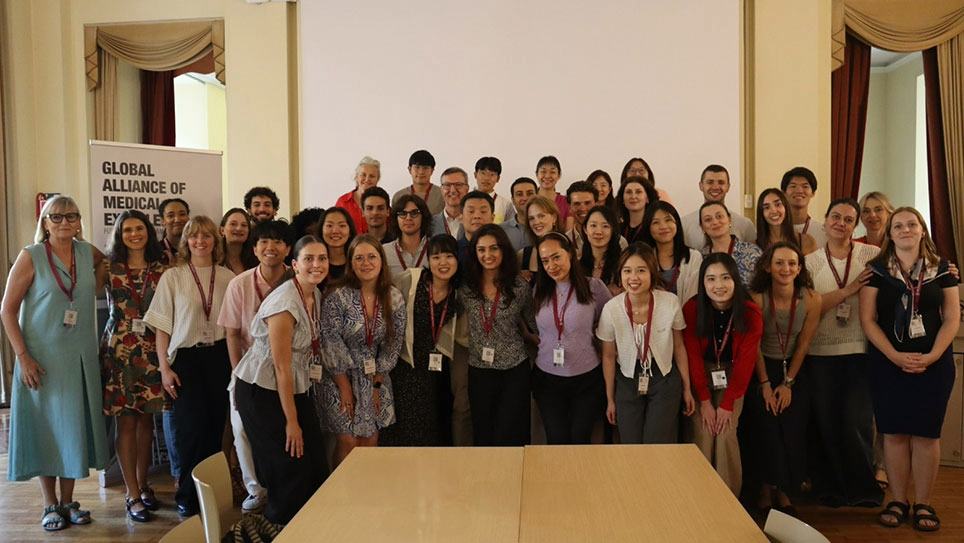 28 students and 17 faculty from 8 GAME universities met in Prato for a 3 day Future Leaders Summit.