
Fulbright scholar David combines bioethics and public health to better manage the ethics of future health crises
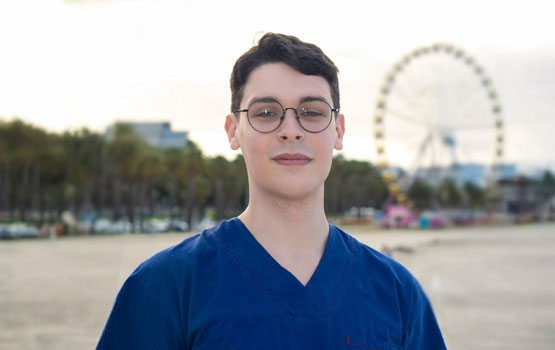
Dr David Motorniak
2025 Fulbright Anne Wexler Scholar Dr David Motorniak; early career doctor, alumnus, public health researcher and bioethics academic; was studying medicine at Monash right when the COVID-19 pandemic hit. Gripped by the impact of lockdown restrictions and needing to see a fresh approach, David deferred his medical degree to do an online Honours year with the Oxford-Monash Bioethics Program.
“I was already interested in political philosophy and ethics, and there’s such a strong focus on social justice, public health and the social determinants of health in the Monash medicine course,” David said. “So doing the Honours year helped me expand on my clinical education and exercise this more philosophical viewpoint on modern healthcare and what the future might hold. Right from the start, I was challenged to consider and explore the ethical dimensions of public health interventions, as well as the topic of my thesis, the moral implications of imposing lockdowns based on age”.
David also took the opportunity to put himself right on the frontline of Victoria’s COVID-19 response by applying for a role as a Public Health Officer, and saw the impact of Melbourne’s lockdowns up close. He took phone calls from the public dobbing in lockdown breaches. He made painful phone calls to shut down people’s businesses and to order people to isolate from their families. He also found himself the subject of outraged calls to talkback radio, naming him publicly and criticising the decisions he’d made to protect the public. He took a phone call from a young man trapped interstate seeking permission to enter Victoria to attend his mother’s funeral, an experience that David found profound and formative.
“I learned that public health policy, which wasn’t always made clear to the public and had been developed without obvious ethical scrutiny, had huge moral costs and could drastically change people’s lives,” David said. “But I also saw that these difficult decisions are always going to happen when the public’s health is at risk in such an enormous way. So, I realised that my greatest public duty as a doctor might actually occur away from the bedside, in looking into these big ethical questions.”
When the pandemic eased, David completed his Doctor of Medicine, winning the Sophie Davis Memorial Prize as the highest-performing student of his cohort, and revisited the Uehiro Oxford Centre for Practical Ethics to research the ethics of novel restrictive public health interventions. Having been stunned by the pandemic, he decided to continue focusing on responding to emerging public health challenges, and took on further studies with a Master of Public Health & Tropical Medicine alongside full-time clinical work.
“During my Masters, I saw that we’re going to continue facing these ethically demanding public health challenges that may require bold, coercive or unpopular action, be it from the next influenza pandemic, antimicrobial resistance, growing chronic disease burdens and the sustainability of Medicare,” David said. “I’ve also worked as a Teaching Associate in bioethics at Monash, where I’ve been fortunate to see students thinking deeply about their opinions and biases in the healthcare environment. After all of these formative experiences, I’m convinced that continuing to pursue ethics in public health is an important step forward for me.”
This conviction led David to successfully apply for the Fulbright Anne Wexler Scholarship in Public Policy for 2025, a prestigious annual foreign exchange scholarship that fosters Australian-American relations in the field of public policy. The opportunity to study a Master of Bioethics in the United States, at a university he’s yet to select, will help him form the knowledge base, relationships and networks that will support his plans for a joint career as a public policy advocate and a clinician-researcher at the intersection of public health and bioethics. “There will be important ethical questions to consider about generational smoking bans, sugar taxes, pandemic restrictions and climate change action,” David said. “Australia needs to get ready for big, bold action.”
“I think in our eagerness to move on and forget COVID ever happened, we run the risk of not learning the lessons,” he continued. “When the next pandemic arrives, we might need lockdowns again. I want to make sure we have the right frameworks in place to consider important ethical questions about collective safety, liberty and fairness to ensure our responses are effective, responsible and moral.”
Find out more about the Fulbright Anne Wexler Scholarship and the BMedSc (Hons) Oxford-Monash Bioethics Program.
About Monash University
Monash University is Australia’s largest university with more than 80,000 students. In the 60 years since its foundation, it has developed a reputation for world-leading high-impact research, quality teaching, and inspiring innovation.
With four campuses in Australia and a presence in Malaysia, China, India, Indonesia and Italy, it is one of the most internationalised Australian universities.
As a leading international medical research university with the largest medical faculty in Australia and integration with leading Australian teaching hospitals, we consistently rank in the top 50 universities worldwide for clinical, pre-clinical and health sciences.
For more news, visit Medicine, Nursing and Health Sciences or Monash University.
MEDIA ENQUIRIES