
Clinical Trials acknowledged at Awards Ceremony
Congratulations to those who have worked to deliver the PEPTIC and REMAP-CAP trials over the years, both of which were acknowledged in the Australian Clinical Trials Association’s Trial of the Year Awards last night.
The ACTA Awards are held annually on May 20th to coincide with International Clinical Trials Day. The awards honour the remarkable Australians who advance our health system by designing, conducting or participating in ground-breaking clinical trials, and promote the importance of clinical trials and the expertise and complexity of work involved. Trials considered for the award are collaboratively developed, multi-centre, investigator-driven randomised controlled trials that were designed to improve patient-centred outcomes or healthcare delivery.
 PEPTIC was the winner of the Excellence in Trials Statistics Award and also was a finalist in the Trial of the Year Award. REMAP-CAP’s corticosteroid domain was acknowledged with Commendations in both the Trial of the Year Award category and the Excellence in Trials Statistics category. The acknowledgements are testament to the expertise in research methodology, sophisticated biostatistics and clinical trial management we hold in the School.
The PEPTIC trial was led by New Zealand-based Professor Paul Young and his colleagues at the Medical Research Institute of New Zealand (MRINZ). Paul is also a researcher with our Australian and New Zealand Intensive Care Research Centre (ANZIC-RC), and a number of the trial’s co-investigators are embedded within ANZIC-RC. Prof Andrew Forbes from the Biostatistics Unit was the trial’s lead statistician.
The trial used an innovative cluster randomized crossover design to compare two routinely used interventions for stress ulcer prophylaxis, proton pump inhibitors and histamine2 receptor blockers, in critically ill patients admitted to ICU and receiving invasive mechanical ventilation. Utilising registry and other routinely collected data, the trial randomised 26,982 patients from a total of 50 ICUs across Australia, Canada, New Zealand, Ireland and the United Kingdom. It is the largest-ever randomized trial conducted in the intensive care setting, yet at a budget of only $500,000 USD, or 1/10th of a typical large critical care trial; largely because of the registry embedding and the efficiency of the trial design.
They found that while widely-prescribed proton pump inhibitors offer a slight advantage in reducing gastric ulcer bleeds, they were also associated with a slightly increased mortality. Results were published in JAMA in January of 2020, quickly becoming one of the most widely downloaded papers of the year.
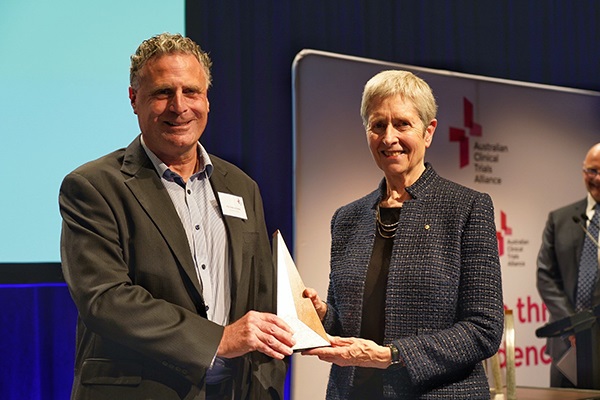 The Excellence in Trials Statistics and the Trial of the Year Finalist awards were accepted by Prof Andrew Forbes and Adj Prof David Pilcher, respectively, on behalf of the PEPTIC team.
A Randomised, Embedded, Multi-factorial, Adaptive Platform Trial for Community-Acquired Pneumonia (REMAP-CAP) mobilized rapidly in 2020 to explore the efficacy of repurposing drugs to treat COVID-19 infections in critically ill people around the world. It is led from the ANZIC-RC, under Perth-based Prof Steve Webb.
A number of drug therapies were, and in many cases continue to be tested, including anti-virals, immune enhancers and convalescent plasma, among others. As of now, more than 7,400 patients have been randomized into the study, from 320 sites around the world. 46 different interventions have or are being trialed, making it an incredibly complex trial both statistically and logistically.
403 participants were randomized to three interventions in the corticosteroid domain: a fixed 7-day course, treatment only when shock was clinically evident, and no treatment with corticosteroids.
Preliminary results, printed in JAMA, demonstrated a 93% and 80% probability of benefit on the primary outcome of organ support-free days at day 21 for the fixed-duration and the shock-dependent course, respectively, when compared with no assigned corticosteroids. For the secondary outcome of in-hospital mortality, there was 54% and 62% probability of benefit across the two steroid-containing regimens, respectively. In the pre-specified subgroup of participants not receiving mechanical ventilation at baseline (n=168), there was a 99% probability that the 7-day fixed course of hydrocortisone was superior to no hydrocortisone with respect to progression to invasive mechanical ventilation, ECMO or death.
The results fed into WHO guidance on administering steroids in this population, along with findings from other international landmark trials such as the RECOVERY trial.
REMAP-CAP is another example of a large-scale, robust trial of statistically complex design, and its findings across other domains such as IL-6 inhibitors have been ground-breaking.
The trial welcomed significant funding from the Minderoo Foundation in May 2020, which enabled them to expand into low- and middle-income countries.