
Central Clinical School celebrates the Day of Immunology
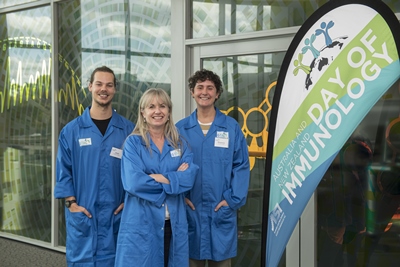
Prof Nicola Harris and PhD students Jesse Mulder and Rhiannon Grant are inspiring the next generation of immunologists
The Day of Immunology is celebrated annually on 29 April, and in Australia the occasion is marked by a series of events organised by the Australian and New Zealand Society for Immunology Inc (ASI).
Central Clinical School (CCS) has been a long-term collaborator in events held in Melbourne, embracing the opportunity to engage with the public and improve their understanding of and interest in immunology.
CCS staff and PhD students supported the delivery of a school workshop at the Gene Technology Access Centre (GTAC) in Parkville, which was attended by around 100 high school students from seven schools.
The program began with a lecture from Central Clinical School’s Professor Nicola Harris entitled ‘Our incredible immune system’.
“You’ve got a really exciting day ahead of you,” Prof Harris enthused. “I wasn’t exposed to the topics you’ll learn about today until my third year at university, let alone high school! But I was your age when I realised how interesting biology was and then later I fell in love with immunology, which I hope you do as well.”
Following the lecture, students had a chance to speak to mentors during a career session, including several PhD students from CCS. Rhiannon Grant said the students were very keen to understand the day-to-day life of a researcher.
“They were very interested in what I do day to day, how often I’m in the lab, the work that I’m actually doing, and why I chose what I’m doing now. They were also quite interested in drug development, how long the process takes – they had a lot of questions around that.”
The students got to see some of the theory they learned in action in the final session, when they participated in a lab project based on a hypothetical outbreak. The students had to prepare bacterial slides to examine through a microscope to identify the bacteria based on its shape. Next, they looked at samples from two asymptomatic patients to learn how to determine when someone is infected with a virus.
“We had a couple of students who were quite interested in learning how what we did today relates to COVID-19 and rapid antigen tests and understanding the theory behind how what we’re doing actually translates into what they’ve been exposed to during the pandemic,” Rhiannon said. “I had another student say they’d seen the theory behind everything we did today, but actually doing it in a hands-on way really heightened their understanding of what was actually happening.”
Ros Clark, a lab technician from Melbourne High School, says days like this are an invaluable opportunity for students. “What I love about bringing the students to GTAC is that they get exposed to real scientists, and they get to use all this equipment we don’t have at our school.
“A lot of our students want to be doctors, so they take biology as a pathway to that, but one of our focuses as science teachers is to help them understand that science is more than medicine and medicine is more than being a GP, and hopefully this will broaden their minds that there are many more areas they can go into.”
This is the second time PhD student Jesse Mulder has been a mentor at the school workshop. He enjoys being able to give students an opportunity he would have benefitted from at their age.
“I wish I had something like this when I was in high school. I didn’t even know immunology existed until well into my undergrad. Towards the end of completing my Bachelor of Biomedical Science at Monash University, I still had no idea what I wanted to do. But when I was looking through the available Honours projects I realised that all the projects that interested me were in immunology. That eventually led to an appreciation for how ubiquitous immunology is, especially in health and disease; everything comes back to the immune system in one way or another.”
Earlier in the week, the Department of Immunology welcomed six members of the public to take a discovery tour of our facilities and learn more about the science in action. During the tour, we demonstrated using light microscopy to investigate how lung tissues and cells can look very different in healthy and pathological conditions. The visitors got to experience different lab techniques, including multi-channel pipetting and performed immunological assays to measure antibody levels in serum samples. The visitors then had a tour of the Monash Micro Imaging (MMI) platform where they were introduced to advanced microscopy and met with the winners of the Monash 2022 Imaging Competition, who explained the science behind the images that they have taken.