
MNHS launches the Health and Climate Initiative
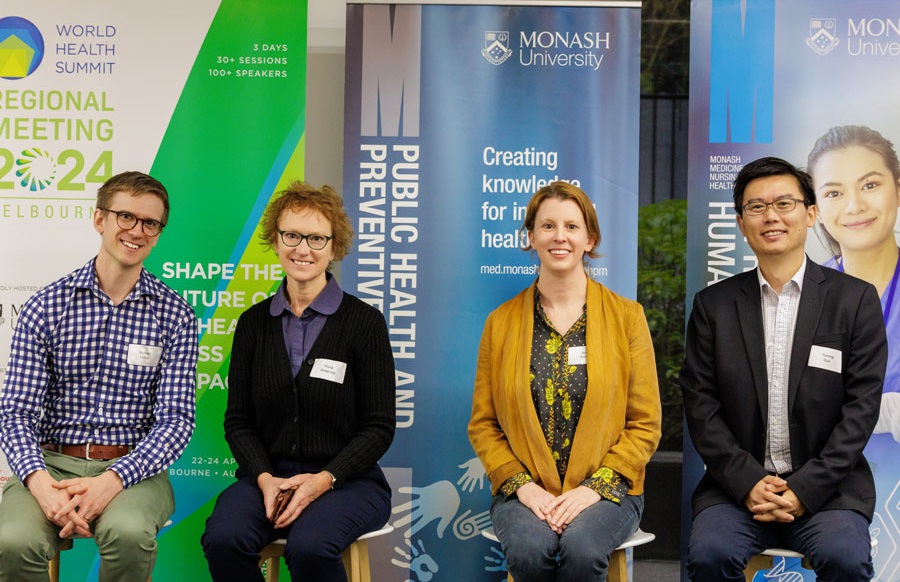
Dr Katie Anders, and Professor Yuming Guo.
Monash Medicine, Nursing and Health Sciences today launched the faculty’s Health and Climate Initiative at an event hosted by the School of Public Health and Preventive Medicine (SPHPM). The initiative will champion the faculty’s critical mass of capability in health and climate research and education, and encourage and support university-wide collaboration on solutions to the urgent challenges climate change poses to our health and health systems.
Recognising the major role that clinician-researchers play in influencing health outcomes, the initiative will champion efforts to reduce the impact of climate change on health, as well as address the impact of carbon-intensive healthcare systems and processes on the climate.
Professor Karin Leder will lead the initiative. She has increasingly come to understand the deep intersection between climate and health through her work as an infectious disease clinician-researcher within SPHPM. “I’ve been drawn towards a planetary health approach as I’ve seen how climate and ecosystem change affect all aspects of human health, including the growth and survival of pathogens that infect humans, their geographic range, and our own behaviours that influence how and when we are exposed to them,” she said.
“To use a simple example, we spend more time indoors in winter, raising the risk of spreading colds and flu person-to-person, but when we’re out at BBQs and the beach in summer, we’re more likely to be exposed to mosquito-borne illnesses when bitten or the gastro-causing microbes that thrive in food exposed to the sun. So, climate patterns change our behaviour patterns, which in turn changes infection patterns,” she explained.
“Japanese encephalitis is a textbook example of how climate can change pathogenic geography,” she said. “Over the last two years, heavy winds have brought birds carrying the virus further to the south in Australia, whereas the virus is usually contained to tropical areas. We’ve also concurrently experienced severe flooding in southern Australia that has contributed to increased mosquito breeding, and mosquitoes transmit the Japanese encephalitis virus to humans. This shows how an interplay of climate-related factors has enabled the virus to now become endemic in southern Australia, necessitating the rollout of a preventive vaccine and precautionary advice to populations at risk.”
“And the infectious diseases angle is just the tip of the iceberg,” she continued. ”The Health and Climate Initiative will cut across other complex climate and health intersections, like the respiratory and cardiovascular health impacts of exposure to increased bushfire smoke and air pollution, the systemic health impacts of heat stroke and sunburn from heat waves, and the mental health impacts of those directly affected by climate disasters like fire and flood.”
Participants at the launch were first welcomed by the Dean of Monash Medicine, Nursing and Health Sciences, Professor Christina Mitchell AO, who outlined the initiatives’ success measures, which included co-evolving scalable and readily implementable preventive pathways that strengthen the resilience of individuals, communities and health systems, informing evidence-based, cost-effective change to policies and practice, and engaging and educating policymakers, communities and health care workers and professionals.
Professor Leder presented a ‘Meet the Changemakers’ session, where Monash researchers already actively addressing health and climate issues showcased their work and findings:
- Professor Yuming Guo presented his world-leading research on using big data to understand climate impacts – view recording here
- Professor Rachelle Buchbinder shared her findings on health system resilience through wiser, higher-value healthcare choices
- Dr Michael Loftus discussed his work investigating sustainable healthcare practices within the Australian healthcare system
- Dr Katie Anders shared her insights from serving as Director of Impact Assessment at the World Mosquito Program
- Adjunct Professor Fiona Armstrong spoke about her learnings having founded the Climate and Health Alliance (CAHA)
- Professor Leder also discussed the effects of climate change on health and health systems.
“The health sector represents seven per cent of the nation’s carbon emissions, and is already overstretched with limited capacity to accommodate the increased risks to physical and mental health that climate change will bring,“ Professor Leder said. “Our challenge is to design climate-resilient and sustainable low-carbon health systems that limit waste, while also preparing to manage the increased health risks to the community due to climate change.”
“We also have a global responsibility for urgent action,” she said. “Many of our neighbours in the Asia Pacific are least responsible for contributing to the emissions that have caused this climate-induced health crisis and yet they are most affected.”
The event was immediately followed by a ‘Meet The Authors’ webinar led by Professor Guo, coinciding with the publication of his latest study in Lancet Regional Health – Western Pacific, exploring 20 years of climate health mitigation strategies across all levels of government in Australia.
The paper, commissioned by The Lancet, highlights the siloed, disconnected and generally inadequate way that government policy has dealt with climate change. The paper also strongly encourages the involvement of First Nations people in developing climate change mitigation strategies.
Monash University is hosting the upcoming World Health Summit Regional Meeting in April 2024, only the second time this high-impact event will be held in the Southern Hemisphere. The summit includes a climate change and health theme, and will provide an opportunity for interested researchers to meet, discuss ideas and generate solutions. Registrations for the event are now open.
Visit the Health and Climate Initiative website for more information, climate news and upcoming events, including the Grand Challenges in Health and Climate meeting at the Monash University Prato Centre, Italy, 27-29 November 2023.
About Monash University
Monash University is Australia’s largest university with more than 80,000 students. In the 60 years since its foundation, it has developed a reputation for world-leading high-impact research, quality teaching, and inspiring innovation.
With four campuses in Australia and a presence in Malaysia, China, India, Indonesia and Italy, it is one of the most internationalised Australian universities.
As a leading international medical research university with the largest medical faculty in Australia and integration with leading Australian teaching hospitals, we consistently rank in the top 50 universities worldwide for clinical, pre-clinical and health sciences.
For more news, visit Medicine, Nursing and Health Sciences or Monash University.
MEDIA ENQUIRIES