
Blood Synergy research program receives new $5 million NHMRC Synergy Grant
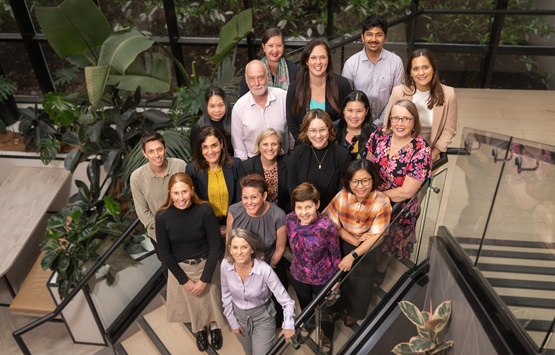
Blood Synergy team
The value of Australia’s national blood supply to the health and wellbeing of all Australians has been recognised this week, with the announcement of a further $5 million NHMRC Synergy Grant to expand the work of an established transfusion research program within the School of Public Health and Preventive Medicine. The grant will allow them to pursue their goal of seeing Australia lead the world in transfusion research and practice, with better blood product access, safer and more appropriate transfusion support for patients, and stronger stewardship of national blood supplies, with reduced costs to the community.
The grant was one of just ten awarded nationally and is the first Synergy Grant to be used to extend an existing program.
Australia spends over $1.6 billion each year on life-saving blood products for the community. Blood is donated by volunteers, so the medical community has important stewardship responsibilities to use blood wisely, and achieve the best outcomes for transfused patients.
Managed by the Transfusion Research Unit, Blood Synergy was established with NHMRC Synergy funding in 2019. The team behind that initial grant application received the inaugural Fiona Stanley Synergy Grant Award at the time, recognising the ‘best in field’ status of their submission. Since its inception, Blood Synergy has delivered on that promise, transforming blood transfusion practice and providing a clearer pathway to improved patient outcomes for Australians requiring blood transfusions.
Lead researcher Professor Erica Wood AO is excited to see the expansion of this work. “With Blood Synergy, we’ve worked hard to create a multidisciplinary platform that unites those with research strength alongside those with deep clinical, policy and guidelines knowledge,” she says. “This means new knowledge created through the group’s activities is rapidly translated into practice, improving the stewardship of precious donated blood stocks, and thereby improving clinical outcomes in a cost-effective, considered way.”
The Blood Synergy research team has established a comprehensive program of research that includes clinical studies, trials, and patient registries. The Rational and Rationalise trials are exploring the most appropriate use of costly immunoglobulin to prevent infection in cancer patients. The FEISTY II trial is exploring the utility of fibrinogen concentrate vs cryoprecipitate to better control bleeding in patients with critical bleeding after trauma injuries. They’ve also launched Australia’s first registry-based transfusion clinical trial: a trial of haemoglobin triggers for red cell transfusions in patients supported by extracorporeal membrane oxygenation (ECMO) in partnership with the EXCEL Registry.
New research infrastructure created by Blood Synergy includes a new national transfusion dataset that harnesses AI and new surveillance systems to better monitor blood stock use and safety from donation to transfusion, and leverages important stakeholder partnerships to unlock ‘missing’ data pertaining to blood stock use. The work also incorporates health economic analyses, which are vital to guide best management given the uniquely precious status of donated blood supplies.
The new funding will allow the 'Blood Synergy 2.0’ program to further expand the national transfusion dataset and to establish a new Australian Transfusion Trials Group and trials methodology centre to support innovative clinical trials of novel blood products and approaches. The program will also focus on models that deliver more personalised care, including transfusion at home for patients with blood disorders, and using 'wearables' to monitor transfusion safety.
Professor Zoe McQuilten is CIB on the program. “I think there’s good general understanding in the community of how fundamentally important blood transfusion is to saving lives - particularly in the context of traumatic injury or childbirth,” she says. “So, it’s essential to know not just where all of our donated blood units end up but also why they are transfused and the outcomes for transfused patients. That’s just one of the underlying gaps in our national systems that the Blood Synergy will work towards closing.”
The Blood Synergy team includes researchers from the University of Queensland, University of Sydney, University of Oxford (UK), Australian Red Cross Lifeblood, Gold Coast University Hospital, Malaghan Institute of Medical Research (New Zealand), Queen’s University at Kingston (Canada) and Griffith University.
Further information on the 2024 Synergy Grants projects can be found on NHMRC’s outcomes of funding rounds webpage.
About Monash University
Monash University is Australia’s largest university with more than 80,000 students. In the 60 years since its foundation, it has developed a reputation for world-leading high-impact research, quality teaching, and inspiring innovation.
With four campuses in Australia and a presence in Malaysia, China, India, Indonesia and Italy, it is one of the most internationalised Australian universities.
As a leading international medical research university with the largest medical faculty in Australia and integration with leading Australian teaching hospitals, we consistently rank in the top 50 universities worldwide for clinical, pre-clinical and health sciences.
For more news, visit Medicine, Nursing and Health Sciences or Monash University.
MEDIA ENQUIRIES
E: media@monash.edu