
Closing the gender gap in health research to improve treatment and care for women and girls
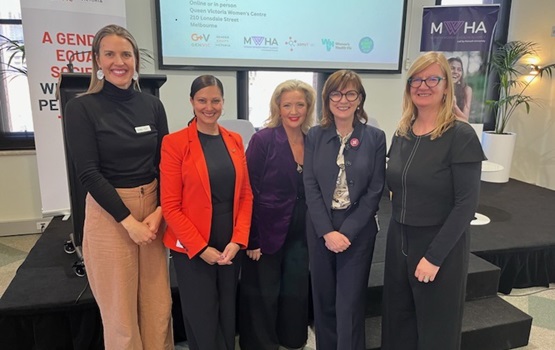
Sally Hasler - Women's Health Victoria, Micaela Drieberg - Gender Equity Victoria, Professor the Hon. Jill Hennessy - Monash Women’s Health Alliance, Hon. Mary Anne Thomas - Minister for Health, Kate Johnston-Ataata - Women’s Health Victoria.
Monash Women’s Health Alliance, in partnership with Gender Equity Victoria (GEN VIC), the Victorian Chapter of the Association of Australian Medical Research Institutes (AAMRI VIC) and Women’s Health Victoria recently held an event exploring the gender gap in health research and the impact on women’s health outcomes, attended by approximately 200 participants.
Hosted by the Chair of the Monash Women’s Health Alliance, Professor the Hon. Jill Hennessy, the event brought together medical researchers, clinicians and women’s health experts to discuss current gaps in research and clinical trials, the implications for treatments and also discuss practical solutions to the problem.
Minister for Health, the Hon. Mary-Anne Thomas MP gave a keynote speech reflecting on the Victorian Government’s action to address the historical exclusion of women and gender-diverse people in medical research, including the Inquiry into Women’s Pain, which aims to improve models of care and service delivery for Victorian girls and women experiencing chronic pain. The proposed women’s health research initiative, of which consultations with researchers are currently underway, will also serve as a unifying collaborative force to drive innovation, from basic research in sex and gender differences through to the lived experience of health care for women and girls and gender-diverse people. “We need to ensure that women and women’s bodies are embedded at every level of medical research,” Minister Thomas said. “This means requiring researchers to think about the gender implications of their work and supporting clinicians to implement the knowledge we already have. We also know that there’s been a lack of focus and funding for research into conditions that uniquely and disproportionally impact women. We do not have a body of medical knowledge built on women's bodies and we need to change the game.”
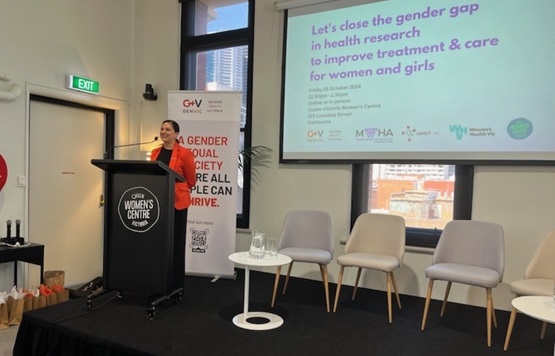
Micaela Drieberg - Gender Equity Victoria.
Professor Carol Hodgson Head of the Division of Clinical Trials and Cohort Studies in the School of Public Health and Preventive Medicine, further discussed the gender gap in health research, leading to women disproportionately experiencing delayed diagnosis, overprescribing and a failure to properly investigate symptoms in healthcare practice and delivery. She also noted the range of intersectional factors, such as discrimination, stigma, poor health literacy, lack of accessible and culturally appropriate services, gender diversity, socio-economic disadvantage, regional and rural location and visa status, that act as barriers to women seeking medical help and receiving care, which contributes to poor health outcomes across specific populations.
Professor Hodgson also stated that women are often excluded from clinical trials, particularly if they’re pregnant, or their participation is impacted by their family and caregiver roles, their level of trust and confidence in researchers, and their concern about the health impacts. She also stated that women are underrepresented in some trials, such as in cardiology, and overrepresented in others, such as those examining their caring responsibilities. “We can change this with a strong culture of equity and inclusion and female leadership in both research and clinical organisations,” she said. “Nothing about us without us - researchers must strive for accurate input, connection and representation from people with lived experience and community members to ensure that research is relevant and important to the people that we serve and meet the consumer and the community where they are, which is online, in clinics, in community health settings, not just in healthcare services.”
Early career researcher Dr Emma Foster, a consultant neurologist, also shared her research into headaches and migraines, which are conditions that impact women disproportionately to men yet remain underresourced and underresearched. She suggested a national strategy is needed to ensure that the more than 6 million Australians who suffer from headaches and migraines can access diagnosis, treatment, information and support, and more research is needed to understand how migraines effect culturally and linguistically diverse groups.
Dr Kate Johnston-Ataata, Manager of Policy, Health Promotion and Advocacy at Women’s Health Victoria, welcomed the increased attention to sex and gender gap in health and clinical research, as the historical lack of attention points to cultural and structural sexism and misogyny compounded by other forms of oppression, including racism, colonialism, transphobia and ableism, which can even lead to sexist research, such as one peer-reviewed 2013 study on the link between endometriosis and attractiveness. She also highlighted the Victorian Women’s Health Atlas, an interactive online tool that researchers and policy-makers can access to obtain sex-specific data on a range of key health and socioeconomic issues that affect Victorian women.
Dr Johnston-Ataata also raised the historical and ongoing lack of urgency in funding research for sex-specific illnesses or differences in health outcomes, pointing to mental health as a stark illustration. “Recent UK research explored why we ‘don’t care’ about the gender gap in common mental health concerns such as depression and anxiety, treat it as inevitable, and rarely examine their drivers as a worthwhile question to pursue,” she said. “We also often ignore the intersections and experiences of diverse communities, which compounds poor mental health outcomes. Treatments are often inappropriate, ineffective or have harmful side effects, and our mental health services can be gender-insensitive, and therefore harmful.”
Dr Johnston-Ataata also highlighted the lack of research into the impact of gender-based violence on women’s mental health, with many of the existing evidence-based trauma treatments focusing primarily on reducing symptoms rather than tackling the underlying trauma. Complex trauma treatment approaches such as emotional regulation and coping with dissociation and flashbacks are also yet to be researched in the context of domestic and sexual violence.

Kathryn Naumenko - AAMRI VIC, Professor Cara Tannenbaum, Michelle Marven - AAMRI VIC, Professor Jane Bourke - Monash Biomedicine Discovery Institute, Dr Ayan Dasvarma - Monash Biomedicine Discovery Institute.
Kim Kwan and Dr Ayan Dasvarma from the Victorian Chapter of peak body the Association of Australian Medical Research Institutes (AAMRI) discussed AARMI’s gender equity diversity and inclusion strategy and the recent launch of The Centre or Sex and Gender Equity in Health and Medicine. Dr Cara Tannenaum , the former Scientific Director of the Canadian Institutes of Health Research - Institute of Gender also shared some learnings from the Canadian experience, such as having strategies and policies in place to ensure sex and gender are taken into account when funding research. “We asked peer reviewers and evaluators to indicate on the research proposal evaluation form whether sex and gender integration was seen as a strength, weakness, or not applicable to the application, “ Dr Tannenaum said. “It worked - evaluators were then under pressure to justify their reasoning, and if two out of three evaluators said that sex and gender integration was a strength, the researcher was two to three times more likely to have their research funded. We fundamentally changed the concept of research excellence because if women and gender diverse people aren’t benefiting from the research, then it's not ethical, scientifically rigorous or generalisable research.”
In closing, CEO of Gender Equity Victoria Micaela Drieberg encouraged participants to continue the conversations and collaborations to promote gender equity in medical research and healthcare.
To learn more about the Monash Women’s Health Alliance, visit the website and follow on Instagram and LinkedIn.
About Monash University
Monash University is Australia’s largest university with more than 80,000 students. In the 60 years since its foundation, it has developed a reputation for world-leading high-impact research, quality teaching, and inspiring innovation.
With four campuses in Australia and a presence in Malaysia, China, India, Indonesia and Italy, it is one of the most internationalised Australian universities.
As a leading international medical research university with the largest medical faculty in Australia and integration with leading Australian teaching hospitals, we consistently rank in the top 50 universities worldwide for clinical, pre-clinical and health sciences.
For more news, visit Medicine, Nursing and Health Sciences or Monash University.
MEDIA ENQUIRIES