
Dr Jo Wainer AM’s revolutionary efforts in women’s health honoured with new faculty prize
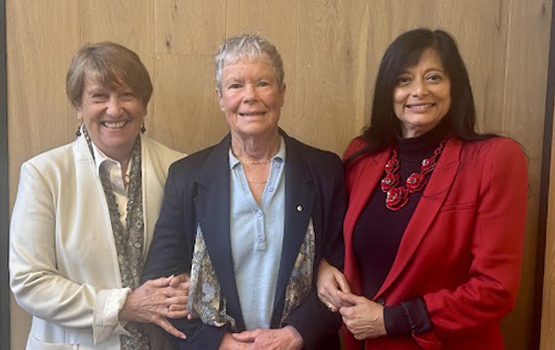
Associate Professor Lynette Clearihan AM, Dr Jo Wainer AM and Professor Jayashri Kulkarni AM.
The average woman living in Victoria might not know the debt of gratitude they owe to the remarkable Dr Jo Wainer AM, health activist, social scientist and past adjunct Associate Professor in the Eastern Health Clinical School.
If she's ever been in the position of choosing to discontinue a pregnancy and done so safely, legally, in the care of a qualified practitioner, she has Jo in part to thank. If you read this story, you'll understand why. Take note of this part in particular, written in Jo's own words:
Before 1969 and the Menhennit ruling abortion was completely illegal. It was conducted clandestinely. There were twelve doctors who provided reasonably safe, reasonably competent abortions, but at a very high price. You found them through an underground network - taxi drivers, pubs, mates (it was usually the responsibility of the man involved to find the abortion provider and to pay for the abortion. The woman just risked her body, her life and her dignity)...
If the providers got into trouble, they couldn't call an ambulance and have the woman admitted to hospital because they would have gone to jail for fifteen years or longer, whether a doctor or not. Women died. We will never know how many as they all had body disposal systems - dump them in Port Phillip Bay, bury them in Sherbrooke Forest, arrange with the local undertaker to bury two bodies in one coffin.
Jo and her husband, Dr Bertram Wainer, a former soldier and general practitioner, refused to accept this appalling yet socially accepted practice. Having seen too many women killed or maimed by unsafe abortions performed by the unqualified, disreputable and corrupt, they embarked on a mission to reform the law and secure safe access to abortion for Victorian women against the odds. Their courageous actions included forcing the Victorian Government to hold two public inquiries into police corruption and the protection of lucrative illegal abortion rackets in 1970, and into general police abuse of power in 1976. They also established Australia's first publicly accessible and affordable abortion practice in East Melbourne, the Fertility Control Clinic, in 1972.
Challenging such powerful interests put Jo, Bertram and their colleagues at enormous personal risk. Dodging snipers, stabbings and firebombings became a way of life. Bertram was bankrupted, suffered heart attacks, and died prematurely at age 59 in 1987. A colleague of Jo's, who declined to be named and often sheltered women seeking abortions in her own home, spoke of her experience in the early 1980s.
"You can't underestimate the violence of the times; it was like a war," she said. "It was a totally different zeitgeist than now, but I fear we have become almost complacent because we have made some progress. We only need to look at the recent Roe vs Wade decision reversal in the United States to know that the rights that Jo and Bertram fought so hard for could easily be repealed."
Following the loss of her husband, Jo continued with their life's work while raising their daughter and caring for her step-children, nephew and niece. She stayed active in abortion reform efforts and set up a women's health clinic, the Wainer Clinic for Women in Richmond, that provided a full range of women's health services identified by the National Women's Health Policy, including abortion. After 40 years of campaigning by Jo and many others, abortion was finally legalised in Victoria in 2008.
In 1995, Jo moved to Gippsland and joined the Monash Centre for Rural Health, becoming a Senior Lecturer in the school the following year. She undertook research projects on medical service delivery in rural areas, explored the specific experience of women rural doctors and in response, introduced a new curriculum unit on women in rural general practice. This developed further into teaching gender and medicine, leading students to understand how to use their gender as a clinical tool.
Jo is also a Foundation and Life Member of the Australian College of Rural and Remote Medicine. She worked with a team of female rural doctors to establish the Women and Rural Practice curriculum as part of their Fellowship program. This work was extended to the World Organisation of Family Doctors.
She then established the Centre for Gender and Medicine in the Faculty of Medicine, Nursing and Health Sciences at Monash University's Clayton campus. Through the Centre, Jo introduced the concept of sex and gender in constructing medical knowledge and the clinical consequences of ignoring women's experience in research and practice. She was part of the team that reviewed the Monash medical curriculum, and with her colleague Dr Ann-Maree Nobelius, she introduced teaching about sex, gender, and medicine, which was a pioneering advancement in student learning at the time.
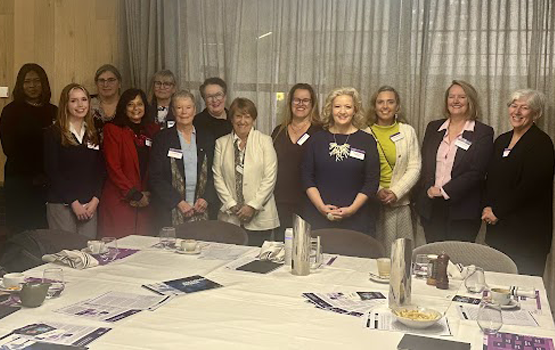
Monash Women's Health Alliance members and guests at the Changemakers of Women's Health Lunch.
The Monash Women's Health Alliance recently hosted a lunch to honour Jo’s revolutionary efforts in women’s health. The lunch was hosted by Deputy Dean (Medicine) and President of the Medical Deans Australia and New Zealand Professor Michelle Leech AM and by Vice-Chancellor’s Professorial Fellow and Chair of the Monash Women’s Health Alliance Professor the Honorable Jill Hennessy and attended by Monash women’s health leaders such as Professor Jayashri Kulkarni AM and Professor Helena Teede AO. Sitting next to her was Professor Danielle Mazza AM, Chair of General Practice in the School of Public Health and Preventive Medicine, Director of SPHERE CRC, and a Monash medicine alumna. Professor Mazza has taken up Jo’s baton and is now a leading national advocate for continual improvements in women’s access to long-acting contraception and abortion.
Associate Dean of Professionalism, Associate Professor Lyn Clearihan AM, was also in attendance to honour her mentor and friend. Associate Professor Clearihan said that Jo helped raise her consciousness about her experience as a ‘woman GP’, who wasn’t just “a man with different parts”, but a woman with her own perspective and experience that provided enormous practical value to her female patients.
“Jo was a crusader,” Associate Professor Clearihan said. “When she first started her work in rural health, there were a lot less women in the medical workforce. The concept of feminisation of the workforce was just emerging, and Jo put blasters through a lot of the myths around what that meant. Women doctors were finally being recognised for the inherent values and skills they brought to medical practice and patient care. She was the first person to give us a voice.“
At the lunch, Professor Leech announced the establishment of a new student award, the Dr Jo Wainer AM Prize. The prize will be awarded each year, commencing in 2025, to a Monash University health professions student who has demonstrated leadership, innovation and integrity in research scholarship that addresses big healthcare challenges.
The prize especially recognises Jo’s work in improving the Monash medical curriculum to ensure that future generations of women receive care from skilled, empathetic medical practitioners with a solid grounding in women’s health matters. “Jo taught us the concept of gender competence, and embedded this new knowledge into our medicine curriculum to ensure that all students learn about women’s specific experiences of illness and medical care,” said Professor Leech. “She holds a very special place in the history of medicine at Monash, and we are delighted to honour her with this new award.”
Jo had frank words to say about the history of medicine overall. “In Europe, a doctor had to graduate as a ‘gentleman’ before he could study medicine and women were totally excluded,” she said. “The science behind medical knowledge is based on studies of the male body, including basic pre-clinical studies on male rodents. The health questions researched were those that bothered men. This is changing now that women have objected to being viewed medically as just ‘small men’ with uteruses. It is a credit to Monash Medicine, Nursing and Health Sciences that they were world leaders in including the implications of sex and gender in their teaching.”
Over the last 20 years, Monash University has continued to embed women’s health into the medicine, nursing and allied health curriculum, and has been an innovator and leader in this space. Read about our women’s health research capabilities, including our PACTS, our menopause practitioners toolkit, and explore our professional development courses for GPs and health care professionals working with women and gender diverse people.
Follow the Monash Women’s Health Alliance on LinkedIn and via their website to stay in touch with our women’s health research and impact.