
Project on AI precision medicine for multiple sclerosis receives $2.9million MRFF grant funding
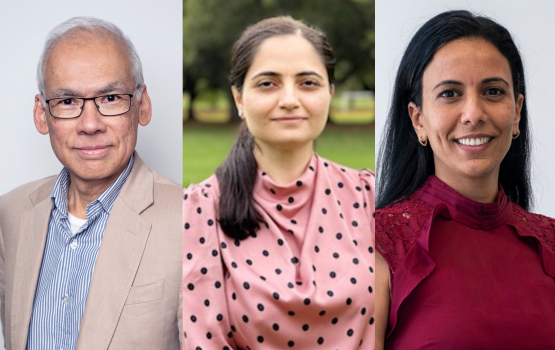
Professor Winston Chong, Associate Professor Mastura Monif and Dr Yasmeen George.
Interventional and diagnostic neuroradiologist Adjunct Clinical Professor Winston Chong from the School of Translational Medicine and Alfred Health has been awarded a $2.9 million Medical Research Future Fund (MRFF) National Critical Research Infrastructure Initiative Grant to lead a team that will build medical artificial intelligence (AI) capacity through developing AI precision medicine for multiple sclerosis (MS).
The project involves multidisciplinary input from neuroradiologists from Alfred Health, neurologists from Alfred Health, Eastern Health and University of Western Australia/Perron Institute and AI/data scientists from Monash University’s Faculty of Information Technology. Industry partners FPT Software, GE HealthCare Australia and consumer representatives will also participate in the project. The team’s chief investigators include Adjunct Clinical Professor Chong (CIA - neuroradiologist), Associate Professor Mastura Monif (CIB - Neurologist), Dr Yasmeen George (CIC - AI/data scientist), Associate Professor Daniel Schmidt, Professor Jianfei Cai, Associate Professor Anneke Van der Walt, Professor Helmut Butzkueven, Dr Katherine Buzzard, Professor Allan Kermone, Associate Professor Darshini Ayton, Dr Binh Tran, Dr Anthony Kam, Bjoern Picker and Dr Daneh Turner.
Multiple Sclerosis affects 2.8 million people globally. In Australia, MS affects over 33,000 people and cost $2.5 billion in 2021. The main unmet health challenges in treating MS include:
- Current tools, including the interpretation of MRI scans by radiologists and neurologists, to monitor disease progression are not highly sensitive or specific enough, nor completely reliable
- Determination of MS treatment failure is difficult to discern
- Lack of evidence to guide fundamental decisions on treatment commencement, and type of treatment to be considered when treatment fails or the response is suboptimal.
Using AI technology, the project aims to address these unmet health challenges by improving decision-making in selecting appropriate MS disease-modifying therapies for individualised patient care (a precision medicine approach) and build medical AI capability.
Adjunct Clinical Professor Chong said that the project should lead to improvements in MS management, with more effective clinical assessment and treatment decision-making compared with current practice. “Other outcomes we aim to deliver include improvement in the accuracy of treatment decisions and reduced uncertainty associated with therapy selection, better monitoring tools to complement current clinical assessments, reductions in MS-related disability accrual, improvements in patient care and experiences and reduced health care costs,” he said. “This project will also build AI workforce capability and capacity, and new translational AI technology.”
About Monash University
Monash University is Australia’s largest university with more than 80,000 students. In the 60 years since its foundation, it has developed a reputation for world-leading high-impact research, quality teaching, and inspiring innovation.
With four campuses in Australia and a presence in Malaysia, China, India, Indonesia and Italy, it is one of the most internationalised Australian universities.
As a leading international medical research university with the largest medical faculty in Australia and integration with leading Australian teaching hospitals, we consistently rank in the top 50 universities worldwide for clinical, pre-clinical and health sciences.
For more news, visit Medicine, Nursing and Health Sciences or Monash University.
MEDIA ENQUIRIES