
From theatre to therapy: MoLBi reaches 100-tumour milestone in just eight months
In a major milestone for Australian cancer research, Monash Health and Monash University have collected their 100th tumour specimen through the Monash Live Bio-Banking (MoLBi) platform, just eight months after its launch.
This milestone includes 30 samples from glioblastoma multiforme, one of the most aggressive and treatment-resistant brain cancers, and 19 metastatic brain tumours. More than 16 of these have already been used to establish patient-derived disease models, providing researchers with powerful tools to test therapies that reflect real patient biology.
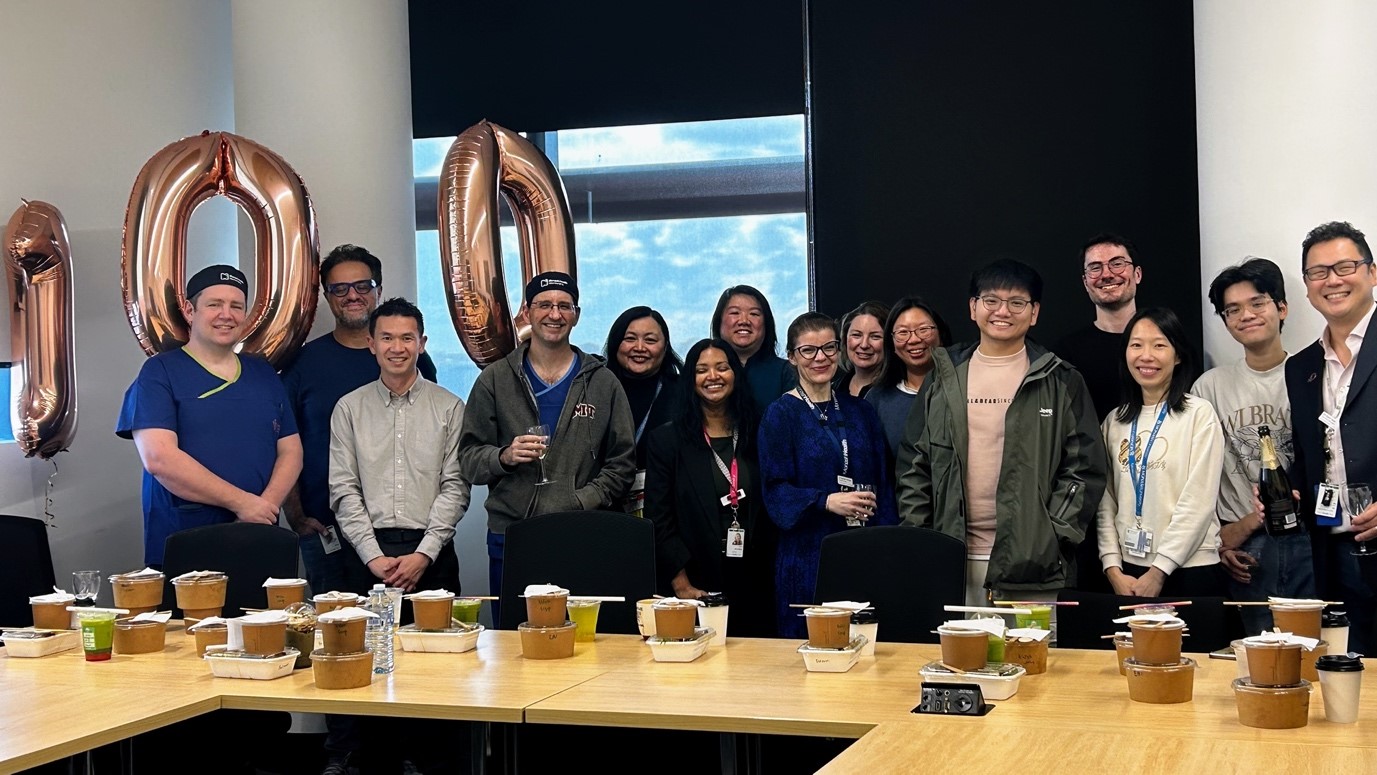
The MoLBi Research Team celebrating the 100 tumour milestone (L-R): Adrian Praeger (Head, Neuro-oncology), Pouya Faridi (Head, Translational Antigen Discovery Laboratory), Joshua Ooi (Head, T-reg Cell Therapy Group), Justin Moore (Director, Neuro-surgery), Tu Nguyen-Dumont (Head, Clinical Genomics Laboratory), Tanya Jhoomun (Audit & Data Manager), Janet Chang (MoLBi Project Manager), Sophia Frentzas (Early Phase Clinical Lead), Beth Francis (Neuro-surgery PA), Yi Tian Ting (Group Lead in Protein Engineering), Erwin Tanuwidjaya (PhD student), Eamonn Gilmore (visiting student – Cambridge University, UK), Kylie Loh (Cell Therapy Lab Manager), Khoi Ly (Lab Assistant) and Gwo Yaw Ho (Chair and PI of MoLBi)
“Reaching 100 specimens in such a short period of time is unprecedented and demonstrates how deeply integrated MoLBi has become in our hospital workflow,” said Dr Gwo Yaw Ho, Chair and Principal Investigator of MoLBi, and Head of the Cancer Immunology Laboratory, School of Clinical Sciences at Monash Health.
The key to MoLBi’s success lies in its live biobanking model. Unlike traditional biobanks that rely on frozen archival samples, MoLBi processes tumours immediately after surgery while they’re still biologically active. This allows researchers to preserve the tumour’s original cellular and molecular complexity, including its immune environment, gene expression and protein signalling. It’s this immediacy that unlocks a new era of precision oncology.
“We work closely with surgeons, oncologists, scientists and consumers to deliver high-quality specimens and data that will transform how we treat patients with very aggressive cancers like glioblastoma, pancreatic and hepatobiliary cancers,” said Professor Justin Moore, Director of Neurosurgery at Monash Health.
This immediacy enables what is known as multi-omic profiling, a method of analysing the tumour across several biological layers including DNA mutations, gene activity, protein production and the immune environment. By integrating these data, researchers can build a comprehensive map of how each tumour functions, uncovering vulnerabilities that may be missed when looking at just one layer in isolation.
The platform also supports advanced immunopeptidomics, an emerging field that studies which fragments of a tumour are visible to the immune system. This visibility is critical in designing highly personalised immune-based therapies, including vaccines or cellular therapies that teach the immune system to recognise and destroy cancer. With this level of molecular precision, the MoLBi platform lays the groundwork for future treatments that involve reprogramming a patient’s own immune cells to recognise and attack their cancer, moving us closer to patient-specific T-cell receptor therapies that were once only theoretical.
These insights are already informing the development of personalised disease models. In more than 16 cases, tumours have been used to grow patient-derived xenografts in preclinical models. These models replicate a patient’s unique cancer and provide an invaluable way to trial potential treatments before they are administered in the clinic.
“This is just the beginning. Our collaborative team is expanding its efforts as part of the global mission to beat brain cancer,” said Dr Adrian Praeger, Head of Neuro-oncology Surgery.
MoLBi is designed not just as a research asset, but as a platform to translate discoveries into care. By embedding biobanking directly into the clinical workflow at Monash Health, the platform has radically accelerated the turnaround time from surgery to science. It ensures every specimen collected is available for immediate research and therapeutic development, forming a pipeline for innovation in cancer treatment.
“MoLBi demonstrates how collaborative infrastructure can be built at pace to promote translational research for better patient care, paving the way for precision medicine as standard of care in cancer and accessible to all,” said A/Professor Zee Wan Wong, Oncology at Monash Health.

Celebrating this achievement with our esteemed neurosurgical colleagues at Monash Health (L-R): Standing - Gwo Yaw Ho, Adrian Praeger (Neurosurgeon), Jeremey Kam, Andrew Gauden, Tanya Jhoomun, Tony Goldschlager, Siddhanth Gujjari, Justin Moore, Annie Chen, Angela Frentiu, Rebecca Limb, Lavanya Palanimalai, Chris Xenos, Kate Gibbons Sitting) - Reece Sher, Ahmad Badran, Piers Thomas
This achievement was made possible through strong institutional support from the Monash Health Oncology Research Support Program (RSP), the generosity of patient donors and the advocacy of groups such as the Brain Tumour Alliance Australia (BTAA).
Dr Adrian Praeger added, “We would like to sincerely thank the patients who have generously donated their specimens to support this research. This is just the beginning. Our collaborative team is expanding its efforts as part of the global mission to beat brain cancer.”
As MoLBi expands to include tumours from pancreatic, liver and gastrointestinal cancers, the platform is poised to become one of Australia’s most advanced engines of translational research. Each specimen collected doesn’t just represent progress in the lab, it offers renewed hope for patients and their families.
About Monash University
Monash University is Australia’s largest university with more than 80,000 students. In the 60 years since its foundation, it has developed a reputation for world-leading high-impact research, quality teaching, and inspiring innovation.
With four campuses in Australia and a presence in Malaysia, China, India, Indonesia and Italy, it is one of the most internationalised Australian universities.
As a leading international medical research university with the largest medical faculty in Australia and integration with leading Australian teaching hospitals, we consistently rank in the top 50 universities worldwide for clinical, pre-clinical and health sciences.
For more news, visit Medicine, Nursing and Health Sciences or Monash University.
MEDIA ENQUIRIES