
New co-designed resources supporting culturally diverse older adults leaving hospital
“My mother came from post-war Europe, and I remember my grandmother who came out and couldn't speak English back then. She tried to learn to speak English but wasn't able to do so. I think that is also a [research] driver for me,” NCHA and Monash University lead researcher, Associate Professor Jacqui Allen said.
“In a healthcare situation, it is scary anyway for anybody let alone when you don't speak English and you come from a different culture. So, anything we can do to support people through those sorts of challenges is wonderful.”
Going home from hospital can be an anxious time for older persons, carers, and other family members. Yet few resources exist that support culturally and linguistically diverse (CALD) carers to access relevant information supporting this transition, despite Australia’s multicultural society.
An NCHA Living Labs project – Improving support for culturally and linguistically diverse (CALD) carers transitioning older adults from hospital to community – addressed this by co-designing multimedia resources with Greek, Italian and Chinese carers, and older adults, to support their interaction with health professionals and care providers.
The project’s impact includes:
- New multimedia resources developed with Australian Greek, Italian and Chinese carers, and older adults with ‘lived experience’.
- Enhanced understanding of the needs of CALD carers when interacting with health professionals and care providers.
- Increased capacity for CALD carers to participate in preparing, planning and follow-up during transitional care of older adults with multi-morbidity from hospital to the community.
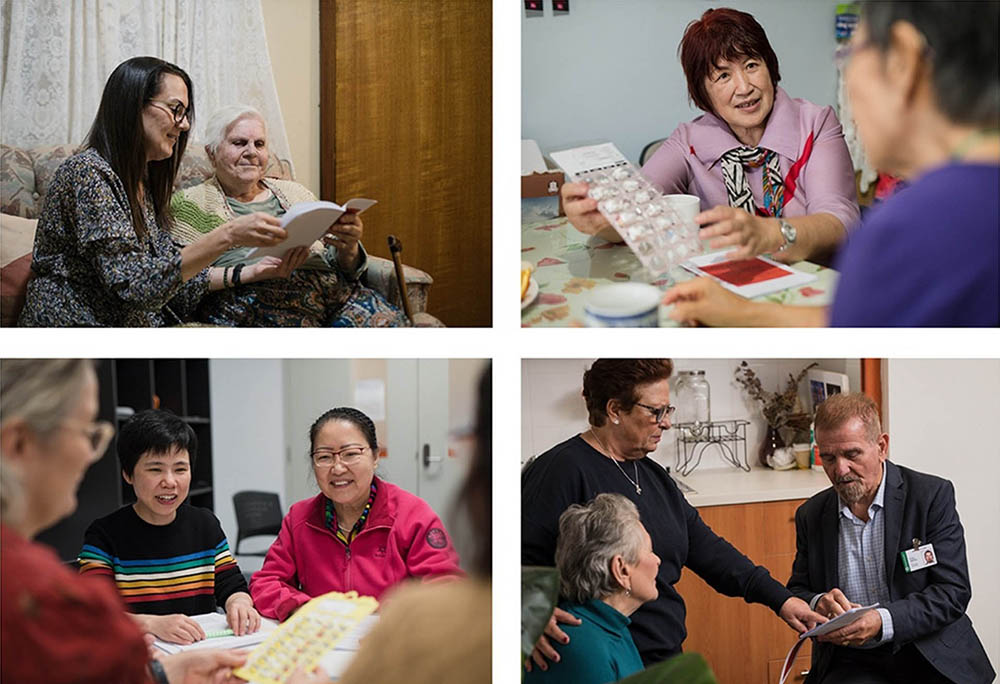
There are many dimensions of cultural and linguistic diversity that affect health status and the ability to navigate the health system. We spoke with the project leads Associate Professor Jacqui Allen and Dr Yaping Zhong from Monash University who both come from migrant backgrounds, about the key themes arising from the research.
Lack of resources supporting carers of CALD adults
Despite Australia’s multicultural society, with one third of older Australians and families from non-English backgrounds according to the 2021 Census, little resources are available for carers as they transition older adults from hospital to home. For example, in the 2021 Census, 62.7 percent of people who used Mandarin at home were first generation Australians, born in China, but they also identified as being the largest group with low English proficiency (176,000).
Associate Professor Allen identified this research gap and was also motivated by her extensive first-hand experience as a district nurse visiting culturally diverse families.
“When you look at the literature there's very limited work been done in the research area to support people from culturally diverse backgrounds, yet we know they have poorer health outcomes. They take a longer time to access health and support services. And there are some structural disadvantages for culturally diverse people as well,” she said.
“But the other driver for me is from my practice background. The families provide extraordinary support, and often without very much input from services in the community or from health services. And there's a bit of attitude of, oh well they just speak a different language and family can come in and do the translating, but it's more complex than that, and we see that play out in poor health outcomes. So, I'm really interested in ways that we can help everybody to have high-quality health outcomes.”
Cultural differences frame attitudes to accessing health support
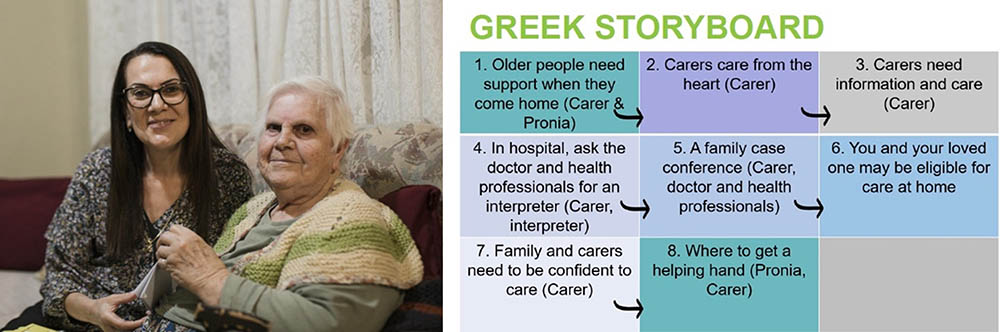
Co-designing resources with three distinct cultural groups – Australian Greek, Italian and Chinese – required the research team to work closely with carers, partner organisations, health professionals and families with lived experience of navigating the hospital to home journey. Each community brought a slightly different approach, often framed around their level of English and digital proficiency and how they liked to access information (booklets, video, person-to-person). They were also involved in providing input through storyboarding, scripting, and hosting the tailored multimedia resources.
Associate Professor Allen said there is often an assumption by Government that everyone has digital literacy but that the research showed many carers from culturally diverse backgrounds don't access support in the same way that people from non-culturally diverse backgrounds tend to access support.
“So going online to My Aged Care for example, or even ringing My Aged Care can be quite challenging, particularly for people who may have never had the opportunity to go to school and don't read and write, or read and write just for a little bit. They'll be relying on other family members, younger family members to assist them with accessing services and support their ideas about things.”
The project’s research fellow, Dr Zhong, said lower levels of English and digital literacy were raised by some of the Greek participants.
“In the Greek group, their education level is much lower, and they don't use the internet, and so it's difficult to run online workshops. [Some of them] told us they couldn't read and would prefer someone to talk to them rather than ask them to read a long document.”
Family is central to their lives and health support
“As Greeks, we don’t think of being a carer. We feel in our hearts that someone in the family needs caring. We just do it.” – a carer with Greek heritage.
Family plays a strong role in all three communities with older people looking to their loved ones for support. Associate Professor Allen said the research showed how this framed accessing health services.
“Things like respite can be quite challenging for carers from culturally diverse backgrounds because the idea of putting the older person into a residential facility for a couple of weeks so the carers can have a break may not make sense to them. They want to go with them. And again, it's that idea of the family. You don't separate your family. You're all in it together,” she said.
“In these communities … the family is such a focus; the world doesn't make sense outside of the family. So, this more individualistic idea that we have of being in the world as Western people just doesn't really work, because for those from a collectivist culture the family is the world, and the individuals are part of the family. So, focusing in on the carer with culturally diverse people is very much focusing on the family.”
Dr Zhong said the Chinese community regarded supporting their loved ones with hospital and health service visits as an extended family responsibility.
“Chinese people, they would think, don't bother others. And they take all the responsibilities on themselves. And as one participant mentioned, one family member would take turns and then a next [family member]. And they are reluctant to ask for help, but they are unaware of the governmental support. Most older adults because of maybe computer literacy don't use the internet or they usually depend on their families.”
Carers reported feeling ignored in health services
The 2021 Royal Commission into Aged Care Final Report highlighted the key role of informal carers in supporting their loved ones in the health services journey, yet many reaffirmed to the NCHA project team their feelings of still being ignored in Australian hospital settings.
“Carers are often ignored in health service, and this is what they shared with us. It's also been my observation,” Associate Professor Allen said.
“In the discharge planning area, there's an assumption made by a lot of health practitioners that the "fairies" somehow come in - the "fairies" being the carers - and wave their wands and everything's kind of sorted out and moves along well. But of course, it's not as easy as that.
“The carers are putting in an enormous amount of all kinds of work, physical work, emotional work, organisational skills they bring ... they're just so critical to keeping older people at home to live independently, with support, and that's in accordance with people's wishes as well.
“We worked with carers to find out and learn from them what their advice would be to other carers. We turned that into scripts through the qualitative work that we did and invited carers and older people to participate in the filming and photography as well. We've got carers sharing and speaking from a more powerful position.”
Dr Zhong said embedding lived experience in the NCHA-supported project reaffirmed her commitment to healthy ageing research.
“From this project I became more committed to this, the consumer involvement, to explore their lived experience. Because, you know, they are the experts of their lives and what we are going to do should be really based on their voices. I think that's very important.”
What’s next?
The research team are inviting carers and older people, particularly from the Italian, Greek, Mandarin speaking or Cantonese speaking communities, to look at the resources and provide some feedback to further improve the resources. Click here to view.
Discover more about NCHA’s Living Lab projects here.