
Simple drawing test could be key to identifying brain toxicity from cancer immunotherapy
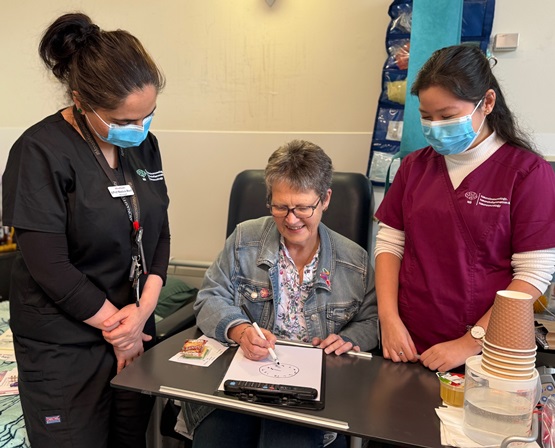
Clinical Neuropsychologist and PhD candidate, Christina Kazzi (right), administering the Clock Drawing Test to a patient (middle) receiving CAR-T therapy, with supervisor Associate Professor Mastura Monif (left)
Immunotherapy has revolutionised the treatment of blood cancers. But in anywhere up to two-thirds of patients, it can cause severe, even life-threatening neurological symptoms.
Known as ICANS (Immune Effector Cell Associated Neurotoxicity Syndrome), these symptoms of brain toxicity are often present in a mild or subtle form - eluding the current bedside tool (known as the ICE score) that allows clinicians to grade their severity and predict a dangerous escalation.
But now, a multidisciplinary team from Monash University and Alfred Health has demonstrated that a commonly used neurological screening tool, the Clock Drawing Task (CLOX), when used in conjunction with the ICE score, can pick up small changes earlier.
The Clock Drawing Task, developed in the early 1900s for returned WWI soldiers, is now widely used to assess cognitive decline and dementia. When patients are asked to draw a clock face from memory, both the end result and any errors they might make along the way can reveal neurological conditions or deficits.
The team was led by Christina Kazzi, a neuroscience PhD student and clinical neuropsychologist at Alfred Health.
“We were particularly interested in finding a test that detects mild cognitive issues in patients who do not look well clinically but have a perfect ICE score,” she sad. “So we came up with a modified CLOX rating scale to solve the problem.”
Published in the British Journal of Haematology, the study introduced a modified CLOX scoring system to rate clock drawings (CLOX-M) to pick up early signs of ICANS.
Chimeric antigen receptor T-cell (CAR-T) therapy is often used in patients with lymphoma, leukaemia and myeloma. It is a form of immunotherapy in which a patient’s own T cells are treated and then reinfused to destroy cancer tumours.
Neurotoxicity from CAR-T therapy is reversible with steroid treatment, but untreated, can cause confusion, tremors, seizures and even death. Early treatment means fewer, less severe complications and shorter treatment duration.
The team analysed time-matched clock drawings and ICE scores of patients who received CAR-T therapy. There was a significant correlation between changes in CLOX-M scores and ICE scores, with the clock drawing task offering high specificity for identifying ICANS-related cognitive decline. A drop of two or more points in the CLOX-M score was strongly predictive of ICANS onset, even when the ICE score was 10/10 (considered to indicate normal brain functioning).
“It’s a simple tool that captures executive dysfunction and visuospatial deficits often missed by conventional assessments,” Miss Kazzi said.
The next steps for the team are to implement short patient friendly computerised cognitive and movement tests in the ward to complement the ICE score. In addition to this the team are focusing on blood and imaging biomarkers, and CART cell expansion dynamics, which when all used in combination hoped is to significantly improve diagnosis and management of CART related neurotoxicity.
Study senior author, Associate Professor Mastura Monif, said: “CART therapy is novel and assessments of neurotoxicity need to be optimised to detect the toxicity early, to characterise it better and to institute treatment as soon as feasible. Ultimately detecting neurotoxicity sooner can improve patient outcomes, and that is where our work focuses on”,” she said.
About Monash University
Monash University is Australia’s largest university with more than 80,000 students. In the 60 years since its foundation, it has developed a reputation for world-leading high-impact research, quality teaching, and inspiring innovation.
With four campuses in Australia and a presence in Malaysia, China, India, Indonesia and Italy, it is one of the most internationalised Australian universities.
As a leading international medical research university with the largest medical faculty in Australia and integration with leading Australian teaching hospitals, we consistently rank in the top 50 universities worldwide for clinical, pre-clinical and health sciences.
For more news, visit Medicine, Nursing and Health Sciences or Monash University.
MEDIA ENQUIRIES