
Infection prevention and control in residential aged care homes is everyone’s responsibility
‘It's not just the direct care staff that have that responsibility for infection prevention.
It's everybody. It's visitors, contractors, it's the residents themselves.’
That’s the key message highlighted in a new infection prevention strategy launched by the National Centre for Healthy Ageing’s A-PRECISE Living Labs project team, led by Monash University’s Professors Helen Rawson and Philip Russo, to tackle this persistent, sector-wide health challenge that extends far beyond just COVID-19.
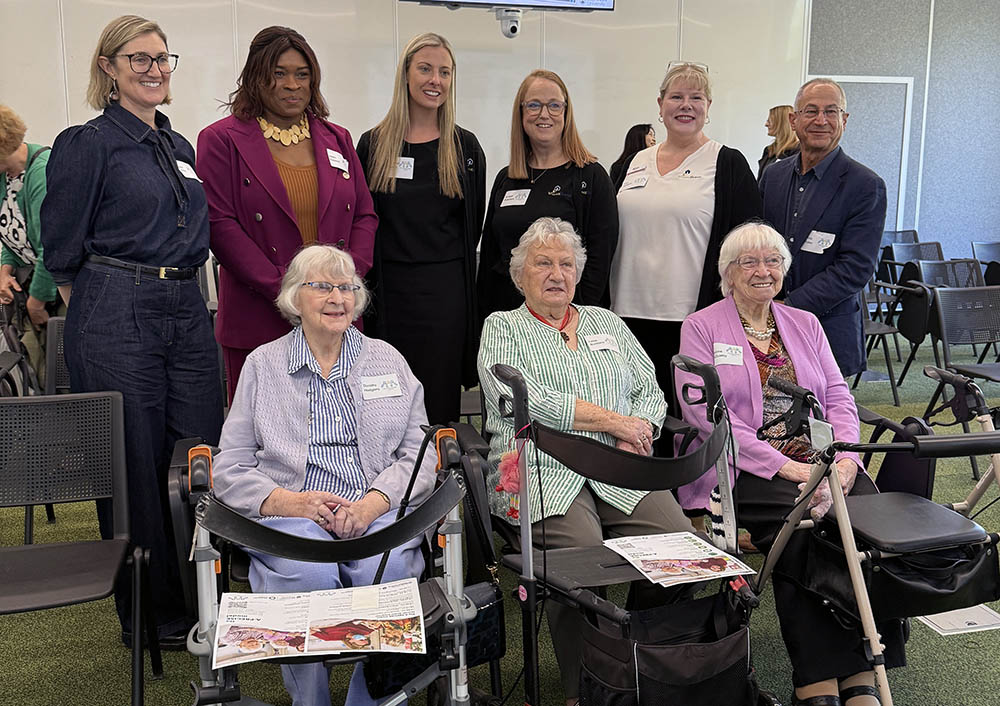
A-PRECISE researchers from the National Centre for Healthy Ageing and Monash University share the new strategy with representatives and residents from The Village Baxter and Olivet Care residential aged care facilities at the official launch. Back row (l to r): Karen Harris, Helen Rawson, Cathrynne Emanuel, Bridget Robinson, Kim Jackson, Philip Russo. Front row (l to r): Dorothy Hodgens, Laine Buckland, Marjorie McCluskey.
Co-designed with the aged care sector, residents and families, the A-PRECISE (Australia - PReventing infECtions In reSidential agEd care) model includes, a suite of free multimedia and educational resources to better support infection prevention and control in residential aged care homes.
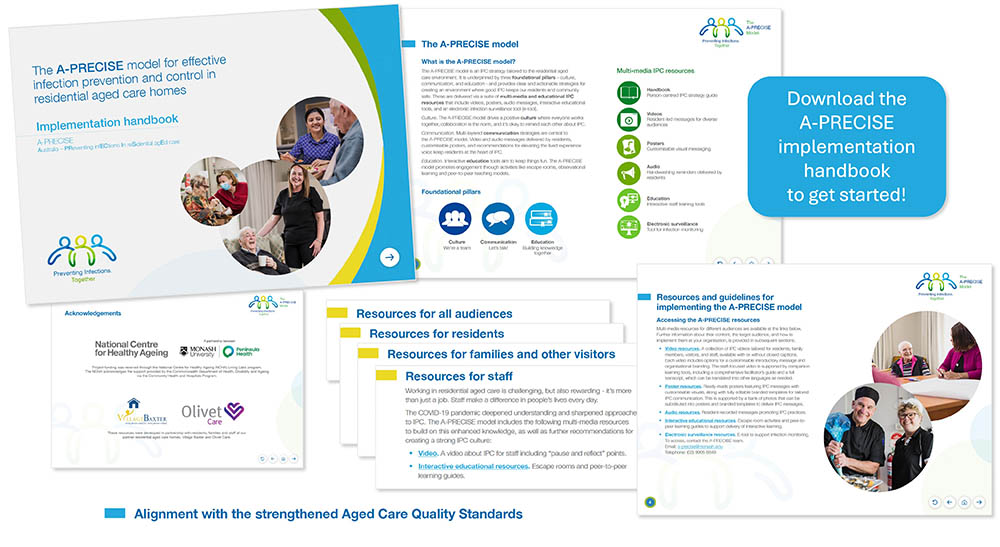
Download the A-PRECISE handbook via the NCHA website
Professor Rawson said it was vital the model’s resources addressed the unique, shared living environments of residential aged care homes and acknowledged that for the residents, it was also their home.
“People in residential aged care homes really want to be the centre of their care. They want to have a say and be part of what happens. They know infections can have a very detrimental impact on their health,” Professor Rawson said.
“The new resources were needed because it was really highlighted by the COVID-19 pandemic that infection prevention and control processes developed for the acute care setting just aren't appropriate for residential aged care homes. We know that the environment is different, and the workforce is different.”
With workforce pressures and residents often living with multiple co-morbidities, the challenge of infection prevention and control is unique in aged care residential homes. Balancing safety alongside dignity, comfort, and a sense of community has never been more critical.
Professor Russo said in Australia there is a big gap in knowledge about infections in residential aged care homes compared to hospital settings.
“There is no routine national data on infections in aged care homes. It's estimated about three per cent of residents at any given time have an infection that they've acquired in the aged care home,” Professor Russo said.
“There’s a big gap in what we know about infection prevention.Resources for acute care don't automatically fit and shouldn't be generalised across aged care. Aged care deserves to have its own specialty knowledge in this space.”
Professor Rawson said the A-PRECISE model aims to implement cultural change around infections, changes in people’s behaviours and raising awareness, by providing clear and actionable strategies for creating an environment where good infection prevention and control practices can keep residents, staff, and the aged care community safe.
“These resources can be used by any aged care provider, in any location, whether it's metropolitan, regional, or rural, it's adaptable based on their specific environment and needs,” she said.
“We are very grateful for the meaningful collaboration with residents, families and staff, in developing this strategy, and to the National Centre for Healthy Ageing for supporting not just what we did but how we did it. Co-design with residents and staff requires time and resources, and their support was integral to the project’s success.”

Video resources available on the A-PRECISE project page on the NCHA website
The co-design approach was welcomed by two Victorian-based organisations involved in the A-PRECISE study, The Village Baxter in Frankston South and Olivet Care in Ringwood.
Cathrynne Emanuel, the Infection Prevention and Control Lead and Nurse Unit Manager at The Village Baxter, said the A-PRECISE project brought together a dedicated resident group whose living experience directly shaped meaningful improvements in infection prevention practices.
“The creation of a comprehensive suite of practical, resident‑centred materials now suitable for use across aged care homes is a stronger, more empowered approach to infection control that elevates safety and engagement across the sector.”
At Olivet Care, using the new resources has already had a positive impact, according to Infection Prevention and Control Lead, Julie Preston.
“The A-PRECISE resources really helped lift awareness and make safe practices part of everyday routine for everyone at Olivet. We’ve noticed better hand hygiene habits and a stronger sense of confidence in keeping our environment safe and healthy,” she said.
Sheila, a resident involved in the study from Village Baxter, explained what she hoped the new resources would achieve.
“I hope they make everyone just a bit more aware of hygiene and infection control, but not be afraid of it. Yeah, I think that's important. It should just become automatic.”
The new A-PRECISE resources are available HERE.