
MoLBi passes 250 tumour milestone and turns focus to promising cancer treatment discoveries
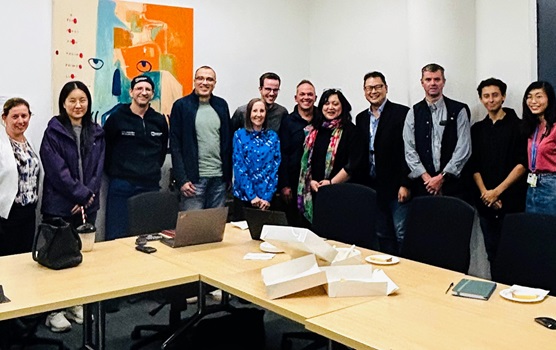
The MoLBi team
The Monash Live Biobanking (MoLBi) platform - a joint initiative between Monash University and Monash Health that collects, preserves and analyses live cancer tumour biospecimens - has reached another significant milestone, having recently collected its 250th tumour specimen, representing tenfold growth in just over 12 months.
MoLBi was established through a close partnership between clinical and research teams, co-led by Dr Gwo-Yaw Ho, medical oncologist and clinician-scientist from the School of Clinical Sciences at Monash Health and Professor Justin Moore, Director of Neurosurgery at Monash Health. The platform is powered by the joint efforts of neurosurgeons, oncologists, nurses, theatre staff, lab scientists and project managers who work together to collect tumours that would otherwise be discarded following routine clinical care and preserve them for profiling, testing and trialling bespoke treatment options.
Focused initially on some of the hardest-to-treat cancers with the poorest prognoses - brain tumours, gynaecological malignancies and upper gastrointestinal cancers - the platform team has a strong vision to shift the dial for these patients through the principles of precision oncology, an approach where treatments are designed to fit the unique biological characteristics of a person’s tumour.
MoLBi is also supported by an engaged group of consumer advocates. On hearing the news that the platform had passed the 250 tumour milestone, advocate, platform supporter and glioblastoma patient Mark Norris posed a simple but important question to Dr Ho: “You’ve collected 250, but what does that actually mean? Does it make a difference to patients?”
“It was a good question,” said Dr Ho. "It challenged us to look beyond the milestone itself and focus on the impact we are creating. We started asking how many specimens we've processed, how many samples we've shared with collaborators, how many tumour models we've generated and, ultimately, how many translational research projects we are supporting."
"Collecting tumours is not the goal,” he said. “The goal is to transform those specimens into new knowledge, new technologies and, ultimately, better treatment options for patients."
Since its launch, the platform has enrolled more than 300 patients and processed almost 306 tumour specimens, generating patient-derived primary cell lines, CAM models, xenograft models and multi-omic datasets that are now supporting numerous collaborative research projects, including four major translational research initiatives.
The first is the Phase Zero study, in which Dr Ho’s team is seeking to test whether novel therapies can reach and target tumours in the brain, despite the generally low success rate of drug therapies for glioblastoma. Taking advantage of the unique MoLBi platform infrastructure, patients receive a short course of an investigational therapy before planned surgery, allowing researchers to directly measure drug concentrations within tumour tissue once it has been removed.
This is the first step towards testing whether the drug has the potential to be effective, rather than exposing patients to therapies that carry toxicity and side effects for no benefit. Initial studies are expected to focus on novel agents, including the CHK1 inhibitor PEP07 and PRMT5 inhibitor PEP08, developed by PharmaEngine.
A second project will focus on testing the potential effectiveness of mRNA cancer vaccines in patients with few or no remaining treatment options. Researchers use genomic and molecular profiling to identify tumour-specific antigens and determine whether patients are suitable candidates for therapeutic cancer vaccines. MoLBi is currently collaborating with Providence Therapeutics, a Canadian biotechnology company developing mRNA-based cancer immunotherapies. For suitable patients, these vaccines may be accessible through compassionate access pathways or future clinical trials.
A third project aims to develop highly personalised T-cell receptor therapies, known as TCR-T therapy. Using tumour samples collected through MoLBi, researchers combine genomic sequencing, immunopeptidomics and immunology to identify tumour-specific targets that are recognised by the immune system. These targets can then be used to engineer a patient's own immune cells to recognise and attack cancer cells. The platform has already identified previously unrecognised tumour targets in ovarian and brain cancers that may form the basis of future personalised immunotherapies.
"This is one of the most exciting areas of cancer research globally," said Dr Ho. "The ability to discover entirely new tumour targets directly from a patient's cancer would not be possible without access to living tumour tissue."
The fourth project, in collaboration with Professor Yiannis Ventikos, Professor Nicolas Voelcker, Professor Raman Singh from Monash University’s Faculty of Engineering, Dr Santosh Panjikar from Australian Synchrotron (ANSTO), and a multidisciplinary team of engineers, neurosurgeons and cancer researchers, aims to develop an implantable tumour-treating fields device capable of delivering low-intensity electrical fields directly to brain tumours.
Current tumour-treating field technologies require patients to wear external electrodes continuously. The team's vision is to develop an implantable system that could deliver therapy directly within the surgical cavity following tumour removal. While still in its early stages, the project represents a novel convergence of engineering, neuroscience and oncology.
The growth of MoLBi, and the translational projects it now nurtures has been rapid and exciting.
“None of this existed 18 months ago,” said Dr Ho. "With initial support through a Monash Health Research Support Package and the commitment of many colleagues across Monash Health and Monash University, particularly Professor Justin Moore, we have established the foundations of a translational precision oncology platform that links patients, clinicians, scientists and industry partners in real time."
Dr Ho believes that the lived experience and advocacy of the MoLBi’s consumer partners have been central to shaping the platform. Consumer representatives, including Brain Tumour Alliance Australia Chair Craig Cardinal, Sarah Tozer, whose 24-year-old son is living with a diffuse hemispheric glioma diagnosis, and Dr Nathan Dalton, a doctor whose mother has glioblastoma, and Mark Norris have become active contributors to the platform.
Rather than acting solely as advisors, consumer partners help shape research priorities, challenge assumptions, participate in strategic planning discussions, assist with fundraising and philanthropic engagement, contribute to public advocacy, and ensure that the platform remains focused on issues that matter most to patients and families. Several consumer representatives now sit on MoLBi governance and steering committees, helping guide the platform's strategic direction and ensuring research priorities remain aligned with patient needs.
"Our ambition is not simply to build a biobank," said Dr Ho. "Our ambition is to create a learning ecosystem where every tumour contributes knowledge that can guide future treatments, accelerate therapeutic development and bring promising discoveries back to patients faster."
While glioblastoma remains one of the most challenging cancers to treat, the MoLBi team hopes that integrating molecular profiling, personalised therapeutics and innovative clinical trial designs will contribute to meaningful improvements in patient outcomes over the coming decade.
“By bringing together surgeons, oncologists, scientists, engineers, industry partners and consumer advocates within a single ecosystem, MoLBi provides a rare opportunity to move discoveries from the operating theatre to the laboratory and back to patients.”
Find out more about MoLBi