
Using existing medicines to help the immune system fight ovarian cancer
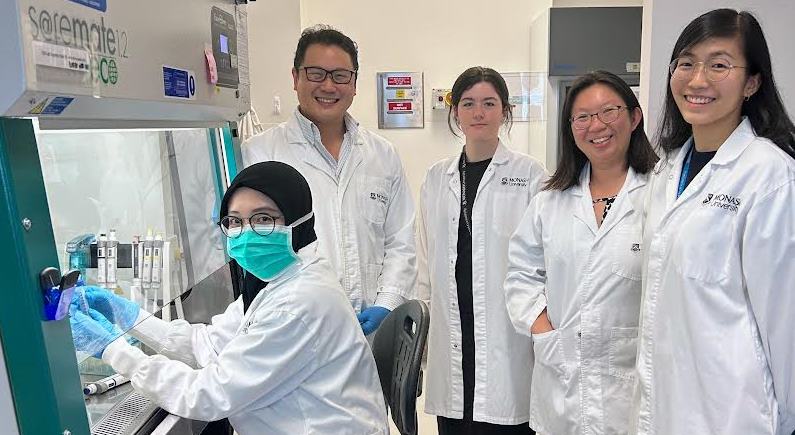
OCRF grant recipient, Dr Gwo Yaw Ho and the Cancer Immunology Laboratory team
A key challenge in treating ovarian cancer is the immune system’s inability to recognise and attack tumour cells. Current conventional immunotherapies work best when immune cells are already present in the tumour (“hot” tumours), but they are less effective in tumours that lack these immune cells (‘cold” tumour) or in tumours that can hide from the immune system. To overcome these challenges, we need to find new ways to reshape the tumour microenvironment so that the immune system can better recognise the cancer and allow existing immunotherapies to work more effectively.
Dr Gwo Yaw Ho, Head of the Cancer Immunology Laboratory in the Department of Medicine, School of Clinical Sciences and Consultant Medical Oncologist at Monash Health received a $260,000 proof-of-concept research grant from the Ovarian Cancer Research Foundation (OCRF) for his research on using old drugs in new ways to make ovarian cancer cells visible to the immune system. This study, developed in collaboration with Professor Grian Gabrielli of Mater Research Institute, The University of Queensland, explores combining a targeted treatment called a CHK1 inhibitor (CHK1i) with low-dose chemotherapy (hydroxyurea), both of which are taken in tablet form.
“This grant will help us bring our discoveries closer to human clinical trials”, said Dr Ho. “We are testing the treatment combination in high-grade serous ovarian cancer , the most common and aggressive form of gynaecological cancer and hope to extend this work to other subtypes, such as clear cell ovarian cancer, in the future”.
In their laboratory studies, recently published in British Journal of Cancer (BJC) (Zheng et al 2026), this combination has been shown to kill a wide range of ovarian cancer cells, including those resistant to standard treatments, and is more effective than either treatment alone. Importantly, early laboratory studies suggest this combination avoided harmful cell stress, which may mean that side effects like hair loss that occur with higher doses may be reduced or prevented.
About Monash University
Monash University is Australia’s largest university with more than 80,000 students. In the 60 years since its foundation, it has developed a reputation for world-leading high-impact research, quality teaching, and inspiring innovation.
With four campuses in Australia and a presence in Malaysia, China, India, Indonesia and Italy, it is one of the most internationalised Australian universities.
As a leading international medical research university with the largest medical faculty in Australia and integration with leading Australian teaching hospitals, we consistently rank in the top 50 universities worldwide for clinical, pre-clinical and health sciences.
For more news, visit Medicine, Nursing and Health Sciences or Monash University.
MEDIA ENQUIRIES