
What I'm Working On: Jessica Da Gama Duarte
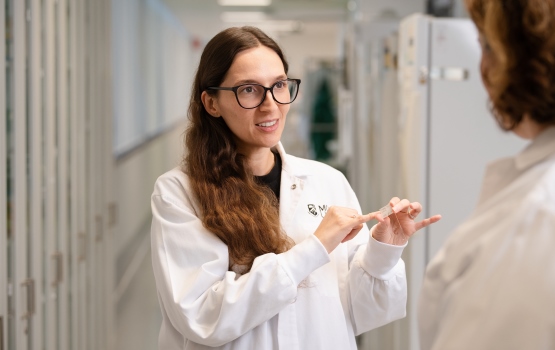
Dr Jessica da Gama Duarte (Lab head, Tumour Immunology Laboratory, Cancer Medicine) is an expert in protein microarrays and tumour immunology, with a specific focus on B cells, antibody production, and Tertiary Lymphoid Structures.
I lead a laboratory focused on a deceptively simple question: can we understand and monitor cancer more effectively using antibodies circulating in our blood?
Antibodies tell a story. They circulate in our blood, and are easily accessible through something as non-invasive as a finger prick. But they do more than hint at past infections or vaccinations—they can also reveal the presence, behaviour, and evolution of cancer. My team works with protein microarrays—advanced slides that can detect antibodies against hundreds to thousands of specific proteins—to map a patient’s antibody profile. These unique fingerprints give us insight into that person’s immune system’s interaction with cancer.
We use protein microarrays to identify diagnostic, prognostic, and predictive biomarkers. In plain terms, we’re trying to answer: Does this person have cancer? How aggressive is it? Will they respond to treatment or suffer serious side effects?
B cells, the precursors of antibodies, are often overlooked in cancer immunology, which has historically favoured T cells. But B cells are crucial. They partner with T cells in the immune response, especially within structures called tertiary lymphoid structures (TLSs) — essentially mini lymph nodes forming near tumours. These TLSs are also known as antibody producing factories, where terminally differentiated B cells can secrete antibodies against tumour-specific or -associated proteins.
We’ve discovered that not all TLSs are created equal. Only mature TLSs generate strong anti-tumour responses. These contain active germinal centres (which produce antibody-secreting B cells and conventional memory B cells) and supportive cells like T helper cells and dendritic cells, along with high endothelial venules that facilitate lymphocyte migration from the bloodstream. If these components are missing, the TLS is immature—present but ineffective, or worse, possibly promoting tumour growth.
Our diagnostic research spans multiple cancers. In melanoma, we’ve identified antibody signatures that detect early-stage disease with up to 98 per cent accuracy. In prostate cancer, antibody patterns distinguish between low-grade and aggressive disease, potentially improving screening beyond unreliable PSA tests. Lung cancer—where there’s no routine screening—also shows promising antibody markers, and we're now scaling up to validate a pan-cancer diagnostic panel.
We’re also studying predictive biomarkers to treatment. In melanoma, for instance, we can at times predict which patients will benefit from immunotherapy—enabling doctors to only treat those likely to benefit. Conversely, patients at risk of immune-related toxicities often show abnormal, broad-spectrum antibody activity before or early on-treatment. In some cases, we could predict toxicity weeks before symptoms appeared.
What makes this truly powerful is accessibility. We’ve developed a method to use dried blood spots from a finger prick—collected at home and mailed in—for array testing. This opens the door to widespread, low-barrier testing, particularly in rural or resource-limited settings.
However, translating this to the clinic is complex. Biomarkers must be rigorously validated, independently reproduced, and integrated into clinical trials before they’re adopted. This requires substantial funding—often beyond what traditional grants provide. But the promise is there: we’re on the cusp of tests that could detect cancer, guide treatment decisions, reduce harm, and save lives.
In short, we’re decoding the language of antibodies—learning how they reflect disease, treatment, and immune dynamics. Every profile is a snapshot of the immune system’s war room. And through this lens, we hope to bring precision medicine closer to reality for people facing cancer.
About Monash University
Monash University is Australia’s largest university with more than 80,000 students. In the 60 years since its foundation, it has developed a reputation for world-leading high-impact research, quality teaching, and inspiring innovation.
With four campuses in Australia and a presence in Malaysia, China, India, Indonesia and Italy, it is one of the most internationalised Australian universities.
As a leading international medical research university with the largest medical faculty in Australia and integration with leading Australian teaching hospitals, we consistently rank in the top 50 universities worldwide for clinical, pre-clinical and health sciences.
For more news, visit Medicine, Nursing and Health Sciences or Monash University.
MEDIA ENQUIRIES