
Monash students set sights on the sun with stratospheric balloon telescope
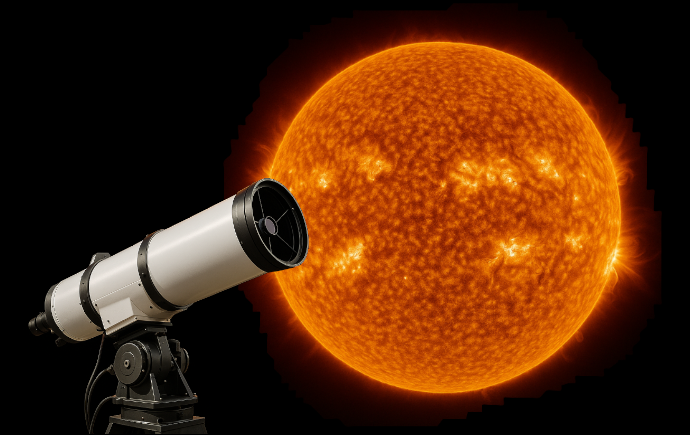
Caption: A telescope aimed at the sun
Credit: Photo supplied
What happens when you hand a telescope, a stratospheric balloon, and a bold challenge to a group of curious university students? At Monash, you get Monash High Altitude Balloon (MHAB) a student-led solar imaging experiment that’s literally aiming for the sky.
Launched as part of the Faculty of Science’s IGNITE program, Project MHAB is bringing together more than 40 Monash students from Science, Engineering, IT, AI, Law and Business to design, build and eventually launch a solar telescope into the stratosphere. Their mission? To capture images of the Sun from near-space using a balloon-based platform, an affordable and innovative alternative to expensive space missions or atmosphere-limited ground telescopes.
“Balloon-based imaging allows us to rise above most of Earth’s atmosphere, which means clearer solar images and better data,” said Dr Alina Donea, a solar physicist from the School of Mathematics at Monash University and the project’s academic lead. “This is cutting-edge science and an incredible educational opportunity for our students.”
MHAB is inspired by SunBYTE, a successful UK student initiative from the University of Sheffield, with whom Monash students are collaborating. The joint team has already been shortlisted for the prestigious European Space Agency’s BEXUS program, an annual launch of scientific payloads via stratospheric balloons over Sweden.
At the time of writing this story two Monash student representatives were travelling to the Netherlands to present the team’s design at a final selection workshop.
Jack Bray, a final year science and engineering student said: “For science students, BEXUS is a rare chance to apply our learning to real experiments in a near-space environment and develop skills beyond the classroom“.
Aayush Prashanth, a final-year engineering student said: “Meeting global leaders in space science through BEXUS is a milestone that proves our balloon mission has real scientific potential, and we’re absolutely thrilled to absorb everything we can and elevate our work to new heights.”
Dr Donea is using IGNITE and her research funds to support one student’s travel, while the Faculty of Engineering has agreed to contribute $5,000 to support the second. The School of Mathematics has also provided funding and hosts the project’s head office.
“This project showcases the best of Monash, interdisciplinary collaboration, global partnerships, and student-led innovation,” Dr Donea said. “Students are progressing through formal design reviews while developing hardware prototypes, a motorised gimbal with autonomous sun-tracking software, and custom science-experiment gondolas for upcoming balloon launches. They’re learning by doing, and it’s extraordinary to witness.”
The team has also presented to the Preliminary Design Review Workshops and 3D printing of telescope components. Four student members will be attending the National Space Science Conference in Melbourne this week. They will begin planning a Space Science and Balloon Platform Workshop for 2026 and prepare to test their electronics and telescope systems from remote locations in early 2026.
A new Science Sub-Team will be launched in early 2026, with student enrolments opening soon. Students will be able to develop science projects for payloads suitable for the extreme stratospheric environment, ranging from biological cell studies and radiation measurements to high-resolution solar observations in Ca-K and Helium spectral lines, as well as mathematical simulations of atmospheric flows, buoyancy-driven ascent, and payload dynamics to support mission design and data interpretation.
“MHAB is more than a mission, it’s a launchpad for future careers in aerospace, science, and engineering,” said Dr Donea. “We’re not just looking at the Sun. We’re helping students shine.”
Further information
Silvia Dropulich
Marketing, Media & Communications Manager, Monash Science
T: +61 3 9902 4513 M: +61 435 138 743
Email: silvia.dropulich@monash.edu