
Professor Katya Pas: fearless in science, passionate about equity
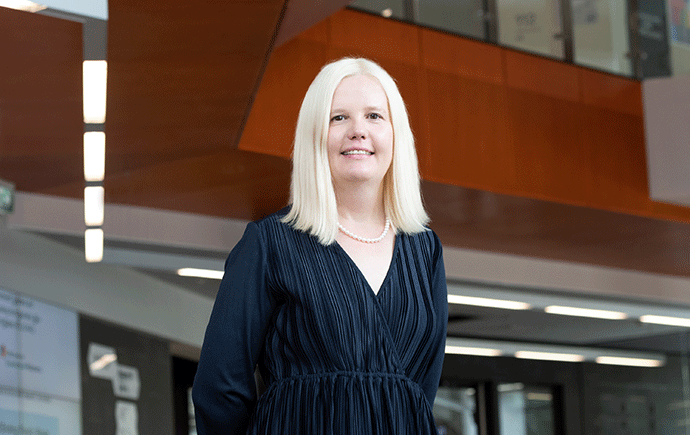
Professor Katya Pas
“If I could give one piece of advice to anyone aspiring to excel in science, it would be to never let your background, or what others expect of you, define your limits. Science is a field that thrives on diversity of thought, and every unique perspective has the potential to spark greatness,” says Professor Katya Pas, Associate Dean (Research) in the Faculty of Science.
These values resonate deeply with the Ratatouille quote she loves: “Your only limit is your soul. Anyone can cook… but only the fearless can be great.”
Professor Pas’s remarkable journey from a young chemist in Russia to a globally recognised leader in computational chemistry reflects a deep commitment to excellence and an enduring belief in the power of science to change lives.
Yet, she is acutely aware that her own success is not the norm for many aspiring scientists, especially women and those from underprivileged backgrounds.
The disparities highlighted in the 2024 Chemistry World article about socioeconomic inequality in Nobel Prize winners are not lost on her. The finding that laureates overwhelmingly come from wealthier families underscores systemic barriers that continue to exclude many talented individuals from achieving their potential in science.
“This reality isn’t just a problem for the individuals who are excluded,” Professor Pas said. “It’s a loss for science itself. How many discoveries have we missed because brilliant minds lacked the opportunity to flourish?”
The theme of inclusion and equity takes on even greater significance as we celebrate the UN International Day of Women and Girls in Science.
Professor Pas emphasises that the barriers are not merely cultural or attitudinal but often structural.
“When I joined the School of Chemistry at Monash 18 years ago there were no female professors. Now we have five female professors,” Professor Pas said.
“It may seem like a drop in the ocean compared to other schools but this shows a lot of progress has been made. Another impressive example of Monash University committing to reducing barriers for women is the number of strong female senior leaders including our Vice-Chancellor, Provost and Deputy Vice-Chancellors for research and education. Having worked with DDRs at other Australian universities I cherish this tremendous progress at Monash University. The culture that has been created is supportive and nurturing.”
“Funding, access to mentorship, the availability of resources — these are critical factors that determine who gets to succeed in science. And too often, they are distributed inequitably,” she said.
Her own story is a testament to the transformative power of access. After completing her Dr. Rer. Nat. in theoretical chemistry in just three years, she gained opportunities through prestigious fellowships that allowed her to establish the Monash Computational Chemistry Group.
These fellowships not only provided funding but also recognition and institutional support — privileges that she acknowledges were pivotal in shaping her career.
Through her leadership roles at Monash University and beyond, Professor Pas is working to create a more inclusive scientific community. She has implemented initiatives to support early-career researchers, particularly women, and has been a vocal advocate for policies that address gender equity and diversity.
“Science is not just about solving problems; it’s about asking the right questions. And to ask the right questions, you need a diversity of perspectives,” Professor Pas said. “Women and girls bring unique insights to the table, and ensuring their full participation is not just a matter of fairness; it’s essential for the progress of science itself.”
She points to her group’s research on green and sustainable technologies as an example of how diverse ideas can lead to innovation. From designing adhesive coatings to developing radical organic batteries, her work addresses global challenges while demonstrating the interdisciplinary nature of modern science. “These achievements aren’t just mine,” she insists. “They’re the product of a team that values collaboration and inclusivity.”
As we mark the UN International Day of Women and Girls in Science, Professor Pas hopes the occasion serves as a catalyst for action. “Together with celebrating achievements we should also focus on dismantling barriers,” she said. This includes addressing biases in hiring and funding processes, creating flexible career pathways to support work-life balance, and ensuring that all students, regardless of background, have access to high-quality education and mentorship.
Professor Pas also believes that stories like hers should inspire not only aspiring scientists but also policymakers and educators to rethink how we define and nurture talent.
“Talent is everywhere,” she said, reflecting the sentiments of the Chemistry World article. “What we need is a system that recognises and nurtures it, regardless of where it comes from.”
For Professor Katya Pas, science is a fearless pursuit, one that demands boldness not only in experimentation but also in the way we think about who gets to participate. Her message to the next generation of scientists is simple: “Be fearless. Take risks. And remember, the future of science belongs to everyone.”
This piece is part of our International Day of Women and Girls in Science profile series. Read more here.
Further information
Silvia Dropulich
Marketing, Media & Communications Manager, Monash Science
T: +61 3 9902 4513 M: +61 435 138 743
Email: silvia.dropulich@monash.edu