
Dr Khay Fong: Scientific truth isn’t static, it evolves as evidence evolves
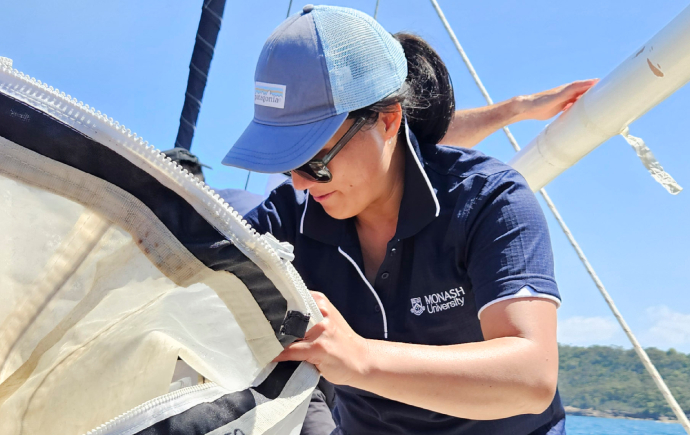
Dr Khay Fong
Dr Khay Fong has always been fascinated by transformation. As a child, she mixed things simply to see what would happen: how colours shifted, textures changed, or materials reacted.
“That’s essentially what I’ve done at different points in my career,” she reflects. “The difference now is that I understand the molecular reasons behind it.”
Today, she leads a research team tackling two of the most urgent scientific challenges of our time: designing smarter nanomedicines by controlling lipid self‑assembly, and developing advanced methods to detect micro- and nanoplastics in the environment and at the interface with human health. Both streams speak directly to global health and sustainability—two areas where scientific innovation is desperately needed.
Her work sits at the intersection of health research, artificial intelligence, and STEM entrepreneurship. Her team recently developed a compact, fast AI algorithm that outperforms human analysts in identifying microplastics from environmental samples. “This algorithm is now being translated into a commercial product,” she explains, crediting her PhD student, Frithjof Herb, who is leading their newly funded AEA grant. “It will enhance spectroscopy capabilities across analytical chemistry applications.”
But her impact extends far beyond the lab. As Course Director for the Master of Green Chemistry and Sustainable Technologies, she is shaping the next generation of scientists to embed sustainability into every layer of chemical design. “The future of chemistry must fundamentally shift toward sustainability,” she says. “We need to minimise waste, eliminate harm, and design materials that can be remade or repurposed rather than becoming permanent pollutants.”
Her journey has been defined by curiosity, resilience, and a willingness to do things differently. She recalls a defining moment early in her PhD: leading 48 continuous hours of synchrotron beamtime.
“I watched sunrise from the same window twice before I slept again,” she laughs. “But the data from that session unlocked my first papers on laser‑activated lipid nanoparticles.”
When asked about challenges, she offers a candid perspective. “I don’t like the way we frame questions about women in science. I am where I am because of who I am. I learned early that I had to do things differently to get things done, and it’s because of my personal experience that I’m here, not despite it.”
She credits her PhD supervisor, Professor Ben Boyd, as a pivotal influence. “He treats people according to their ability, not what they look like or who they love. He created a collaborative atmosphere that I’m sure all of us carry through the rest of our careers.”
Her advice to young women and girls considering science is characteristically direct: “You do you. Choose excellence, but don’t be a dick about it. Never stop being curious. Don’t be afraid to make mistakes.”
Outside the lab, she rock climbs [“problem‑solving but exercise”] and plays piano, a hobby she returned to after a bike accident left her with a concussion. “It’s funny how brains work,” she says.
If there’s one thing she wishes more people understood about science, it’s that knowledge is never final. “Scientific truth isn’t static, it evolves as evidence evolves. That’s not a weakness of science; it’s its greatest strength.”
Today, we celebrate her work, her leadership, and her commitment to building a more sustainable, equitable, and innovative future in STEM.
This piece is part of our International Day of Women and Girls in Science profile series. Read more here.
Further information
Silvia Dropulich
Marketing, Media & Communications Manager, Monash Science
T: +61 3 9902 4513 M: +61 435 138 743
Email: silvia.dropulich@monash.edu