
Two stacked 2D materials act like a 3D crystal, scientists find
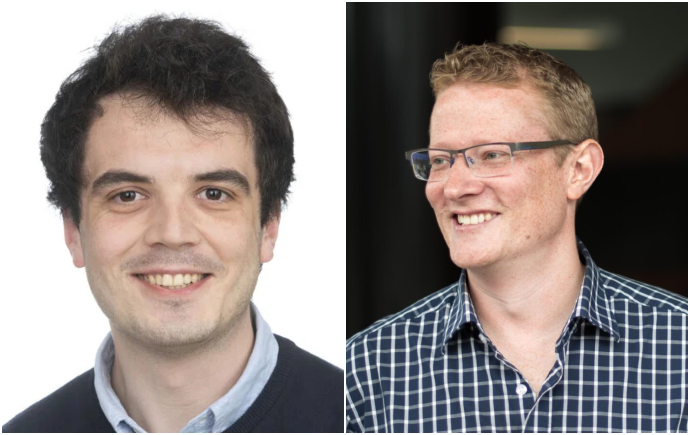
Dr Oliver Clark and Associate Professor Mark Edmonds
A pair of atomically thin materials can behave like a full three-dimensional crystal, according to new research led by Monash University in collaboration with the University of Manchester, Diamond Light Source and international researchers. The discovery shows that even simple van der Waals heterostructures can mimic the electronic behaviour of bulk solids, creating a powerful new platform for tunable quantum materials.
Published in Newton, the study demonstrates that asymmetric stacks made from just a few layers of transition metal dichalcogenides (TMDs) can host electronic bands that extend coherently across mismatched interfaces. These delocalised states produce emergent energy bands that closely resemble the out-of-plane (kz) dispersions normally seen only in bulk crystals.
“What’s remarkable is that you don’t need a carefully engineered superlattice or dozens of layers,” said lead author Dr Oliver Clark, who was a postdoctoral researcher at the Monash School of Physics and Astronomy when the research was carried out and is now at Diamond Light Source.
“Simply pairing two different TMD flakes is enough for the 3D electronic structure of the new hybrid system to take form.”
Using nano-focused angle-resolved photoemission spectroscopy (nano-ARPES) and first-principles calculations, the team studied heterostructures six to eight layers thick, combining MoSe₂, WSe₂ and NbSe₂ flakes. Despite the absence of periodic stacking, they observed a full set of quantised kz sub-bands—clear evidence that electrons spread across the entire structure.
This behaviour stems from the orbital makeup of TMDs: in-plane orbitals remain confined to individual layers, while out-of-plane orbitals strongly hybridise across the van der Waals gap and even across material boundaries. The result is a mixed-dimensional electronic landscape where 2D and 3D states coexist.
“These asymmetric stacks behave like artificial crystals with properties you can’t find in nature,” said senior author Associate Professor Mark Edmonds. “They can host kz-driven topological transitions, semimetallic phases with spatially separated carriers, and other phenomena normally restricted to bulk compounds.”
With more than 30 stable TMDs available, the approach opens a vast design space for custom quantum materials. By selecting different combinations, thicknesses or twist angles, researchers can tune band gaps, engineer topological states or manipulate correlated phases—all within a simple, modular platform.
The findings position intermediate-layer TMD heterostructures as promising building blocks for next-generation nano-quantum devices, offering a practical route to 3D band engineering without the complexity of epitaxial growth or multilayer fabrication.
Further information
Silvia Dropulich
Marketing, Media & Communications Manager, Monash Science
T: +61 3 9902 4513M: +61 435 138 743
Email: silvia.dropulich@monash.edu