
Fragile bird footprints dating back to over 100 million years discovered on the Southern Australia coast
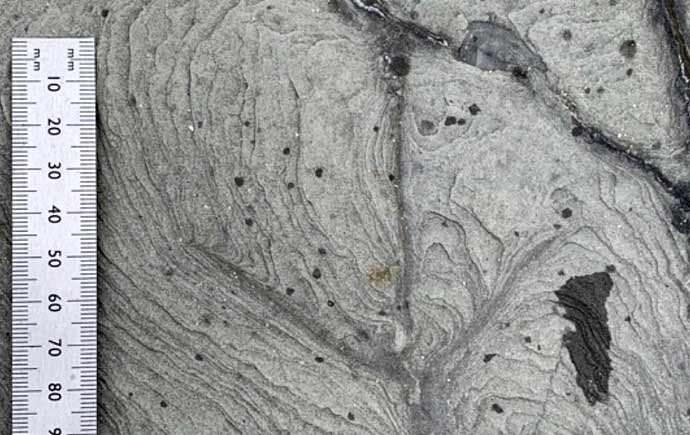
An international team of researchers involving Monash University scientists has found that birds set foot near the South Pole in the Early Cretaceous period, providing the oldest-known evidence for birds so far south.
The discovery of 27 avian footprints on Australia’s southern coast is detailed today in PLOS ONE in a study which shows some of the oldest, positively identified bird tracks dated between 120 million and 128 million years ago.
Most of the bird tracks and body fossils dating as far back as the Early Cretaceous are from the Northern Hemisphere, particularly from Asia. The new discovery shows that there were many birds, and a variety of them, near the South Pole about 125 million years ago.
“This is the first occurrence of birds here in the south along with tracks of dinosaurs, and invertebrates mostly unknown until the last few years,” said study author Emerita Professor Patricia Vickers-Rich, from the Monash University School of Earth, Atmosphere and Environment.
The study was led by Professor Anthony Martin from Emory University with collaborators from Monash University and the Museums Victoria in Australia; the Benemérita Normal School of Coahuila in Mexico and the Smithsonian Institution.
The 27 bird tracks identified in the study vary in form and size and are among the largest known from the Early Cretaceous. They range from seven to 14 centimetres wide, which is similar to tracks of modern-day shorebirds, such as small herons and oystercatchers.
The tracks were found in the Wonthaggi Formation south of Melbourne. The rocky coastal strata mark where the ancient supercontinent Gondwana began to break up around 100 million years ago when Australia separated from Antarctica.
The polar environment at that time was a rift valley with braided rivers. Although the mean annual air temperature was higher during the Cretaceous than today, during the polar winters the ecosystem experienced deep, freezing temperatures and months of darkness.
The Wonthaggi avian tracks occurred on multiple stratigraphic levels, indicating a recurrent presence of a variety of birds. It also suggests seasonal formation of the tracks during polar summers, perhaps on a migratory route.
The Wonthaggi Formation is famous for its variety of polar dinosaur bones, although bird-fossil finds are extremely rare. The Cretaceous strata of the formation has yielded only one tiny bird bone — a wishbone — and a few feathers.
“Birds have such thin and tiny bones,” said Professor Martin. “Think of the likelihood of a sparrow being preserved in the geologic record as opposed to an elephant - birds are also lightweight and don’t leave much of a foot impression.”
Co-author Melissa Lowery, a local volunteer fossil hunter, first spotted some of the tracks in the current discovery in 2020. Dubbed “the doyenne of dinosaur discovery,” Lowery has found hundreds of bones and more than 100 dinosaur footprints.
Due to travel restrictions during the COVID-19 pandemic, Professor Martin had to wait until 2022 before he could travel to the site to lead the analyses of the tracks. He was joined in the field by co-authors Professor Vickers-Rich, and Thomas Rich, curator of vertebrate paleontology at Museums Victoria. The couple have led a major effort since the 1970s to uncover fossils in the Australian state of Victoria and to interpret the biota of Gondwana. Also assisting in the field analyses were co-authors Professor Mike Hall, a geologist at Monash University, and Peter Swinkels, a taxidermist at Museums Victoria.
The fossil record indicates that birds evolved from theropods, a bipedal, carnivorous dinosaur clade. The theropod Tyrannosaursus rex, for instance, had a vestigial rear toe — evidence that T. rex shared a common ancestor with birds.
The discovery of the Australian bird tracks raises questions about where the birds originated and whether the polar environment was part of a migratory route.
“Seven of the tracks that Melissa found in 2020 are no longer there,” Professor Martin said. “Some fossils, including tracks, are exposed only for a brief amount of time after being buried for millions of years. We humans have to rush in and document them before they disappear again.”
Media enquiries:
Silvia Dropulich
Marketing, Media & Communications Manager, Monash Science
T: +61 3 9902 4513 M: +61 435 138 743
Email: silvia.dropulich@monash.edu