
From Science degree to planetary defence: how Mark Fittock’s science background contributed to the Hera mission
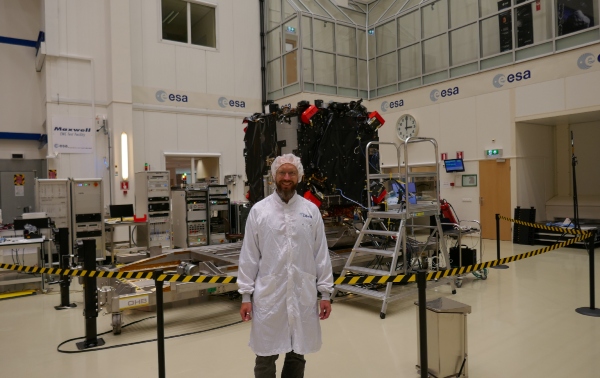
Mark Fittock standing in front of the spacecraft at European Space Agency.
In a world where space exploration and planetary defence are becoming increasingly critical, science graduates like Mark Fittock play a vital role in shaping the future.
As a 2006 graduate of a Bachelor of Science/Engineering, Mark now holds the prestigious position of Project Manager at OHB, where he has been instrumental in the early phases of the European Space Agency’s (ESA) Hera mission. This mission, which aims to study the effects of a kinetic impact on an asteroid, is an essential step in understanding how to protect Earth from potential asteroid threats.
The Hera asteroid probe was launched on 7 October 2024 at 16:52 CEST on a Falcon 9 rocket from SLC-40 at the Cape Canaveral Space Force Station in Florida. After separation from the rocket, Hera sent her first sign of life from space at 18:13 CEST. There was great cheer from all the teams when this ‘first signal’ was received.
Hera is now on her way to the double asteroid system Didymos / Dimorphos. OHB System AG, a subsidiary of the space and technology group OHB SE, has developed, built, and tested the asteroid probe on behalf of the European Space Agency (ESA) in only four years
Mark’s role as Project Manager in the early phases of the Hera mission involved navigating a range of scenarios together with the team at OHB to ensure that the mission could launch in 2024—a goal that seemed ambitious at the time. Reflecting on his journey, Mark highlights how his science degree laid the foundation for his success in such a cutting-edge project.
“My science degree helped me understand the purpose of the mission, the data needed, and the many cameras on board,” Mark said. His scientific training not only provided the technical knowledge required for the mission but also enabled him to communicate effectively with the science team, fostering the cooperation needed for Hera’s success.
Communication and teamwork are vital for missions such as these. Mark recalled, “The passion which the team had for this mission was evident and it was an amazing experience to work together with the people from OHB and ESA.”
The Hera mission is significant not just for its technological achievements but also for its potential to defend Earth from asteroid impacts.
By analysing the effects of NASA’s DART mission, which successfully deflected the asteroid moon Dimorphos in 2022, Hera will provide critical data on how such deflection techniques can be improved and applied in the future.
“It’s fantastic,” Mark said, “knowing the technology we’ve worked on is part of such a critical mission for planetary defence.”
One of the most exciting innovations of the mission is the use of CubeSats—miniature satellites that Hera will deploy to study the asteroid.
Mark, who also worked with CubeSats while working at GomSpace, is particularly enthusiastic about GomSpace’s Juventas, one of the CubeSats carrying a radar to investigate the asteroid’s interior.
This technology marks the first time scientists will be able to examine the inside of an asteroid, an achievement that has enormous implications for future space exploration and planetary defence strategies.
Despite the tight timeline—four years to design, build, and test the spacecraft—Mark and the team managed to overcome the many challenges they faced, often finding creative solutions.
“The biggest challenge was time itself,” Mark recalled. “We had to constantly challenge the status quo and mindsets to resolve issues creatively. Getting a spacecraft and all its instruments ready in just four years simply couldn’t have been done without this team’s experience and hard work.”
Mark’s journey from a science student to a key player in one of the most critical space missions today serves as an inspiring example of how a science degree can open doors to extraordinary opportunities.
For current science students or recent graduates looking to make their mark in space exploration, Mark offers this advice: “Get out there and start building up your experience. Work on student projects, seek placements in space organizations, and don’t be afraid to take a leap into the unknown.”
As Hera embarks on its journey to study the double asteroid system, the mission not only showcases cutting-edge technology but also the power of collaboration, problem-solving, and scientific curiosity—qualities that are fostered by a solid foundation in science education. For Mark Fittock, his science degree has not only been a stepping stone but a vital asset in contributing to one of the most ambitious space missions of our time.
More information and details about the mission, the probe and its instruments can be found at www.esa.int/hera and OHB technology to protect our planet: Asteroid probe Hera is fit for space.
Media enquiries:
Silvia Dropulich
Marketing, Media & Communications Manager, Monash Science
T: +61 3 9902 4513 M: +61 435 138 743
Email: silvia.dropulich@monash.edu