
Pyrophoric and other highly reactive Flammable Substances
This information sheet provides an overview of the hazards and general risk management requirements associated with pyrophoric and other highly reactive flammable substances.
Pyrophoric chemicals are highly reactive substances that can ignite spontaneously in air or react violently with water, some can produce flammable hydrogen gas.
Some compounds may release toxic gas in contact with water or acids.
Small amounts of these substances can cause fires, violent reactions or generate toxic fumes if not managed correctly.
Examples of Pyrophoric and highly reactive flammable substances in use at Monash University
- Borohydrides: Sodium borohydride, lithium borohydride, potassium borohydride, calcium borohydride
- Metal hydrides: Sodium hydride, lithium aluminium hydride, Calcium hydride
- Cyanoborohydrides: Sodium cyanoborohydride
- Alkali metals: Lithium, sodium, potassium
- Organometallics: Butylmagnesium chloride, organolithium compounds
- Silanes: Methyldichlorosilane, triisopropylsilane, phenylsilane
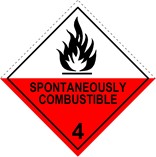
DG Class | Diamond | Description and reactivity |
4.2 |
| Substances liable to spontaneous combustion: Flammable substances that are capable of spontaneous combustion or being heated up in contact with air. |
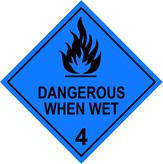
4.3 |
| Substances which, in contact with water, emit flammable gases: On contact with water, these substances can become spontaneously flammable or emit flammable gases in dangerous quantities & form explosive mixtures with air. |
Common GHS Hazard Codes & Statements associated with highly reactive flammables:
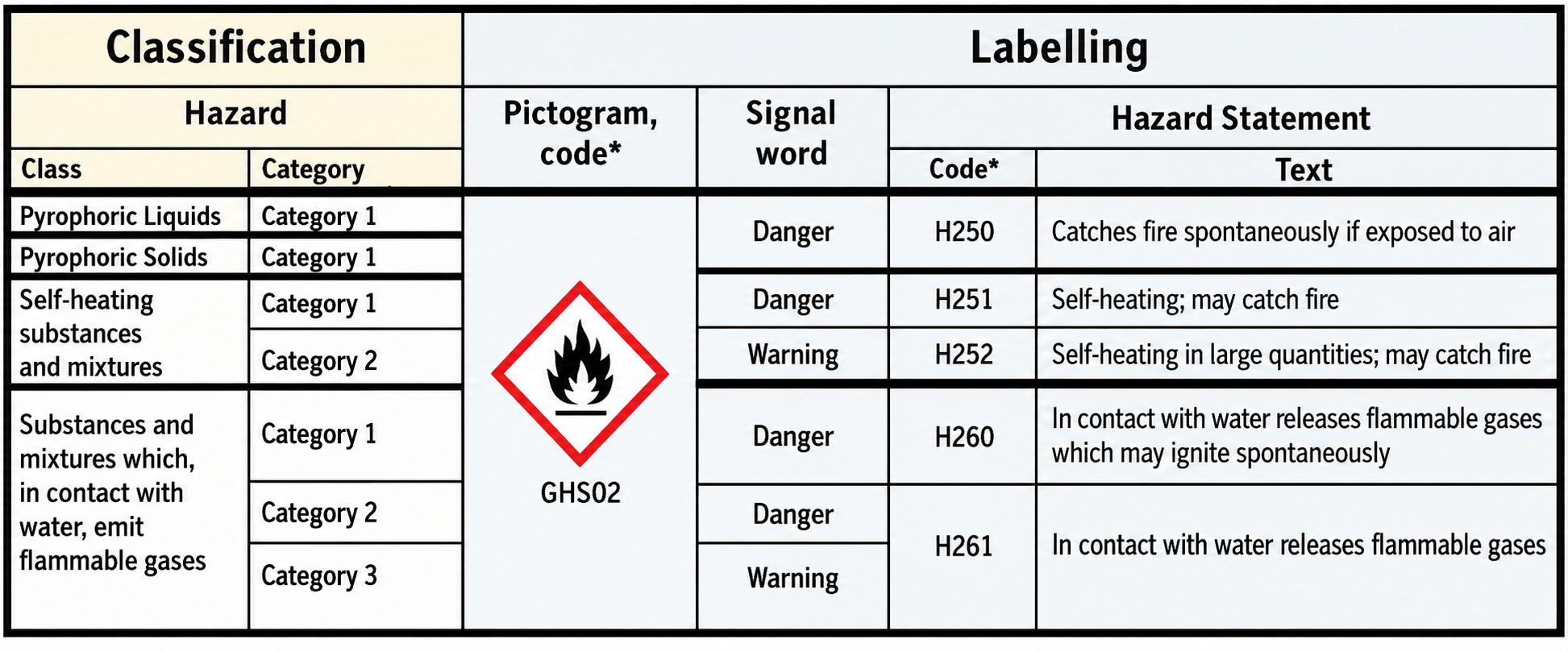
*Source: SafeWork Australia “Classification and labelling for workplace hazardous chemicals poster”
Many pyrophoric and highly reactive flammable substances have other hazardous properties in addition to flammability. These may include being corrosive to skin and eyes or toxic if inhaled or ingested, with some classified as fatal upon exposure.
Always consult the SDS from the supplier or manufacturer to identify the specific hazards, classification, and appropriate control measures for each chemical.
Ensure that you have a thorough understanding of the reactivity of the chemical, and knowledge of appropriate safe handling techniques, before conducting the risk assessment or purchasing. If necessary, seek expert advice.
All activities involving the use of pyrophoric and highly reactive flammable substances must have a risk assessment completed in SARAH. Refer to the Risk Management Guidelines: Chemicalfor guidance.
Safe Work Instructions (SWIs) must be documented following the risk assessment and must include provisions for storage, safe use, disposal, spill management and emergency response.
The most current SDS must be available in Chemwatch and recorded in the relevant manifest folder immediately upon introduction into the laboratory. Maximum aggregate volumes stored in the location must be recorded in the Chemwatch manifest.
All users of pyrophoric and highly reactive substances must complete local competency-based training that includes a thorough understanding of the relevant SWIs and a review of the applicable SDS. Before commencing work, users must demonstrate competency in safe handling technique and be formally signed off by the activity supervisor.
The training records must be maintained locally. The Local OHS Training records proforma may be used.
Risk assessment:
The risk assessment should consider elimination and substitution controls first.
Elimination:
- Dispose of unused or old chemicals via the relevant DG waste stream. Old chemicals may degrade overtime and can become unstable.
Substitution:
- Consider alternative reagents or methods that pose lower risk.
- Purchase and use only the minimum quantity required.
When elimination or substitution is not possible, the following risk management strategies for storage and handling should be considered:
Storage:
- Store in sealed secondary containers (e.g. vacuum desiccator) and/or use dry inert gas to backfill containers before sealing;
- Ensure the secondary container is appropriately labelled. Refer to Labelling of Decanted Chemicals;
- If reagents are received in a specially designed storage or dispensing container, ensure that the integrity of that container is maintained;
- Store in a locked cupboard, accessible only to trained personnel;
- Do not store with oxidisers, flammable liquids, toxic substances or near water sources.
Handling:
- Best practice is to handle the highly reactive substances inside a dry glove box under an inert atmosphere (e.g. nitrogen or argon gas). This is especially important when handling flammable substances that are capable of spontaneous combustion or being heated up in contact with air.
- Prior to commencing work ensure that all equipment (e.g., glassware, syringe needles, spatulas) is dry and is at ambient temperature.
- If a glove box is not available, substances must be handled in a clean, dry fume hood. Keep the sash at the recommended height and avoid working close to the edge of the fume hood. Refer to Fume Cupboards for guidance.
- Ensure that the work area is adequately prepared prior to the work and is free of combustible materials and nonessential chemicals. If working with substances that can react with water, ensure that the water tap is not used. The water supply can be isolated and a warning sign placed on the tap.
- A container of soda ash (powdered lime) or dry sand should be kept within arm’s reach when working with these substances.
- Wear appropriate PPE i.e. lab coat, enclosed shoes, nitrile/neoprene gloves and safety glasses. For the more reactive pyrophorics, consider a fire-resistant lab coat (e.g. made from Nomex). Avoid nylon or polyester lab coats.
Note: Some tasks may require double-gloving (e.g. weighing), to ensure the top glove can be removed and disposed of without the risk of skin exposure.
Avoid working alone or outside of normal work hours when the area's ability to respond to emergencies may be limited. If out of hours use is necessary, seek supervisor approval. A buddy system should be in place and Fire Safety & Extinguisher Training is strongly recommended.
Ensure to identify appropriate reaction quenching process specific to the chemical as part of the SWI. Quenching of chemical reactions and contaminated (or potentially contaminated) laboratory materials must be completed before disposal ensuring that:
- Any container with a residue of reactive materials should never be left open to the atmosphere.
- Residues of reactive materials are never disposed of into the drain or the general laboratory/workshop waste bins.
- All waste and quench material is collected for chemical waste disposal.
- All waste containers are appropriately labelled according to the relevant chemical waste stream.
Contact your Monash University Store for specific advice before transporting your waste materials to be collected by the licensed chemical waste provider.
- Spill management and emergency response must be considered as part of the risk assessment and documented in the relevant SWI. Areas where pyrophoric and highly reactive flammables are stored and used must be equipped with a suitable spill kit containing soda ash (powdered lime) or dry sand or vermiculite and users must be trained in its use.
- Check that a dry chemical fire extinguisher is available in the area. Refer to the Fire Extinguisher Guide
- Small spill:
- Eliminate nearby ignition sources including turning off power points.
- Wear a lab coat, nitrile gloves and safety glasses before attempting clean-up. A dust mask should be worn when cleaning up powder spills.
- Do not use combustible materials (paper towels) to clean up a spill as these may increase the risk of igniting the reactive substances.
- Soda ash (powdered lime) or dry sand should be used to completely smother and cover any small spill that occurs.
- Use clean, non-sparking tools (e.g. plastic scrapers or spatula) to collect absorbed material.
- All contaminated material must be treated as hazardous chemical waste.
- Large spill:
- Alert others working in the vicinity.
- Isolate ignition sources and close doors.
- Evacuate the area.
- Contact Emergency Services (0-000) and Monash Security (9905 3333 or ext. 53333).
- All spills involving pyrophoric and highly reactive flammables must be reported in SARAH as soon as possible.
Note: A large spill is considered to be a spill that exceeds the area's capacity to contain and clean-up the spill safely or where the risk of attempting clean-up is high.
Specific volume identifying what is deemed as a large spill should be documented in the risk assessment and the SWI.
Chemical Fire Response:
Do not begin cleaning up a pyrophoric chemical spill if it is showing any signs of instability, such as smoking, smouldering or burning. If safe to do so, use a fire extinguisher or sand to smother the reaction first.
In the event of fire, evacuate the area and alert the Emergency Services (0-000) and Monash Security (9905 3333 or ext. 53333).
Never use water to attempt to extinguish a pyrophoric/reactive material fire as it can enhance the combustion of some of these materials.
Personal Exposure - Immediate Response
- Remove contaminated clothing and use the safety shower or eyewash station to flush exposed skin or eyes with water for 15 mins.
- Contact your First Aider and Safety Officer.
- If medical attention is required, ensure to bring the SDS with you.
- Notify your OHS Consultant or Advisor by phone as soon as possible.
- Submit an incident report in SARAH within 24 hours.
In addition to the local competency-based training the following courses available in myDevelopment, should be considered in accordance with the HSW Training Requirements Matrix:
Additional Resources
- Risk Management and Safe Work Instructions
- Chemical Management
- Chemwatch
- Risk Management Guidelines: Chemical
- Monash University Stores - Chemical Waste
Need help?
For more information, contact your HSW Business Partner or email hsw@monash.edu.