
Harnessing the power of sleep for healthy brain ageing
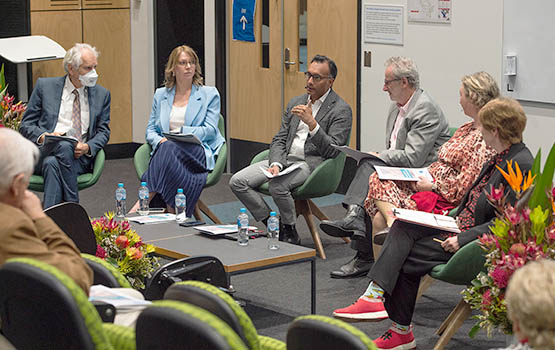
L-R: Professor Charles Czeisler, Associate Professor Melinda Jackson, Professor Shantha Rajaratnam, Jon Faine, Professor Amy Brodtmann, and Professor Kathryn Moyle.
Our Sleep Health Week panel explained what it takes to get a good night’s sleep for brain health as we age.
For the 1 million Australians living with dementia, and their carers, sleep is often hard to come by, with poor sleep making symptoms worse and compromising resilience. At our panel event, Harnessing the Power of Sleep for Healthy Brain Ageing, five experts moderated by broadcaster Jon Faine discussed the latest in sleep research, what happens when we sleep - and what doesn’t happen in the brains of people with dementia - as well as strategies for better sleep.
Some of the most exciting research on preventing cognitive decline is focused on sleep, says Professor Sharon Naismith, Chief Investigator of CogSleep (Centre for Research Excellence to Optimise Sleep in Brain Ageing and Neurodegeneration) from the Brain and Mind Centre at the University of Sydney. “We now understand that 10 to 20 years before someone even presents with clinical symptoms, changes in the brain leading to dementia are already occurring.
“If we can target sleep early enough as a risk factor and find better ways to screen for sleep disturbance, potentially we may be able to delay the onset of dementia or reduce the cases of dementia.”
The panel discussion was convened by CogSleep in collaboration with the Sleep Health Foundation and Monash University, for Sleep Health Week, 25 Sep-1 Oct 2023.
What is sleep good for?
“Sleep is really critical for memory consolidation,” visiting Harvard Medical School Professor Charles Czeisler told the panel. “It's really at the beginning of the night, when you're in deep, slow-wave sleep, that you will consolidate what you learn.
“In the latter part of the night, rapid eye movement (REM) sleep is associated with vivid dreaming and emotional regulation. That's when you integrate what you learned today, with everything else you're already doing. That's when you have your creative thoughts, and you can rise above the individual pieces of information to solve problems.”
Over the past decade, researchers have begun homing in on the brain’s waste processing system. Professor Amy Brodtmann, of the Monash Clinical School, says the glymphatic system cranks up at night to clear proteins that are innocuous enough unless they’re allowed to build up. “It’s believed that if we don't have a normal glymphatic rinse cycle each night, that may be contributing to the plaques and tangles that are a feature, pathologically, of Alzheimer's disease.”
Is it actually dementia?
Amy says one of the most common reasons people visit a memory clinic is not because they suspect dementia, but because they are living with depression or anxiety. All of these conditions are intimately related to sleep, and several conditions are associated with altered REM sleep, including Parkinson's and Lewy Body disease.
“Neurologists will ask a lot about sleep,” she says. “Depression and anxiety are the commonest cause of sleep disorders in our society, and they are ones that can be easily treated.
“We know that when we treat depression, and anxiety, your sleep gets better, your mood gets better, and then your cognition gets better. So it's one of the few times that we can actually cure someone with what looks like a dementia or a cognitive disorder.”
The importance of treating sleep apnea
Charles Czeisler says it is also important to rule out sleep apnea or sleep disordered breathing. “There's tremendous overlap between obesity and sleep apnea,” he says.
It is rare for someone who's overweight or obese not to have sleep apnea, but about 20 per cent of people are unaware of their condition.
“Sometimes when that sleep apnea is treated, it turns out that the individual does not have the early stages of dementia or neurocognitive impairment but they actually have a sleep disorder.”
Sleep: dementia’s canary in the coalmine
Dementia Australia ambassador Professor Kathryn Moyle said the first obvious sign of her partner’s Frontotemporal Dementia (FTD) was that he was sleeping 18-20 hours a day. The stress caused by the disruptions to her own sleep from her partner’s nighttime wakefulness were a major factor in her decision to retire.
Kathryn says her experience has shown the importance of carers and clinicians understanding the journey of dementia - “that the symptoms change over time, and it’s important to understand that what we see today in one person may be different in a year’s time”.
CBT-I and digital interventions
Many GPs are unaware that Cognitive Behavioural Therapy for Insomnia (CBT-I) is the preferred first line treatment for sleep problems, endorsed by the World Sleep Society, with input from Monash researchers.
CBT is expensive and not everyone responds to it. Monash researchers are also looking at digital interventions to help carers and people living with dementia.
“There’s a whole gamut of solutions on the market, but not all of them are evidence based,” says Associate Professor Melinda Jackson, of the School of Psychological Sciences. Her research partnership with A Mindful Way is currently seeking older adults to take part in a trial that will evaluate sleep, mental health and cognitive outcomes.
“A lot of people will finish a course in CBT-I and still have rumination and overthinking before bedtime. Mindfulness can give you a different relationship with those thoughts at night,” Melinda says.
Including carers at the centre of research
Shantha Rajaratnam, Professor of Sleep and Circadian Medicine at the School of Psychological Sciences was surprised when he examined the links between sleep behaviours and the mental health and wellbeing of adults and caregivers during the COVID-19 pandemic, in the award winning COPE project.
“We started this work early in the pandemic, when there was a dramatic rise in the need for people to become involved in caregiving… we estimate … about 2.7 million individuals in Australia identify as a caregiver.
“Those individuals, whether they're caregivers of children, or caregivers of adults, have about double the risk of depression, anxiety, fatigue, and burnout, and if they are caregivers of children and adults, it's about a five times increased risk of those conditions.”
Shantha says the School’s research agenda is shaped by feedback from providers,caregivers and patients or consumers about gaps in healthcare. “That is why we're delighted to work with organisations like Dementia Australia, because it reflects that critical role, that the individual, the person with the lived experience of the condition will play all the way through right through to the translation.”