
An innovative digital health passport informing personalised hospital care in Victoria
People accessing the healthcare journey increasingly want to be active partners in their care and healthcare decisions. So how is a digital healthcare solution addressing that need?
A novel web-based tool (a health passport) has been developed in Melbourne and undergone initial testing at Peninsula Health through the NCHA-supported project, Capturing consumers’ values, needs and preferences in their journey through hospital care.
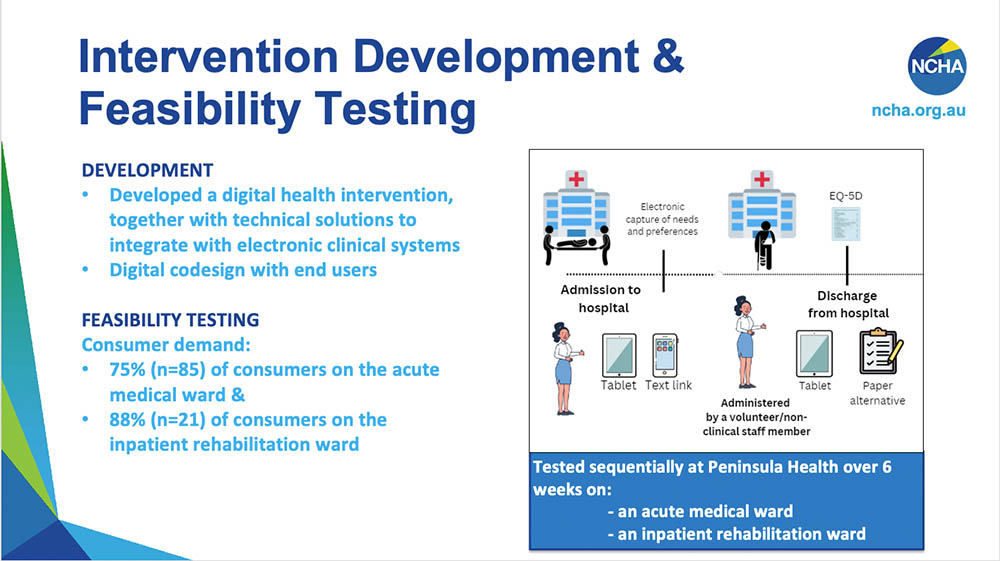
The new approach has been favourably received by end users, with 75 per cent of people approached on the acute medical ward and 88 per cent approached on the inpatient rehabilitation ward at Peninsula Health using the digital health passport during a six-week testing phase.
The research team has now partnered with six health services to explore the potential to scale up the intervention across Victoria.
Rebecca Barnden, a Senior Physiotherapist and Project Manager at the National Centre for Healthy Ageing (NCHA) and Peninsula Health, is leading the Health Passport Project.
“I think what's really novel and important about the work that we've been doing in the tool that we've developed is it enables people to capture their needs and preferences once, and that information will travel with them, including between encounters with health services,” she said.
Traditionally health systems were not designed to support person-centred care, but Ms Barnden believes the Digital Health Passport will help change that, improving communication across health settings for patients and capturing what’s important to them.
Rebecca Barnden, Senior Physiotherapist and Project Manager at NCHA and Peninsula Health.
Intervention codesigned in partnership with diverse end users
The digital intervention was codesigned in partnership with diverse end users. Across the life of the project the project team have partnered with 92 clinicians across 16 clinical areas at Peninsula Health including Emergency, inpatient wards, mental health, women's, children's, rehabilitation, ambulatory and community care and importantly 27 healthcare consumers and their support people, including those living with disability and/or complex needs. This expansion to priority populations was possible through the research team’s close collaboration with the Peninsula Health’s NDIS and Disability Manager Michelle Bult, and its program.
Collaboration with multi-partners a key success factor
Arising from seed funding from NCHA, the project has developed into a breakthrough initiative that will assist consumers and health services. Ms Barnden says it’s been a very collaborative project.
“There's been a number of partners we've worked with - health service staff, consumers, and industry. And we're really excited now that we're progressing to implementing our tool so that people coming into Peninsula Health are able to use that tool,” she said.
“But really what excites me about the project is the next phase where we're hoping to scale up the intervention across Victorian health services. And so that's really where our project team is directing our focus and attention.”
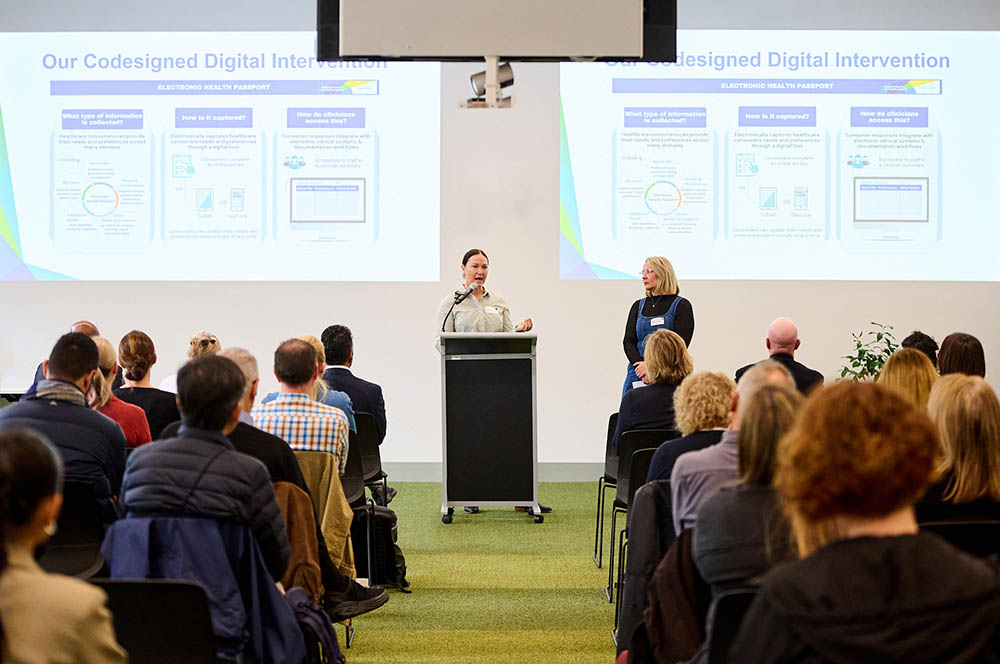
Rebecca Barnden, Senior Physiotherapist and Project Manager at NCHA and Peninsula Health and the Digital Health Passport Lead presenting with Michelle Bult, Peninsula Health’s NDIS and Disability Manager at NCHA’s Showcase 2024.
How it works
Consumers can update their needs and preferences digitally at any time. The information collected is integrated with clinical systems and documentation workflows that clinicians can access.
“Someone can do it when they're well before they come into hospital, or they can do it when they come into a health service. And that information will travel with them. So, they're not having to continually repeat their story, but also that people are hearing directly from the consumer what it is that matters to them,” Ms Barnden said.

Consumer and staff feedback – a snapshot
“It’s good that you are trying to find out what people want…. being in hospital can be overwhelming” (consumer participant)
“I thought it was pretty comprehensive and addresses quite a lot of pitfalls” (consumer participant)
“… early identification of concerns … it would be good to know early on they were struggling, or they didn’t have enough in their package” (staff participant)
“Even though nurses have those conversations, sometimes its only basic on care…. did you want a shower today, and this is what we’re going to today, nurses don’t always have time to have those conversations” (staff participant)
“It’s not a lengthy document … It’s really clear … I think if people knew that it was a simple and easy and a clear snapshot of the patient wants I think it would be … enticing to open up” (staff participant)
Find out more about the research underway at the NCHA’s Living Labs